

Fix the meeting before anyone sits down
Showing up early isn't the point. Showing up early to kill the problem everyone's about to trip over is what gets you noticed.
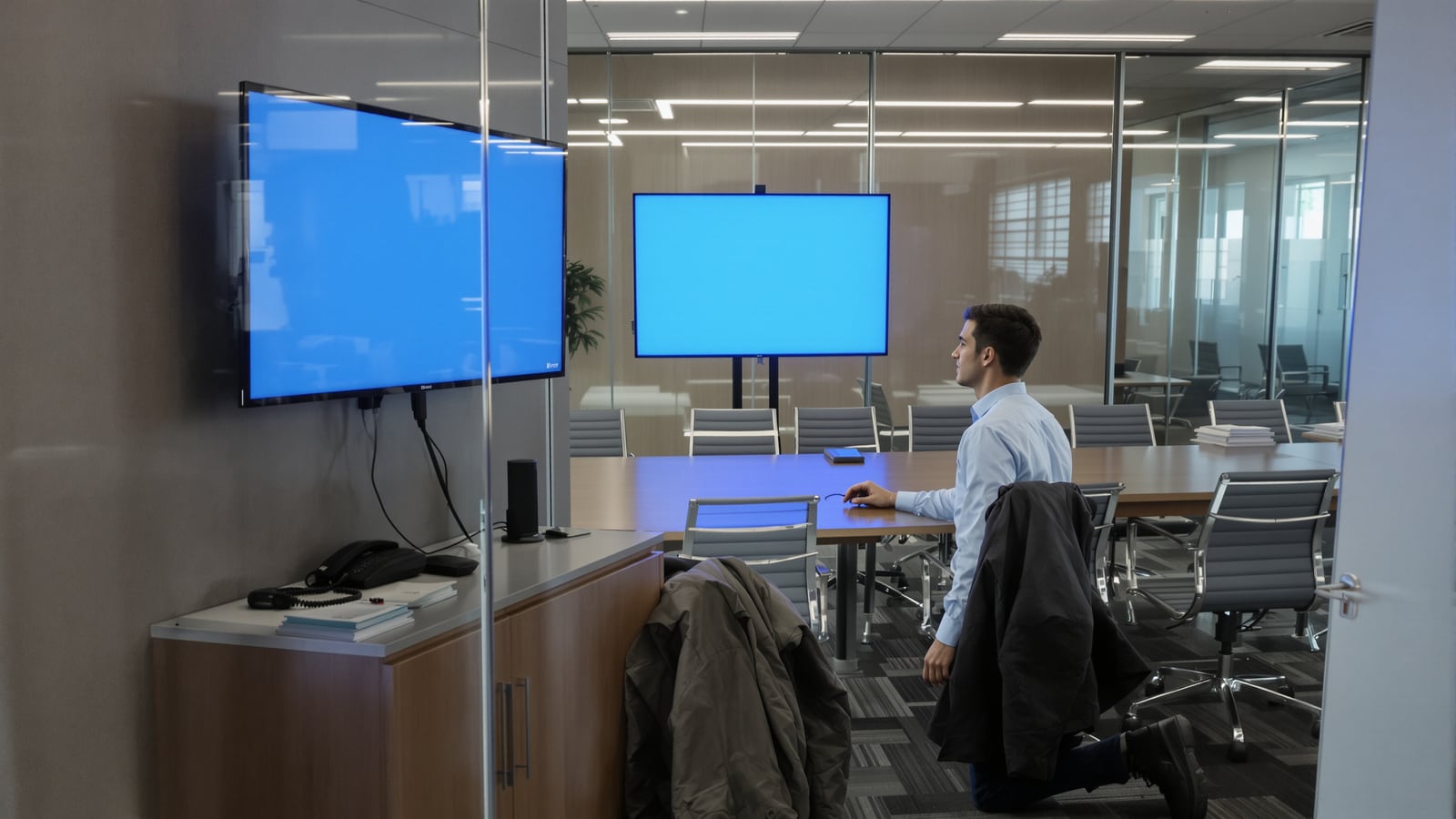
Quick answer: Get to the room twenty minutes early and fix the three things that can derail it: the screen, the link, and the paper. Do it quietly, don't announce it, and don't let it become your permanent job.
Picture a 9:00 quarterly review. At 8:40 the conference room display won't pair with anybody's laptop. The remote office dial-in link has the wrong date on it. The deck on the shared drive is last month's version.
None of that is anyone's assignment. So at 9:00, six people sit down, the VP checks her watch, and ten minutes disappear while somebody crawls behind a credenza hunting for an adapter.
Or you were in the room at 8:40 and it never happened. Nobody saw you do it. That's the point, and it's also the way it gets noticed.
What the room actually remembers
People rarely remember who sat quietly through a smooth meeting. They remember who rescued a bad one, and they remember, even more, who prevented one.
Senior people have lost ten minutes to a dead projector more times than they can count. They've learned to spot the person around whom it doesn't happen. Not consciously, usually. It shows up later as "he's got his act together" or "put him on the client call." That's how a reputation forms, one boring Tuesday at a time.
This isn't the same as being the first car in the lot. Plenty of men are at their desks at 7:00 and have nothing to show for it. Early without a job to do is just early. Early with a job is a signal.
The twenty-minute routine
Get there before the room is crowded, and run the same short list every time.
- Screen. Plug in your own laptop and the display. Confirm the cable or wireless connection works. Carry your own adapter. A ten-dollar one in your bag has saved more presentations than any amount of talent.
- Link. If anyone's dialing in, open the invite and check the date, the time zone, and whether the link works. Join early and confirm the audio. The remote guy at the other end will remember who made sure he could hear.
- Paper. Make sure the right version of the deck or the agenda is what's actually on the screen, and print copies if the room still runs on paper. Wrong version is the quiet killer.
- Room. Check the temperature, the chair count, and whether the last meeting left a mess. If the previous group is running over, politely tell the organizer now, not at 9:00.
That's it. If you find yourself doing more than that, you've stopped helping and started taking over.
Fix the logistics, not the content
One line to hold. You fix what's broken, not what's someone else's.
If you spot a typo on slide four of somebody's deck, text them. Don't edit it. If the agenda looks wrong, ask the organizer a question instead of rewriting it. You're clearing the road, not driving their truck.
And don't turn the early window into a place to work your angles. It's tempting. The decision-maker is alone in the room at 8:50, and you've got her ear. A little conversation is fine, natural even. Talk about her weekend, ask about the project, be a decent human being. But if you're fishing for credit, she'll feel it, and the whole habit goes sour. The value of this move is that it's honest. Keep it that way.
The trap
Here's the part nobody tells you. Do this well for six months and you become the person who "handles the room."
Then it's you who's setting up every all-hands. You who's fetching the cables, taking the notes, ordering the lunch. Your own work slides, and your name gets attached to the housekeeping instead of the results. The men who got promoted for it were the ones who did it in addition to excellent work, not instead of it.
Serving your team is right. Being a pushover isn't. A man with a backbone can do both.
So set the terms early.
- Do the pre-meeting check for the meetings that matter to your work and your people, not every meeting on the calendar.
- When a recurring meeting gets going, rotate it. "I've got setup this week, who's got next?" is a perfectly good sentence, and it makes the team better, not just you more tired.
- If somebody starts assuming you'll always take the notes, say no plainly and pleasantly. "I'll pass this one, Mark's up." Then keep your word on the things you did agree to.
- Never let it eat the hour you need for your own deliverable. If it does, the habit has stopped paying for itself.
The same idea applies when you move into management. Hand off the work you're best at first and your setup habit becomes a standard the team can run without you, which is the better outcome anyway.
Leave the room better than you found it
The other half is what you do at 10:00.
When the meeting ends, don't bolt for your desk. Wipe the whiteboard. Push the chairs in. Pick up the cups and the stray printouts. Close out the call and send the recap before people are back at their desks. It takes four minutes, and it's the same old code as returning a borrowed truck with a full tank. Whoever walks in next shouldn't be able to tell you were there, except that everything works.
The next group will assume the room is always like that. You'll know better, and so will the one or two people who've been watching.
Why this works on the right people
There's a cynical version of this advice, where you do it purely to be seen. Skip that one. It collapses the first time you're caught checking who's looking.
The honest version is simpler. You're saving other people's time and sparing them embarrassment. That's good manners, and it happens to be rare. Managers and clients notice the man who treats a stranger's meeting like it's his own responsibility, because that's the same man they'd want running a project, a team, or an account.
That ties directly to something the promotion goes to the guy people already follow gets at. Nobody follows the guy who's good at being seen. They follow the guy who makes their day easier and doesn't mention it.
Be in the room at 8:40. Have the adapter. Leave it cleaner than you found it. Then go do your actual job well.
Marcus Vale
Editor-in-Chief
Twenty years in magazines, most of it deciding what to cut. Writes about work, discipline and the decisions that compound.

Watch
Worth an hour of your evening
More from Corporate Men.
From channels we rate. Plays on YouTube.
Read next