Rats don't break into your feed. You leave the door open.
Dry feed in a metal can on a hard floor beats any trap or poison you'll buy. Set it up once and the rats move on to somebody else's barn.
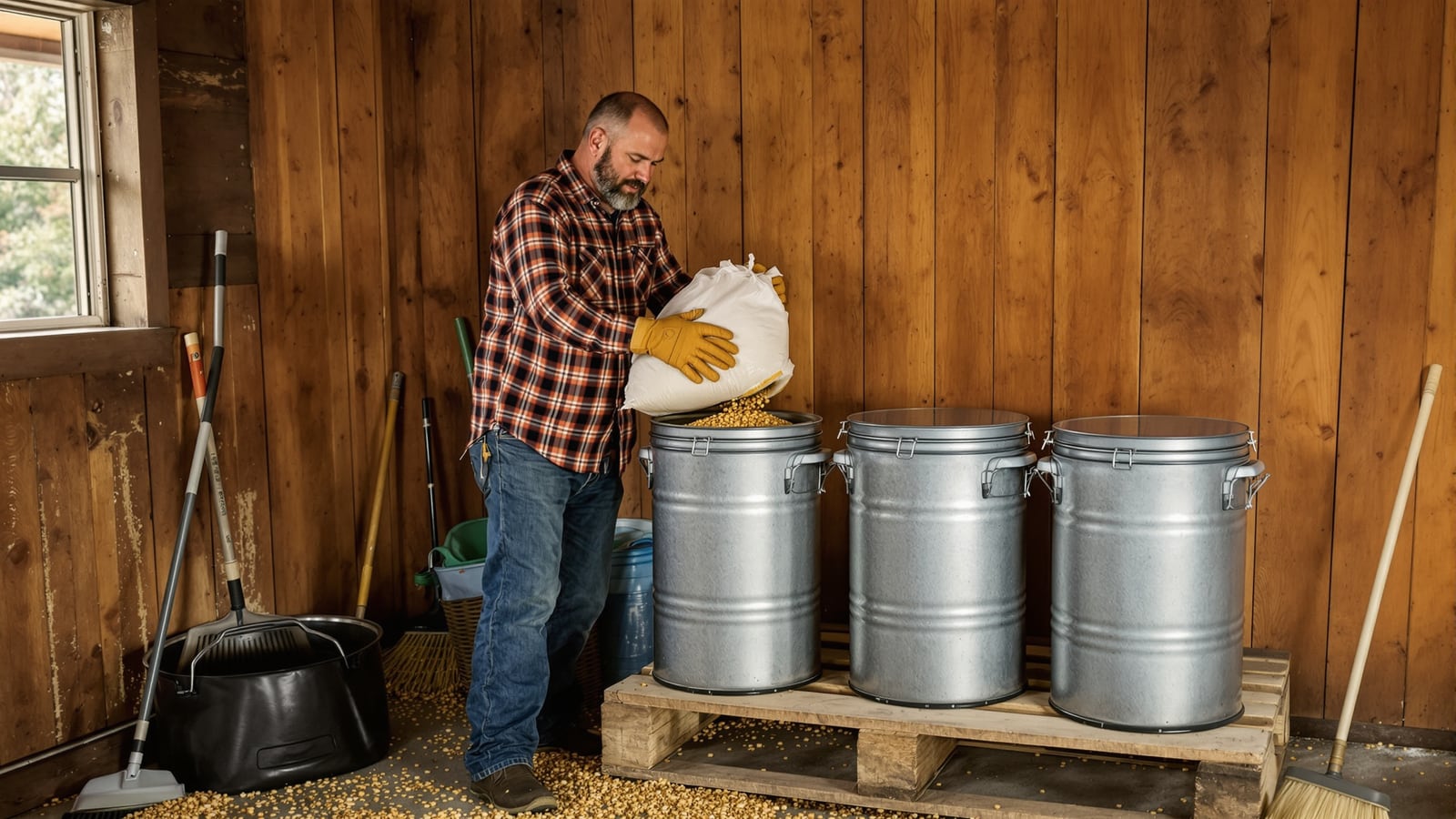
Quick answer: Keep feed in lidded metal cans, off the floor, in a room with no gaps bigger than a quarter. Buy only what you'll use in a month or two, and sweep every spill the day it happens.
A rat needs a hole the size of a quarter and a reason to use it. A torn corner on a 50-pound bag of layer pellets is the reason. You supply it by leaving the bag on the shed floor with the top rolled down, and by the second week you've got a tenant who doesn't pay rent and brings friends.
Most people respond by buying poison. That's backwards. Poison deals with the rats you already have. Storage decides whether you get more.
Water is the bigger enemy
Rats steal feed. Moisture ruins all of it. Damp grain heats up, molds, and clumps into a block at the bottom of the bin. Moldy feed can sicken livestock, and horses are especially touchy about it. Call your vet before you decide any suspect batch is "probably fine." If it smells sour or musty, or it's caked, it's not fine. Throw it out where animals can't get to it.
Moisture gets in three ways.
- From below. A bag on bare concrete wicks damp straight up. A bag on dirt is worse. Put everything on pallets or a plank rack, at least a few inches off the floor and a few inches off the wall so air moves.
- From the air. Humid summers and big temperature swings make condensation inside a bin. A sealed container with the feed filling most of it leaves less air to sweat.
- From the grain itself. If you're storing your own corn or oats, the moisture content going in decides how long it keeps. Your county extension office will give you the safe number for your grain and your timeline. A cheap grain moisture meter pays for itself the first time it tells you not to bin a wet load.
Pick the container for the pest
Plastic keeps water out. Metal keeps rats out. Rats chew plastic and wood without much effort, and thin plastic lids are an invitation. Metal doesn't care how hungry they are.
The setup that works for most small places is a galvanized steel trash can with a tight lid, one can per feed type. Get the kind with a locking lid or add a bungee or a cinch strap across the top. Raccoons will open a plain lid in one night, and a loose lid does nothing against either animal.
A food-grade plastic barrel with a gasketed ring lid is fine for a dry shop or a garage where you've already ruled out rodents. In a barn, it's the weak link.
Two details people skip:
- Don't dump new feed on old. The stuff at the bottom of the can goes stale, then moldy, then gets covered by a fresh bag and nobody notices until the animals stop eating. Empty the can, wipe it out, let it dry, then refill.
- Write the date on the can with a paint marker. Check the manufacture date on the tag when you buy, too. Feed that sat in the store's back room all summer is already old.
Buy what you'll use, not what's cheapest
The bulk price is tempting. A pallet saves real money per bag. But a pallet you can't finish in a couple of months is a pallet you're storing, and storage is where the savings go to die. In hot, humid weather, shorten that window.
A rule that holds up: if you don't have the cans and the dry floor ready, you don't buy the pallet. Split one with a neighbor if the math works. That's the sort of arrangement that keeps good relations out here, and it goes best when you know the unwritten rules of having neighbors. Pick up your half the same day, and if you use their truck or trailer, bring it back clean with a full tank.
Keeping chickens? Feed is the biggest line item, and spoiled feed makes it worse. The numbers in the real cost of a dozen backyard eggs get worse fast if a third of your bag goes in the trash.
Close the building
The feed room is the restaurant. The walls and floor decide whether anyone can get to it.
Walk the room slowly with a flashlight, in the evening, and look at:
- The bottom of the door. Daylight under it means a rat can fit. Add a metal kick plate or a sweep.
- Where pipes and wires come through. Stuff the gap with steel wool and seal over it with caulk or spray foam. Foam alone gets chewed.
- The foundation line. A gap where siding meets slab is a doorway. Cover it with hardware cloth.
- The floor. Dirt floors get tunneled. Concrete doesn't. If you can't pour one, lay hardware cloth under a plank floor.
For screening, use half-inch hardware cloth at the very least. Mice will squeeze through half-inch, so if they're the problem, go to quarter-inch. Chicken wire isn't a rodent barrier. It's a suggestion.
And clean up outside. Rats don't live in a shed they have to cross open ground to reach. Cut back the brush against the wall, move the woodpile away from the feed room (stacked wood is a hotel, which is one more reason to burn it down on schedule, as in split it in March, burn it in December), and don't leave pet food bowls out overnight.
The broom matters more than the trap
Spilled feed is what keeps rats coming back. A scoop that dribbles on the way to the bucket leaves a trail, and the trail is the advertisement.
Keep a broom and a dustpan in the feed room and use them every time. Sweep the floor after each feeding. Don't leave a half-open bag on the shelf. Clip it, pour it into the can, and throw the empty bag in a sealed bin. The ten seconds it costs you is less than any bait station.
If you've already got rats, trap first. Snap traps against the wall, baited with a dab of peanut butter, set along the paths where you see droppings or greasy rub marks. Use plenty. Two traps for a rat population is a training exercise for the rats.
Poison is a last resort and it comes with a cost. Poisoned rats get slow, and slow rats get eaten by barn cats, owls and the neighbor's dog. If you use bait, use tamper-resistant stations placed out of reach of pets, kids and poultry, and read the label twice. A barn cat is a fine addition, but it's a deterrent, not a plan. One cat won't empty a nest under a slab.
The test
Once a week, open each can, smell it, and look at the top inch. Check the floor behind the pallets for droppings. Look for gnaw marks on the lid edges.
That's about five minutes. If you find something, you've found it early, and that's the whole point. Feed room problems are cheap when they're small and expensive when you discover them by the smell.
Build it once. Cans, pallets, a sealed door, a broom. Then the only thing a rat finds in your barn is a closed door.
Wes Dunbar
Country & Skills
Grew up on an acreage and never quite left. Covers trucks, trades, land, and how to do the thing yourself.

Watch
Watch how it's done
Picked for this article.
From channels we rate. Plays on YouTube.
Sixth Day Ranch
The BEST Way To Safely Store Your Feed. | Keep The Rats & Mice Out!
Windy Branches Farm
Mice In The Feed Container! Tractor Supply Haul & "Rodent Proof" Storage. We will see about that!
Read next