Teach your daughter the tells, not the type
You can't vet every boy she meets. You can hand her a standard, a vocabulary, and a ride home at 2am with no questions asked.
She's fifteen, standing at the kitchen island, telling you about a kid from her chemistry class. You've got maybe ninety seconds before she decides whether this is a conversation she'll ever start again. What you say matters less than what you don't say, and what you don't say is any version of "I don't like the sound of him."
Because here's the trap. The more you push against a specific boy, the more she has to defend him, and the more defending him becomes part of who she is. You can win the argument and lose the girl. Good fathers do it every year.
The work is earlier and quieter than that. It's teaching her what to look at.
She's already got a reference point, and it's you
Not in a greeting-card way. In a data way. She has watched a man operate at close range for fifteen years, in traffic, on the phone with the insurance company, on the third day of a stomach bug, in the eleventh year of a marriage. That's the baseline she's calibrated to, whether you like the reading or not.
So the first question isn't what to tell her. It's what she'd say about you if a friend asked.
Does he apologize, out loud, with the actual words, to her mother? Does he keep his temper when the drywall job goes wrong? Does he do what he said he'd do on a Tuesday when nobody's watching and there's no credit in it? She's not grading you on perfection. She's grading you on repair. A man who blows it and comes back and owns it's teaching her something far more useful than a man who never blows it at all, because the second man doesn't exist and she'll never meet him.
Teach verbs, not adjectives
"Nice guy" is useless. So is "red flag," which has been worn down to mean anything from a felony to a bad text response time.
Give her behaviors she can actually observe.
- What does he do when he's told no? Not the first no. The third one, about something small, when he's tired. Does he argue, sulk, go silent for two days, or just say okay?
- How does he treat people who can't do anything for him? The kid bagging groceries. The freshman on the bench. Her little brother.
- Do his words and his calendar agree? He says he'll be there at seven. Is he there at seven? Run that test forty times and you know everything.
- Who is he around his friends? Not around her. Around them. If he's a different man in that room, the man in that room is the real one.
None of that requires her to read minds. It requires her to pay attention over time, which is exactly why every bad actor wants to move fast.
The one tell that matters most
Isolation. If a boy is slowly, pleasantly reducing the number of people in her life, that's the tell, and it almost never looks like control at the start. It looks like devotion.
He doesn't like her best friend. He gets quiet when she goes to her cousin's birthday. He'd rather she skip the trip. Each move is small and defensible, and the sum of them is a girl with one person left to talk to, and that person is him.
Name it for her when she's twelve, watching it happen in a movie or to a friend at school. Say it plainly: a man who's good for you makes your world bigger. The other kind makes it smaller and calls it love.
Don't forbid him. Stay in the room.
If she's dating someone you don't trust, your leverage is proximity, not prohibition.
Invite him to dinner. Ask him what he's building, what he's working toward, what his dad does. Watch how he handles a direct question from a grown man. Let her see you be decent to him, because if it ever goes wrong, she has to believe she can come back to you without eating a single serving of I told you so.
And ask her questions instead of delivering verdicts. "How do you feel after you hang out with him?" is worth more than an hour of your opinion. So is "what does he do when you disagree?" She'll hear her own answer. Sometimes that's enough.
Build the exit before she needs it
This is the part most dads skip, and it's the most practical thing on the list.
Long before there's a boy worth leaving, make leaving logistically boring. A checking account at a credit union in her name only, with a few hundred dollars in it that isn't earmarked for anything. Her own car keys, or at minimum the ability to get herself home from any address in the county. Teach her to change a tire in the driveway on a Saturday, badly, twice, until it's not an event. Teach her to check her own oil and to keep the tank above a quarter.
When she's old enough, take her to the range and teach her to shoot. Proper instruction, hearing protection, the four rules until they're reflex, and a real conversation about awareness and about what the law in your state actually says. Self-reliance isn't a mood. It's a set of skills she either has or doesn't at 11pm in a parking lot.
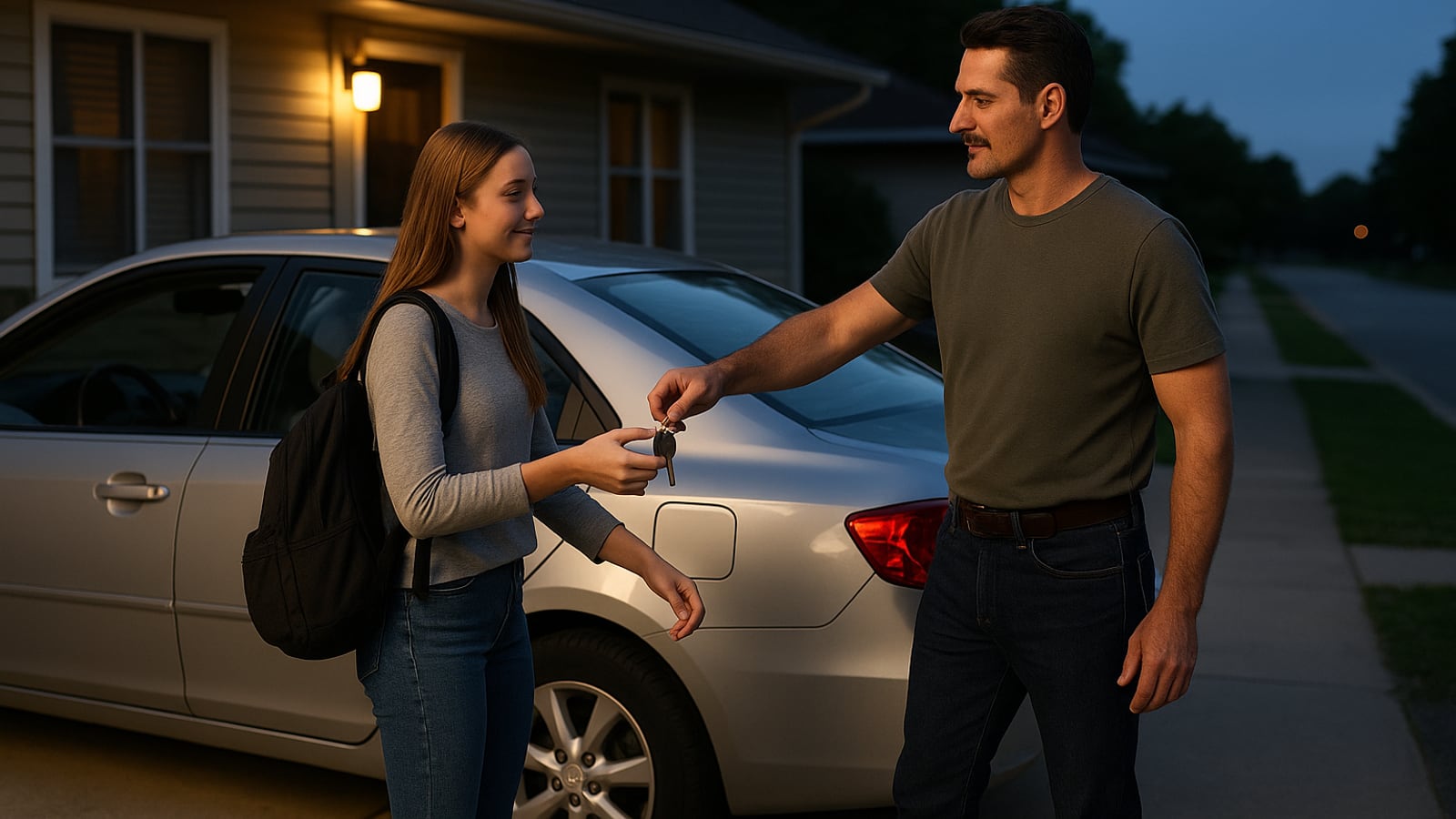
Then the standing offer, given once and honored forever: call me, any hour, any distance, and I will come get you, and I won't ask you a single question in the car. Say it when she's ten. Say it again when she's seventeen. Then, the night she uses it, shut up and drive. If you interrogate her once, she'll never call again, and the next time she's stuck she'll get in a car with somebody who's been drinking instead.
Rehearse the sentence
Most young women don't stay because they're weak. They stay because they don't know how to end it without hurting somebody, and they've been taught their whole lives to be nice.
So give her the words and let her practice them out loud, awkwardly, in the kitchen. "I don't want to keep dating. I'm not going to change my mind. Please don't call me." No debate, no list of reasons, no door left cracked to be polite. Reasons are just material for the next argument.
Tell her she's allowed to leave without a case file. She doesn't need proof. "I don't want to" is a complete sentence and always was.
You'll be wrong about somebody
You will. The kid with the truck held together by zip ties and the haircut you hate may turn out to be the one who shows up at 6am when her transmission dies, every time, for ten years. And the polished one who shakes your hand firm and calls you sir may be the one you spend a decade regretting.
That's the humility this job requires. Your read is a data point, not a ruling. Say it once, say it kindly, then keep the relationship, because the relationship is the only thing that still works when you were right.
Keep your keys by the door. That's the whole job on the night it matters.
Cal Brennan
Fitness
Strength coach. Trains fathers, tradesmen and desk workers, which means programs that survive a bad week.

Watch
Worth an hour of your evening
More from Dads.
From channels we rate. Plays on YouTube.
Read next