The laugh track isn't the problem. Lazy jokes are.
Some of TV's best comedies have canned laughter, and some of its worst don't need it to fail. Here's how to tell, and what to put on tonight.
Quick answer: The laugh track isn't the flaw. A joke that dies without it is. Start with The Dick Van Dyke Show, The Andy Griffith Show and I Love Lucy, and use the pause test below on everything else.
This is commentary.
Pause an episode right after the audience roars. Now say out loud what was funny.
Sometimes you can. Barney Fife puffs out his chest, gets the law exactly backward, and the joke is the whole man standing there. Other times a character walks into a room, says "Well, hello," and a wave of laughter arrives with nothing underneath it. The track is doing the writer's job.
That's the pause test. After the laughter, can you name the joke, who it's about, and why it worked? If you can't, the laugh was a cue. It was telling you what to feel.
Real laughter and bottled laughter
They aren't the same thing, and the difference is timing.
I Love Lucy was shot on film in front of a live studio audience. So were The Dick Van Dyke Show and The Honeymooners. Those rooms laughed because something happened, and the actors knew it. Watch Jackie Gleason stand perfectly still and let a studio full of people come to a boil. He's waiting for them. You can't write that into a script. You have to learn it, and he had.
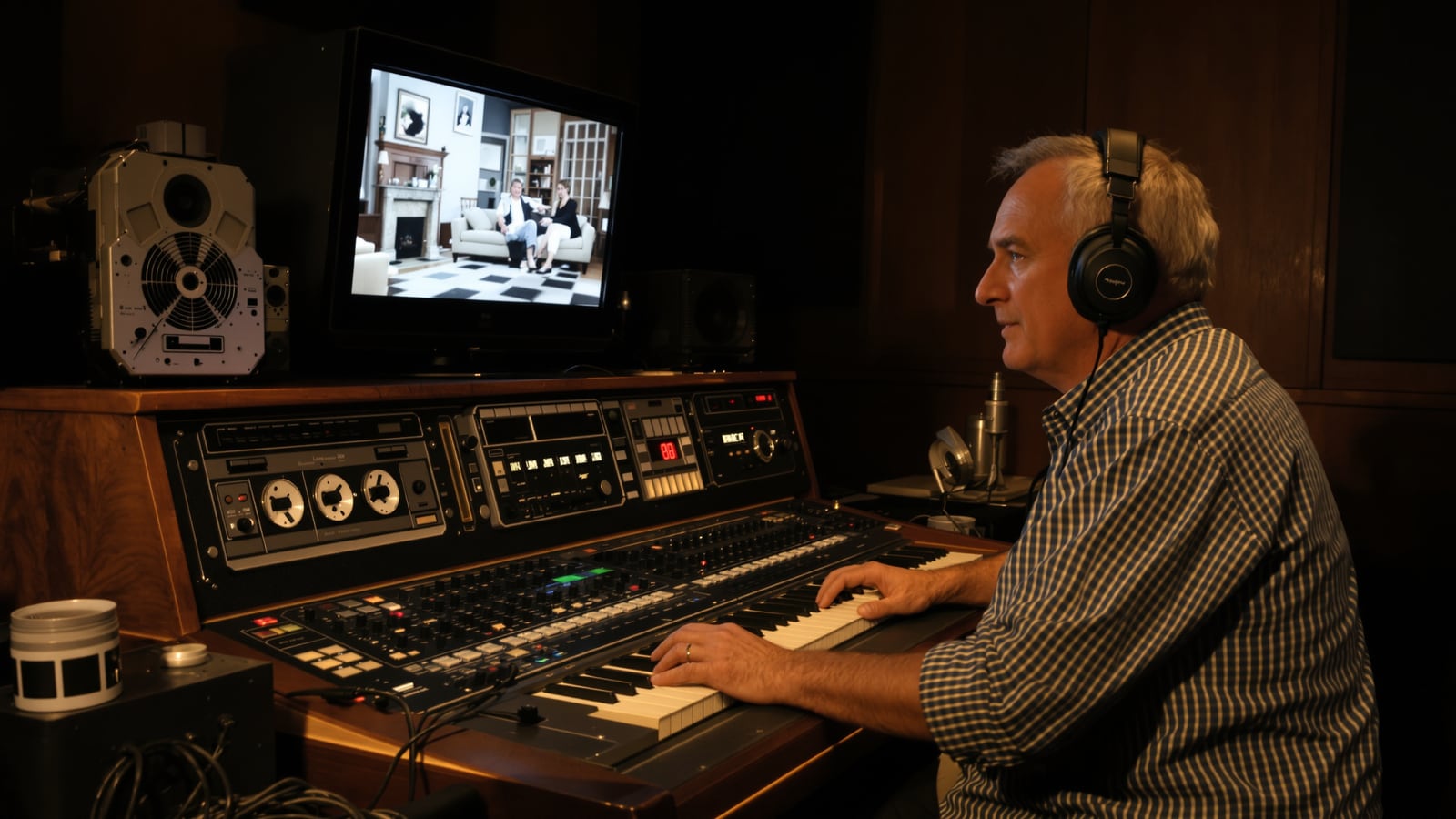
Canned laughter came from a keyboard-driven machine, the "laff box," built by a sound engineer named Charles Douglass in the early 1950s. It let producers lay a crowd over any show, and it made a cheap kind of comedy possible. Film it quickly, skip the live room, and let the machine tell people when to smile. Plenty of live-audience shows got a little extra sweetening too, so nobody's hands are perfectly clean.
The one that breaks the rule
The Andy Griffith Show was made without a live audience, and the laughter was added later. It's also one of the best-written half hours the medium has produced.
So what saves it? Character. Mayberry is a place you could find on a map. Andy is a single father who solves problems by talking. Barney is a man whose confidence runs a full lap ahead of his ability, and Aunt Bee's pickles are a crisis the whole town takes seriously. The laughs are small and they come from people, not from setups.
Andy rarely carries a gun in the show. Barney does, with a single bullet kept in his shirt pocket. He is the best argument for range time ever put on television.
The track on Mayberry is background. The jokes would land in a silent room. That's the real test, and it's why "all laugh tracks are bad" is a lazy rule.
Where the track is holding the joke up
Gilligan's Island is a good time for a seven-year-old, and I mean that. The costumes are fun and the slapstick is clean. But it's the same joke every week. Somebody almost gets rescued, Gilligan wrecks it, and the track tells you to laugh at the exact moment it always has. Take the track away and you notice how little is left.
That's the pattern. When a show needs the machine to find its punchlines, the writers have stopped looking for them.
What to watch, and what to know first
Every title below is clean enough for a family room. Here are the plain content notes.
- The Dick Van Dyke Show. Start with "Coast-to-Coast Big Mouth," where Laura says something on national television that she shouldn't about the boss's hair. Content notes: a few marital spats, a comic fight or two. The couple sleeps in twin beds, as the era required. Nothing to flinch at.
- The Andy Griffith Show. Any episode in the early black-and-white seasons. Content notes: Otis, the town drunk, is a gentle running gag, and there are a few period attitudes about women. Talk about them with younger kids.
- I Love Lucy. "Job Switching" is the chocolate-line episode, and it's as good as its reputation. Content notes: Ricky makes old-fashioned threats of a spanking, and some period jokes about men and women haven't aged well. In "Lucy Does a TV Commercial," the tonic Lucy keeps sipping is mostly alcohol, and she gets tipsy.
- The Honeymooners. Only 39 episodes survive from the classic run. Gleason and Art Carney are worth the evening. Content notes: Ralph's "right to the moon" threats are played for laughs. Alice never takes them seriously, and she never backs down, either.
- Bewitched. A flag, not a recommendation. Magic and witchcraft are the premise, so some families will pass. You know your house.
- **MASH.* Grown-ups only. The creators fought their network over the laugh track and lost most of that argument. The compromise was no laughter in the operating room scenes. Content notes: wartime violence and casualties, plus adult humor, especially in the early seasons. It's a good show. It isn't family night.
What the old shows understood about men
The best sitcom dads of that era could be a fool for one scene. They weren't fools by design.
Rob Petrie writes comedy for a living, adores his wife, and loses an argument with an ottoman. Andy Taylor is the sharpest man in town and still takes advice from a boy of eight. Their marriages and fatherhood are never the punchline. The home is the thing worth protecting, and the jokes happen inside it.
Plenty of newer comedies run the other way. The father is the family's problem to be managed, and the marriage is something to sneer at. That's a choice a writer makes, and it's a worse one. It's also usually lazier, because contempt is easier to write than affection. The old shows did the harder work.
How to run the evening
Preview one episode before the kids see it. A sitcom runs about twenty-five minutes without commercials, so it takes less time than finding the remote. The method in Vet a Movie in Eight Minutes Before Family Night works for a single episode as well as a feature.
You may not need another subscription. Check your library for DVD sets, and look at what you already pay for before you add anything. What Your Streaming Bill Is Actually Buying You will tell you what's already in the house.
Then run the pause test with your kids. Hit pause right after a big laugh and ask who can explain the joke. Kids are ruthless at this. A seven-year-old will tell you in four seconds whether anything was there.
If your kids are older, move on to the movies. The Classic Movies Your Kids Should See Before Thirteen is a good next step once the sitcoms have done their work.
Good timing doesn't need a machine to tell you it worked. You'll know, because you'll be laughing on the couch before the track gets a chance.
Marcus Vale
Editor-in-Chief
Twenty years in magazines, most of it deciding what to cut. Writes about work, discipline and the decisions that compound.

Watch
Worth an hour of your evening
More from Movies & TV.
From channels we rate. Plays on YouTube.
Read next