Walker Texas Ranger Still Knows What a Good Man Looks Like
The fights are telegraphed, the bad guys attack one at a time, and the show still gets more right about courage than most of what's on now.
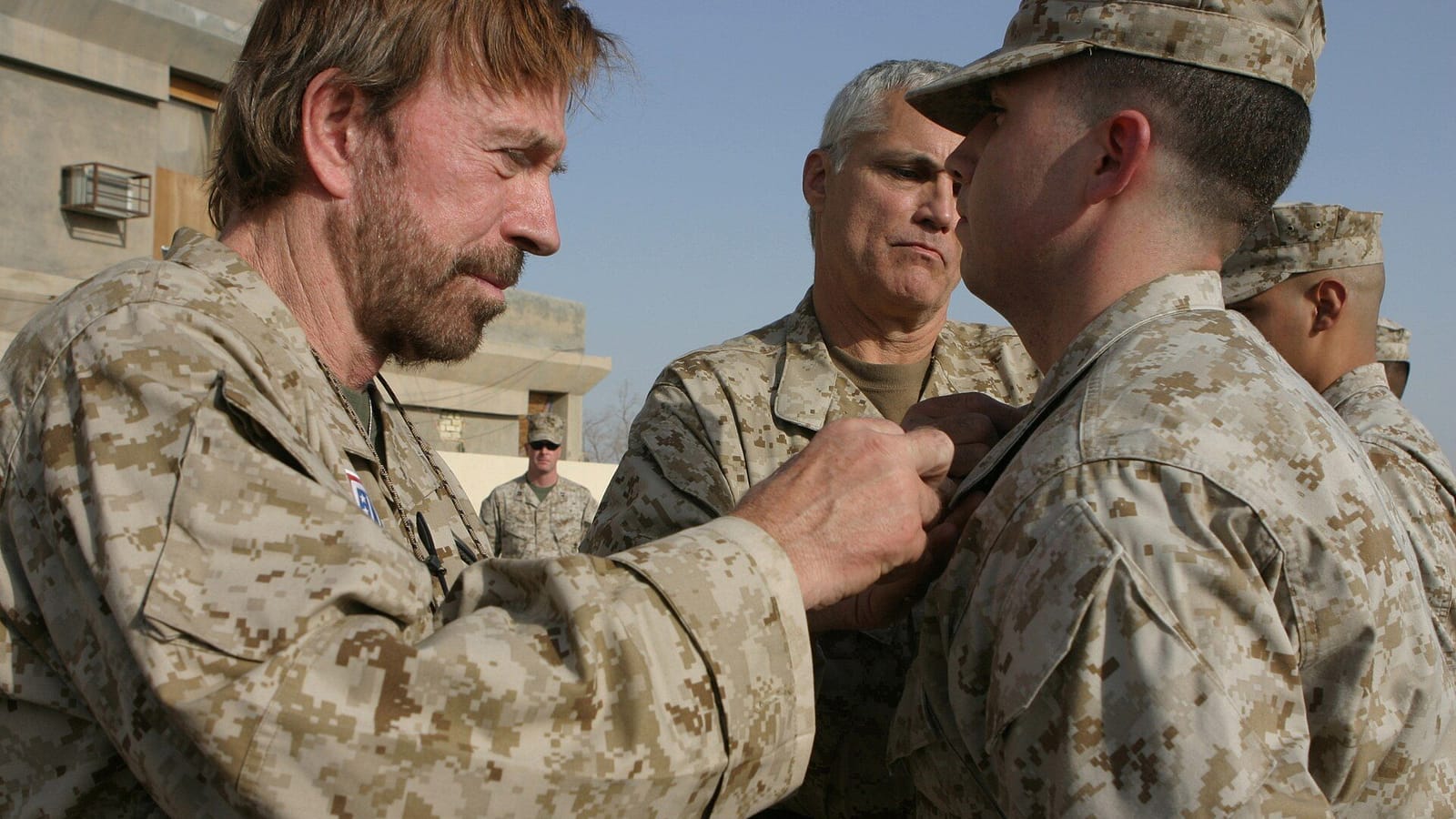
Chuck Norris sings the theme song. Not a session guy, not a Nashville ringer. Him, low and flat, over a harmonica and a shot of a man on horseback: "eyes of a Ranger, the unsuspecting stranger." You either bounce off that in four seconds or you're in for eight seasons.
I'd argue you should be in.
Walker, Texas Ranger ran on CBS from 1993 to 2001, mostly Saturday nights, back when Saturday night television was aimed at families who were home. Norris plays Cordell Walker, a Texas Ranger working out of the Dallas–Fort Worth area. Clarence Gilyard Jr. plays his partner James Trivette, an ex-Dallas Cowboy who does the computer work and takes the ribbing for it. Sheree J. Wilson plays Alex Cahill, the assistant district attorney who prosecutes what Walker drags in and who eventually marries him. Noble Willingham plays C.D. Parker, a retired Ranger who runs the bar where everybody debriefs.
That's the whole machine. It never changes, and it isn't supposed to.
The shape of an episode, and why the shape is the point
Cold open: somebody does something genuinely evil to somebody who can't fight back. Act two: Walker figures out who. Act three: the law can't quite reach him. Act four: Walker reaches him, usually with a roundhouse kick delivered in slow motion from an unlikely height. Tag scene: everybody's at C.D.'s, and somebody says the thing the episode was actually about.
Compare that to the crime shows that came after, where the detective is an alcoholic, the department is rotten, the case ends ambiguously and the moral of the story is that nothing means anything. Walker is the opposite proposition. Evil exists, it's identifiable, it's beatable, and beating it costs a man something. He gets hurt. He loses people. He keeps showing up.
There's a scene type this show does better than anything in its class: Walker talking to a kid who's one decision away from going bad. Not lecturing. Asking. He puts the boy in a gym, or on a horse, or in front of the man he's been running from. The show ran that play dozens of times over eight years and it almost never felt cynical, because the man playing it was doing the same thing off camera. In 1990 Norris started a program that puts karate into Texas public schools as a character class, taught by trained instructors during the school day. It's still running. The show and the life pointed the same direction, which is rarer than it should be.
The content, named plainly
This is a crime drama about violent criminals. Don't hand a seven-year-old the remote and walk away.
Violence. Hand-to-hand fighting in nearly every episode, plus gunfights, car chases, and explosions. It's 1990s network violence: fast, bloodless, largely consequence-free on screen. Nobody's head comes apart. But people do get shot and people do die.
Subject matter. The villains of the week include drug traffickers, kidnappers, racist gangs, cult leaders and men who prey on women and children. Crimes against women, including sexual assault, come up as the thing being prosecuted. Nothing is depicted. It's discussed in police and courtroom language, and the show's position is never in doubt: the man who did it's a coward and he's going to be caught. Still, a nine-year-old will ask what the lawyer meant, and you should be in the room to answer.
Language. Mild. Network standards of the era, which were stricter than most people remember.
Romance. Walker and Alex court for years. It's handled with restraint that would look old-fashioned in 2010, never mind now. Nothing you'd have to explain.
Alcohol. C.D.'s is a bar. People drink in it.
My rough guide: solid from about ten with a parent alongside, fine on their own around twelve or thirteen. Preview any episode where the cold open involves a child. Those hit harder than the ratings suggest.
The part where I concede everything
It's corny. Cheerfully, unapologetically corny.
The fight choreography operates on the ancient rule that henchmen attack one at a time and wait their turn politely. Norris isn't a versatile actor and the show never asks him to be. The dialog lands with a thud roughly once a scene. Some plots resolve because a criminal confesses for no reason other than that there are four minutes left. Conan O'Brien built an entire running bit around a lever that played random Walker clips, and the bit worked because the clips were funny without any help.
Willingham left before the run ended, and the show never really filled the hole where C.D. had been. The later seasons sag.
Also this: co-created by Paul Haggis, who went on to write far more prestigious and far more pessimistic things. The bones underneath the corn are better built than the corn suggests.
None of that's a reason to skip it. It's a reason to know what you're sitting down to. This is a meat-and-three show. You don't order it expecting a tasting menu.
Actual Rangers, actual history
Worth knowing before you watch, and worth telling the kids. The Texas Rangers trace back to 1823, when Stephen F. Austin hired a small group of men to protect the colony, which makes them the oldest state law enforcement outfit in North America. They were formally organized in 1835. They're a real division of the Texas Department of Public Safety today, handling major investigations and unsolved cases.
"One riot, one Ranger" comes from a story about Captain Bill McDonald stepping off a train alone and being asked where the rest of the men were. Historians treat it as legend more than transcript. The show used it as the title of the pilot anyway, and honestly, good. Legends are load-bearing.
Where to start
Start with the pilot. You'll know inside twenty minutes whether the tone is for your house.
After that, don't binge it. Walker rewards the format it was built for: one hour, once, with the lights on and somebody in the kitchen. Twelve episodes deep in a weekend and the seams show badly. One a week for a year and it's a pleasure.
It moves between streaming services and free ad-supported channels often enough that I won't promise you a platform. Check before you announce it at dinner.
Clarence Gilyard Jr. died in 2022. He'd spent his later years as a theater professor, teaching acting to college students in Nevada, after Trivette, after Theo in Die Hard, after Top Gun. Go back and watch him work opposite Norris. He's carrying more of that show than the credits admit, and he does it with a lightness nobody handed him in the script.
That's the thing about a program with a moral center. The people inside it tend to have one too, and it shows up on the film.
Dean Shaw
Gear & Garage
Reads the warranty, the parts list and the long-term owner reviews before anything else. Trucks, tools, watches, and the cheap version that costs more.

Watch
Watch how it's done
Picked for this article.
From channels we rate. Plays on YouTube.
Wild Westerns
DANNY TREJO Talks Down Gang of Kids | Walker, Texas Ranger
Read next