Walking to your car alone, and the ten seconds that matter
Parking garages, late flights and hotel corridors don't require paranoia. They require about six habits you run without thinking.
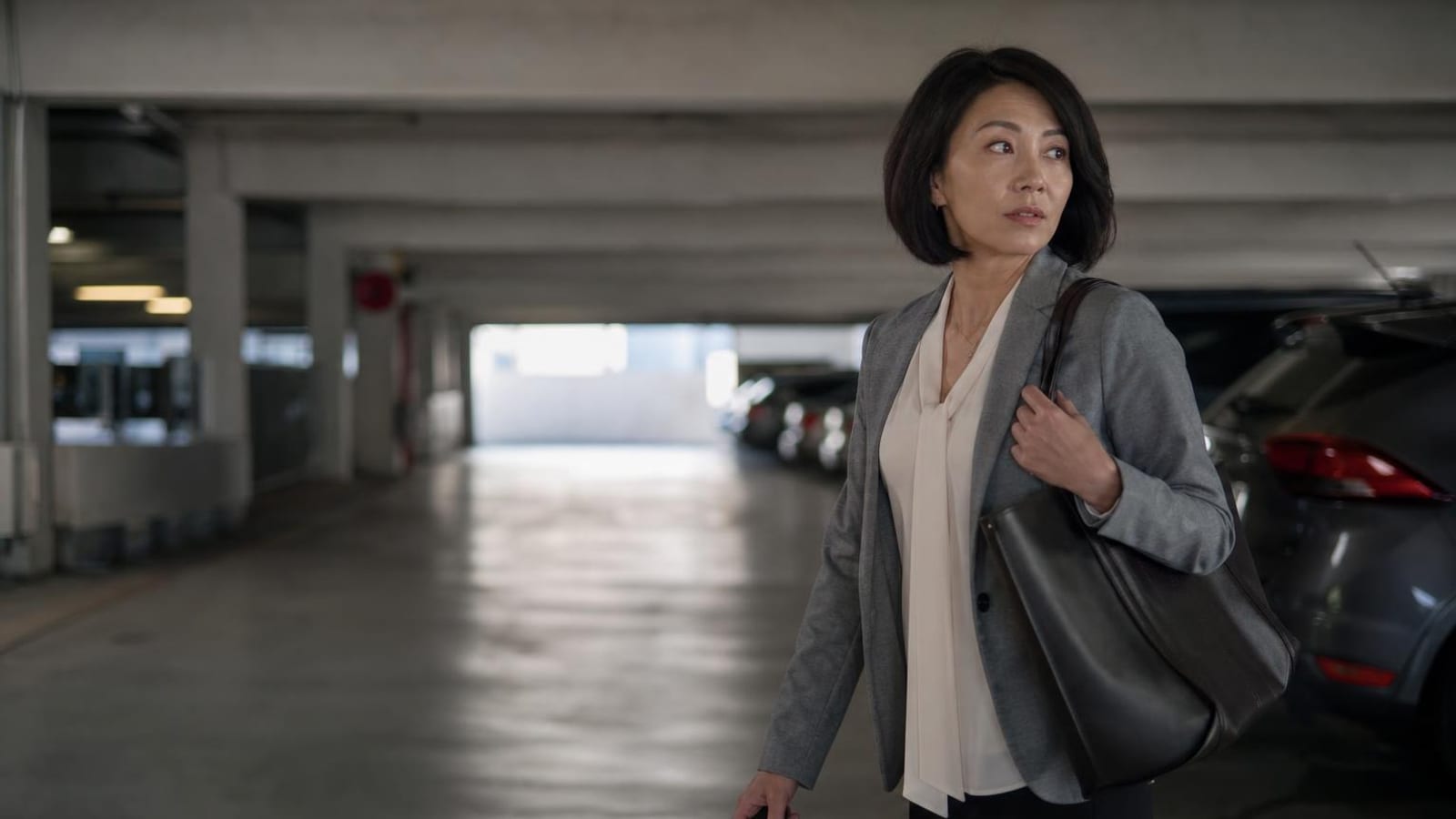
The decision that matters in a parking garage gets made in the lobby, not in the garage.
That's where you put your phone away, get your keys in your hand, and look at the route you're about to walk. Thirty seconds of planning at the doors buys you everything. Once you're out on level three with your head down and both hands full, your options have already narrowed to whatever you can improvise.
Most personal safety advice fails because it asks you to be alert all the time. Nobody can do that. Alertness is a battery and it runs flat. What actually works is a short list of habits that run whether you're thinking about them or not, so your attention is free for the one night something's off.
The keys thing is wrong, and here's what to do instead
You've been told to thread your keys between your fingers. Don't. You'll shred your own hand before you do meaningful damage to anybody, and it occupies the hand you need for your phone, your door, your push-off. Hold the key you need, fob in palm, thumb on the panic button. That's it. The alarm is louder than you're and it doesn't get tired.
Then walk like you have somewhere to be. Head up, shoulders back, a pace that means business. Not a performance. Just the difference between a person scanning the deck and a person reading texts.
Look at the space around your car before you're standing in it. The van parked tight against your driver's door is a reason to walk back inside and ask security for an escort. Every mall, hospital and office garage in America has somebody whose job that is. Use them. The worst outcome is a mildly awkward golf cart ride.
Parking garages, specifically
Park near the exit ramp or the stairwell you'll actually use, in a lit spot, and back in. Backing in costs you twenty seconds on arrival, when you're fresh and the lot is busy, and saves you a three-point turn at eleven at night with somebody standing behind your bumper. Some garages post signs against it because of plate readers. Fine. Then park nose-in near a camera and pillar-free sightlines.
Check the back seat before you unlock, not after. Look through the glass as you approach. Unlock the driver's door only, not all four, if your fob allows it.
Get in, lock, go. Don't sit in your parked car answering email. A woman sitting stationary in a lit car with her face in a screen is the single most common thing I see in garages and it's the one habit I'd break first. Drive out, park somewhere public, then check your phone.
Keep your tank above half. Keep the spare inflated. A breakdown at 10 p.m. on a two-lane road is a safety problem dressed up as a maintenance problem.
Walking alone
Vary your route if you walk the same stretch at the same hour every day. Not because somebody's watching you, but because predictability is the cheap resource a stranger gets for free.
One earbud out, always. Volume low enough to hear a car slow behind you. If you need both ears for a podcast, you don't need the podcast.
If you think you're being followed, cross the street. That's the test. Crossing is a normal thing a person does and it costs you nothing. If they cross too, you now have information, and you go into the nearest open business and say out loud, "I think somebody's following me, can I stand here a minute." Say it to the barista, the gas station clerk, the guy restocking shelves. People help. They just need to be told what's happening.
Trust the thing in your stomach that fires before your brain has an argument ready. It's not mystical. It's your eyes catching a mismatch faster than you can narrate it. You're allowed to act on it and be wrong. Being wrong costs you a detour.
Being rude is a skill, so practice it
The most reliable vulnerability isn't physical. It's the trained instinct not to make a scene.
A stranger asks you to help carry something to his car. A man in the stairwell wants to know if you're heading to the fourth floor too. A guy at the hotel bar walks you to the elevator you didn't ask him to walk you to. In every one of those, the polite answer and the safe answer point in opposite directions, and forty years of being a considerate person will shove you toward the polite one.
Say no. "No thanks." Keep moving. You don't owe an explanation, and the explanation is the crack somebody works on.
Practice out loud, in the car, alone. "Back up." "Don't come closer." Loud, flat, no smile at the end. The first time you use your command voice should not be the night you need it, because a voice you've never used comes out thin.
Hotels and flying solo
Ask for a room above the ground floor. Not the far end of a long empty corridor. Near the elevator means more foot traffic past your door, which cuts both ways, and I'll take the traffic.
When the desk clerk says your room number out loud, ask for a different room. That's the whole policy. A good hotel retrains on it immediately.
Pack a rubber door wedge or a portable door alarm. Both run under twenty dollars and weigh nothing. Use the deadbolt and the swing bar, and put the wedge down anyway, because the swing bar has a known workaround and the wedge doesn't care.
For rideshares, match the plate before the face, make the driver say your name rather than you saying his, and sit in the back on the passenger side. Share the trip with somebody. If the car that pulls up doesn't match the app, it isn't your car, no matter how confidently he says it is.
Tell one person your itinerary. Not the internet. Post the photos when you're home.
Tools, and the honest part about them
If you carry, carry lawfully and carry trained. That means more than a qualification course. It means a class where you draw from the holster you actually wear, under a clock, with somebody correcting you. A firearm in a purse you've never drawn from under pressure is a liability, and the woman who's put in range time with a compact she can run well is in a far better position than the woman with a bigger gun she flinches through.
Know the law before you cross a state line. Reciprocity isn't uniform, some cities layer their own rules on top, and "I didn't know" isn't a defense. Check the statutes for every state on your route and talk to an instructor or an attorney licensed there. Flying changes everything: unloaded, in a locked hard-sided case, declared at the airline counter, checked baggage only. Never the carry-on.
Pepper spray has its own patchwork of rules and can't fly in your carry-on either. A flashlight can go anywhere, works every night of your life, and turns a dark stairwell into a lit one.
Then take a self-defense class where the partner resists. Compliant drills teach you a dance. You want the version where somebody grabs you and doesn't let go, so you find out what your hands do when your heart rate is 160.
If it goes bad
Property goes. Purse, phone, car, all of it. Throw the bag one direction and run the other.
You don't go to a second location. Whatever is being offered at location two is worse than whatever is happening at location one, and the parking lot with people in it's the best real estate you'll have all night. Fight there. Yell "fire" if you have to, because it moves people to windows.
Most nights, it's just a walk to the car. Build the habits for the night it isn't, and you'll still be home in time for the second half of the game.
Nina Castellan
BRO for Her
Runs the women-facing desk. Same standard, same tools, written for a different reader — not a softer one.

Watch
Watch how it's done
Picked for this article.
From channels we rate. Plays on YouTube.
Nick Drossos Defensive Tactics
Indoor Parking Lot Safety Tips for Women
Stay Safe Martial Arts
Parking Lot Safety Tips EVERYONE Should Know
Read next