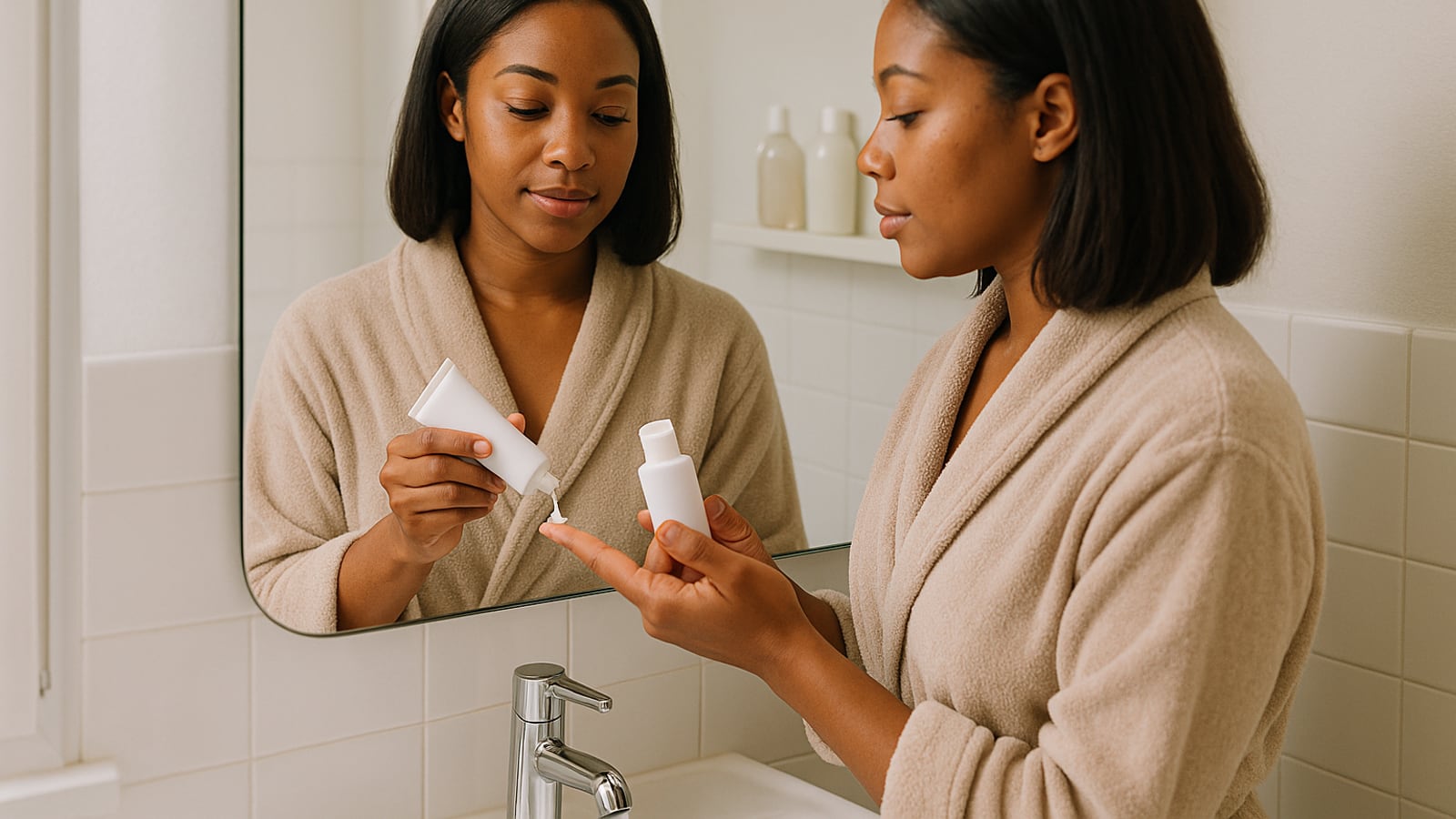
Measure your sunscreen once. A quarter teaspoon for your face and another quarter for your neck and ears, or two full finger-lengths squeezed out of the tube. Look at it sitting in your palm. It's more than you've been using, and the gap between that blob and your usual pea-sized smear is the difference between SPF 30 and something closer to SPF 8.
That's the whole hard part. Everything else in a twenties skincare routine is optional, adjustable, or somebody's ad.
The amount matters more than the number on the bottle
SPF ratings get tested with a thick, even layer nobody applies in real life. So an SPF 50 applied thinly is worse than an SPF 30 applied properly. Buy whatever broad-spectrum SPF 30 or higher you'll actually use every morning, and use a lot of it.
Two more things people skip. UVA passes through window glass; UVB mostly doesn't. That means a long commute is quietly aging one side of your face while you feel nothing, because UVA is the wavelength that breaks down collagen without burning you. And reapplication is real. Two hours outdoors, or after swimming, or after you've toweled your face at a soccer game in July.
For reapplying over makeup, a stick sunscreen or an SPF powder is the practical answer. Neither gives you the full lab-tested protection of a proper layer. Both beat the nothing you'd otherwise apply at 1 p.m. because you didn't want to wreck your foundation.
If your sunscreen pills up into little gray rolls under makeup, it's usually a texture fight between a silicone-heavy sunscreen and a water-based primer, or you rubbed a second layer over a first that hadn't set. Press it in with flat hands instead of rubbing, wait 90 seconds, then go. If it still pills, that's a bottle you return, not a habit you abandon.
A drugstore tube runs somewhere in the teens. The Korean and Japanese formulas that feel like moisturizer cost about the same and are worth trying if American sunscreens make you look like a ghost in photos. Tinted mineral versions solve the white cast for deeper skin tones and cost a bit more.
Tanning beds aren't a beauty decision. They're a health one, and the answer is no.
Cleansing: twice a day, and never until you squeak
Morning and night is plenty. If your skin is dry or you live somewhere with hard winters, rinse with water in the morning and save the cleanser for bedtime.
The squeaky-clean feeling women chased in high school is your barrier sending up a flare. Tight, shiny, faintly stinging skin after washing means you stripped the lipids that hold water in, and your face responds by producing more oil, which convinces you to wash harder. That loop is responsible for an enormous number of "I have oily skin" diagnoses that are actually "I have a sink problem."
Use a gentle cleanser that rinses clean and leaves your face comfortable, not tight. Lukewarm water. Thirty seconds of actual contact, not a splash and a prayer. If you wear heavy sunscreen or full makeup, an oil or balm first, then the regular cleanser. Two cleanses at night, one product in the morning if that.
Skip the facial brush. Skip the rough washcloth. Your face isn't a pan.
Two actives, not eight
Here's where the money goes and where the damage happens. In your twenties, the short list of ingredients with real evidence behind them is small.
A retinoid at night. Over-the-counter retinol, adapalene, or a prescription tretinoin if a dermatologist agrees it's a fit. It's the most studied anti-aging and anti-acne ingredient you can buy. Start twice a week. Pea-sized for the whole face. Expect a few weeks of flaking while your skin adjusts, and moisturize on top if you need to. Build to nightly over two or three months, not two weeks.
Sunscreen every morning, which we've covered, and which does more for how your skin looks at 40 than every serum combined.
That's the core. Vitamin C in the morning is a reasonable add if you like it and it doesn't sting. Niacinamide is mild and helps some people with redness and oil. A salicylic acid cleanser or a leave-on BHA earns its place if you get clogged pores along your jaw and forehead. None of that's mandatory.
What you don't do is layer a retinoid, a glycolic toner, a vitamin C serum and a weekly peel on the same face. That's not a routine, that's a chemical burn on installments. The symptoms of an overworked barrier look exactly like the problems people are trying to fix: redness, stinging, small bumps, oil, breakouts that won't quit. Then they buy another product.
Change one thing at a time and write down the date
When your routine has eleven bottles and your face reacts, you have no idea which one did it. So pick a suspect, change one product, and give it eight weeks before you judge. Retinoids take three months to show their real work. Acne treatments take about the same.
Keep the note in your phone. Product name, date started, what your skin did in week two and week six. It sounds fussy. It's the only thing that turns money spent into information.
And when you get a bad reaction, strip all the way back. Gentle cleanser, plain moisturizer, sunscreen. Nothing else for two weeks. Most angry skin calms down on that regimen alone, and now you've got a clean baseline to rebuild from.
What isn't worth your twenties
Eye creams marketed for wrinkles you don't have. Collagen powders, which get digested like any other protein. Ninety-dollar serums whose active ingredient is in a twelve-dollar version at the drugstore, because the patent expired years ago. "Detox" anything. Pore strips, which pull out the top of a clog and let the rest refill by Thursday.
Also skip the routine you saw a nineteen-year-old with naturally clear skin perform in a ninety-second video. She isn't lying. She's just not evidence.
When to stop tinkering and call a dermatologist
Some things don't respond to shelf products and waiting them out costs you.
Deep, painful cysts along the jaw and chin that last for weeks. Acne that's already leaving marks or dents. A mole that changes shape, color, or size, or one that itches or bleeds. Persistent facial redness with flushing and visible vessels. Anything that a full drugstore routine hasn't budged in three months.
Scars are far harder to treat than the acne that caused them, which is the practical argument for going early rather than after a year of trying. Bring your product list and your dates to the appointment. A dermatologist can read that log in thirty seconds and skip a month of guessing.
The best skin in the room at 45 usually belongs to the woman who was boring about it at 25. Two products, applied generously, most days, for twenty years.
Nina Castellan
BRO for Her
Runs the women-facing desk. Same standard, same tools, written for a different reader — not a softer one.

Watch
Worth an hour of your evening
More from BRO for Her.
From channels we rate. Plays on YouTube.
Read next