Pick one golf ball and play it until October
Every new ball resets what your wedges and putter tell you. Choose one model, buy it by the dozen, and give it a full season.
Quick answer: Choose one ball model in the spring and play nothing else until the season ends. Your short game depends on knowing how a ball reacts, and you can't learn that from a different ball every round.
You're 85 yards out. Pin's back left. You've got a smooth gap wedge in your hands and no idea what's about to happen.
It's not your swing. It's the ball. Last week it was a soft two-piece you found in the rough on 14. Today it's a three-piece you bought on sale. They don't fly the same, they don't stop the same, and they don't come off the putter face the same. You're asking your hands for a number they've never measured on this particular ball.
That's the whole argument. Golf at the 90 and 100 level is decided inside 100 yards. A consistent ball is the cheapest way to make that part of the game less random.
What changes when the ball changes
Most golfers think of the ball as ammunition. Swap it, and the swing is the swing.
It isn't quite true. Covers and cores differ. A soft-feeling ball and a firmer one will come off a wedge and a putter differently. A ball built to cut sidespin will curve less than one that isn't. You don't need a lab to feel any of this. You feel it on a 30-foot putt that runs six feet past when you hit it the way you've hit a hundred others.
The most obvious casualty is distance control with the short irons and wedges. You build a feel for "that's a three-quarter pitching wedge, it goes 105." That number belongs to a ball. Change the ball and the number is a guess with a confident face on it.
Putting takes the same hit. Speed is everything on the green, and speed is built from repetition. A ball with a different feel off the face can turn a good lag putt into a three-putt, and you'll blame your stroke when it was the ball.
The real cost of the sale bin
The pattern is predictable. You buy whatever's cheapest or whatever's in the pro shop bargain basket. You lose three balls on Saturday. You pick up two on the way and play the next dozen as they come.
By July you've played nine different models and learned nothing about any of them. Every round is a first date.
The fix isn't spending more. It's choosing once. Read The Golf Ball You Should Be Playing If You Shoot 95, pick a model that fits your game and your budget, and commit. If you lose a lot of balls, pick a model you won't wince at losing. A plain, affordable, soft two-piece you're willing to buy by the dozen beats a premium ball you rope off and save for special occasions.
Build a one-ball season
Here's how it works in practice.
- Buy in volume. Get at least two dozen of the same model in the spring. Running out in June is the number one reason people drift.
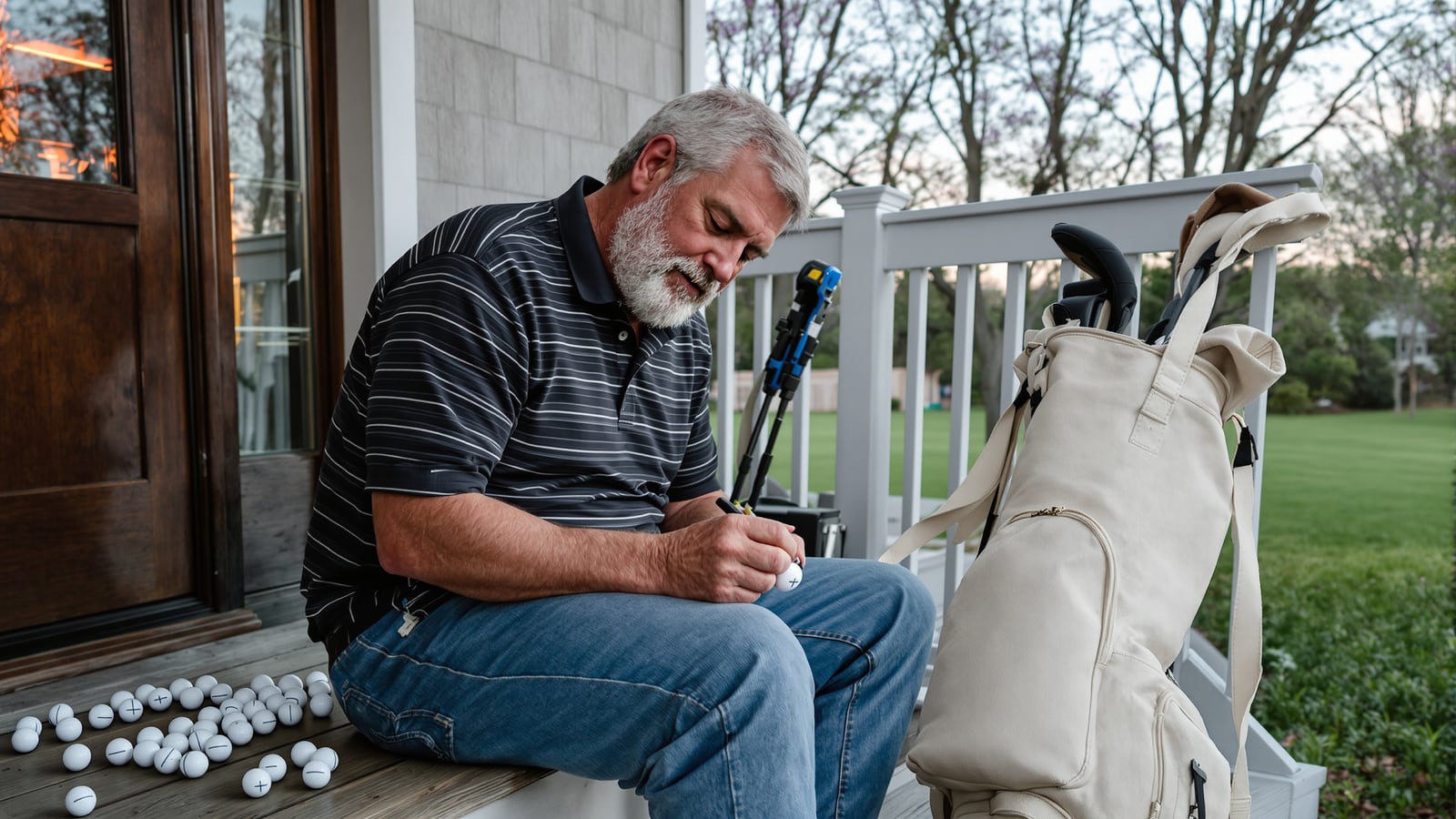
- Mark them. Use the same Sharpie pattern every time. A dot and a line, or initials. It keeps you from playing the wrong ball and gives you a ready answer when someone asks whose ball is in the fairway.
- Retire the damaged ones. Same model doesn't mean same ball. A cart-path scuff or a cut cover changes how it flies. Move it to the practice bag.
- Practice with it. Range balls are hard, beat up and mostly useless for distance numbers. When you're learning yardages, use your own ball on a real green, a real chipping area, or an open field.
Do that and you'll see the payoff in a month.
Two drills that teach you the ball
These take 30 minutes and give you real numbers.
The three-wedge ladder. Take a lob wedge, a sand wedge and a pitching wedge to a practice area with flags at 40, 60 and 80 yards. Hit ten balls to each flag with each club using a smooth, repeatable swing. Write down where the balls land: short, pin-high, long. After 30 swings you'll know which club-and-swing combination gets you closest to each number. That's your yardage map, and it only belongs to this ball.
The lag putt gauge. Drop five balls 30 feet from a hole and putt them all. Don't try to make anything. Try to stop each one inside a three-foot circle. Count how many do. Repeat from 40 feet. Do it twice a week and you'll tighten your speed control faster than you would by working on your stroke. It's the same ball, so what you learn carries over to the course.
If you want to know how much these short shots matter to your scorecard, The Five Changes That Get You Under 100 lays out where most strokes hide. Your handicap will tell you the same story if you read it properly. Your Handicap Is Not Your Average Score explains why.
When to break the rule
There are honest reasons to switch.
Your swing speed changes a lot. A winter of training, a new club, an injury, or just age can shift what you need from a ball. If your numbers have clearly moved, test another model.
The ball gets discontinued or reformulated. It happens. Buy a fresh dozen of what's left, or pick the closest replacement and treat it as a new season.
You're playing somewhere cold. A ball that behaves in July might feel like a rock in November. That's a legitimate case for a softer ball, and the right time to switch is when the weather turns, not on a whim.
And one more, plainly. If the ball you picked in April turns out to be wrong for you, switch in May and stick with the new one. The goal isn't loyalty to a brand. It's consistency in a single ball.
The part nobody wants to hear
You probably don't need a better ball. You need the same ball.
A player who shoots 98 won't find a fix in a $55 dozen. But they will find a few strokes by knowing their 60-yard shot and trusting their 25-foot putt. Those come from repetition with one thing that doesn't change.
You already know this about clubs. Nobody would swap irons every round and expect to learn their distances. The ball is the one piece of equipment that hits the club on every shot, and it's the one most golfers treat like a disposable cup.
Pick one this week. Write the model on the inside of your bag pocket. Then go find out what it can do.
Dean Shaw
Gear & Garage
Reads the warranty, the parts list and the long-term owner reviews before anything else. Trucks, tools, watches, and the cheap version that costs more.

Watch
Worth an hour of your evening
More from Golf.
From channels we rate. Plays on YouTube.