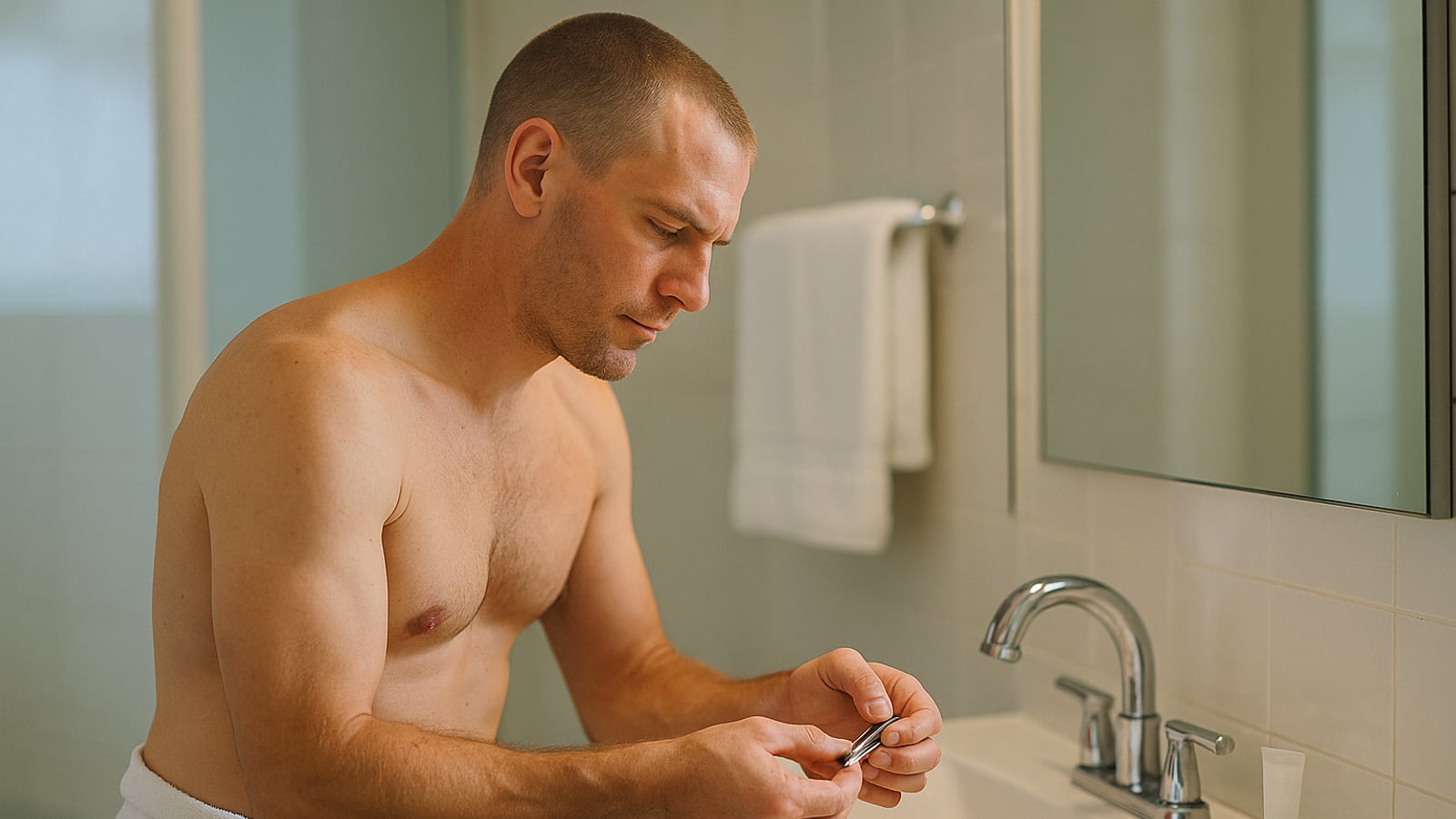
Cut your nails after a shower, not before.
Wet nails cut cleanly. Dry nails shatter, split at the corner and leave a ragged edge that catches on everything for the next four days. That one change fixes more problems than any product you can buy, and it costs nothing.
Hands are the part of you people see at close range. A handshake, passing a card across a table, holding a menu, putting your hand on your kid's shoulder in a photo. Nobody's inspecting them. But they register, the same way a stain on a collar registers. The good news is that the whole job takes about five minutes once a week and twenty seconds a night.
The kit, and what you can skip
Four things.
- A decent nail clipper. Not the flimsy one in the bathroom drawer that's older than your marriage. A clipper with a sharp, properly aligned jaw cuts instead of crushing. Crushing is what causes the split.
- A file. Glass or a fine-grit emery board. Glass ones last for years and you can wash them.
- A nail brush. Cheap, lives by the sink, takes ten seconds to use.
- A hand cream you'll actually use. More on this below.
Skip the cuticle nippers. Skip the six-step manicure kit with the little metal spoon you'll never identify. Skip anything marketed as a "nail strengthening serum" — nails are dead keratin, and there's no cream that makes them grow back stronger from the outside. What helps isn't damaging them in the first place and keeping the skin around them in good condition.
The weekly five minutes
Shower first, or at least soak your hands in warm water for a couple of minutes.
Clip each nail in two or three small cuts rather than one big one. Following the curve of your fingertip is fine. Don't cut down into the corners — that's how you get an ingrown nail on your thumb, which is a genuinely miserable thing to live with.
Leave a thin sliver of white. The rule of thumb that works: rest your fingertip flat on a table. If the nail touches before the pad of your finger does, it's long.
File in one direction where you can, or at least use light strokes. Sawing back and forth heats the nail edge and frays it. Run your finger along each nail afterwards to find the catch you missed. There's always one.
Push your cuticles back gently with a towel while your hands are still damp. That's the whole cuticle job. Cutting them removes a seal that keeps bacteria out of the nail fold, and infected nail folds are painful, slow and sometimes need antibiotics. Not worth it for a marginally tidier line.
Finally, the brush. Under the nails, thirty seconds, done. Don't dig around with a metal point — repeated poking can lift the nail away from the bed and make the gap bigger, which then collects more dirt. It's a loop you don't want to start.
Cream: what the ingredients actually do
Hand cream isn't one product category. It's three jobs, and most tubes do at least two.
Humectants pull water into the outer skin. Glycerin is the workhorse. Urea does the same and also softens thickened skin, which is why you see higher-strength urea creams sold for heels and hard hands.
Occlusives sit on top and stop the water leaving. Petrolatum is the most effective thing in this category and has been for a century. Dimethicone is lighter and less greasy. This is the part that does the heavy lifting overnight.
Emollients fill the gaps between skin cells so it feels smooth rather than rough.
What this means in practice: a light, fast-absorbing cream is for daytime, so your hands aren't slippery on a steering wheel. A thicker, greasier ointment is for the last thing at night. If your hands are genuinely cracked in January, the greasy one is the one that works, and you'll need to accept the feel of it for ten minutes before you fall asleep.
If your skin is irritated or splitting, go fragrance-free. Fragrance is the most common cause of contact reactions in cosmetics, and there's no benefit to it beyond the smell.
Washing is the thing that wrecks your hands
Not weather. Washing.
Hot water and repeated soap strip the oils out of the outer layer of skin faster than anything else in a normal day. If your hands are worse now than they were in summer, look at how many times a day you're at the sink, and how hot you run the tap.
Warm, not hot. Dry properly — damp hands left to evaporate lose more moisture than hands you've actually dried. And when your hands are clean and you're just topping up after handling a door handle, an alcohol rub with glycerin in it's usually gentler on the skin barrier than another round of soap and water.
Then the twenty-second habit that matters more than everything else: cream on immediately after the last wash of the night. Keep the tube by the bed, not in the bathroom cabinet where you won't see it. Habits live where you can see them.
The specific problems
Hangnails. Don't pull. Pulling tears live skin and you'll be nursing a throbbing thumb for a week. Clip it flush with sharp clippers, cream it, leave it alone.
Split fingertips. Common in cold, dry months and in anyone who works with their hands. Ointment at night and a plaster over it to hold the moisture in overnight closes most of them. Pharmacists sell liquid skin adhesives for the deep ones — worth asking about if the split keeps reopening.
Ridges running lengthways. Normal. They come with age, like gray hair. Nothing to fix.
White spots. Almost always a knock to the nail weeks earlier growing out. Not a calcium deficiency, despite what you were told at school.
Calluses. Keep them. Just file the ragged edges down after a shower so they don't catch and tear mid-lift. Filing a callus flat is fine. Ripping one off is how you lose a week of training.
Some things belong with a doctor, not a file. A new dark stripe running the length of a nail. A nail lifting away from the bed. Redness, swelling and heat around a nail fold. Thickened, crumbling, discoloured nails that don't grow out. None of that's a grooming problem, and none of it improves by being ignored.
Working hands still count as good hands
There's a version of this advice that ends with soft, pale, unused hands, and that's not the target.
Scars are fine. Calluses are fine. A thumbnail that's still growing out a bruise from a hammer strike in October is fine. What you're aiming for is clean, trimmed, not cracked, not bleeding, nothing catching. A carpenter can hit that standard. So can a man who spends all day on a keyboard, though he has less excuse.
Keep a tube of cream in the truck, one by the bed, one in the desk drawer. Clippers in the same place every time so you don't spend four minutes hunting for them and then skip it. Sunday night, after the shower, while the kettle's on.
Your hands are the part of you that does the work, holds the door, fixes the bike, signs the papers and gets held at the end of the day. Spend five minutes on them.
Tobias Reed
Style & Grooming
Spent a decade in menswear retail watching men buy the wrong size. Believes fit is ninety per cent of it and says so weekly.

Watch
Worth an hour of your evening
More from Grooming.
From channels we rate. Plays on YouTube.
Read next