Keep the callus. Stop the crack.
Calluses are armor. Cracks are the failure. A three-step routine that fits around work keeps the first and prevents the second.
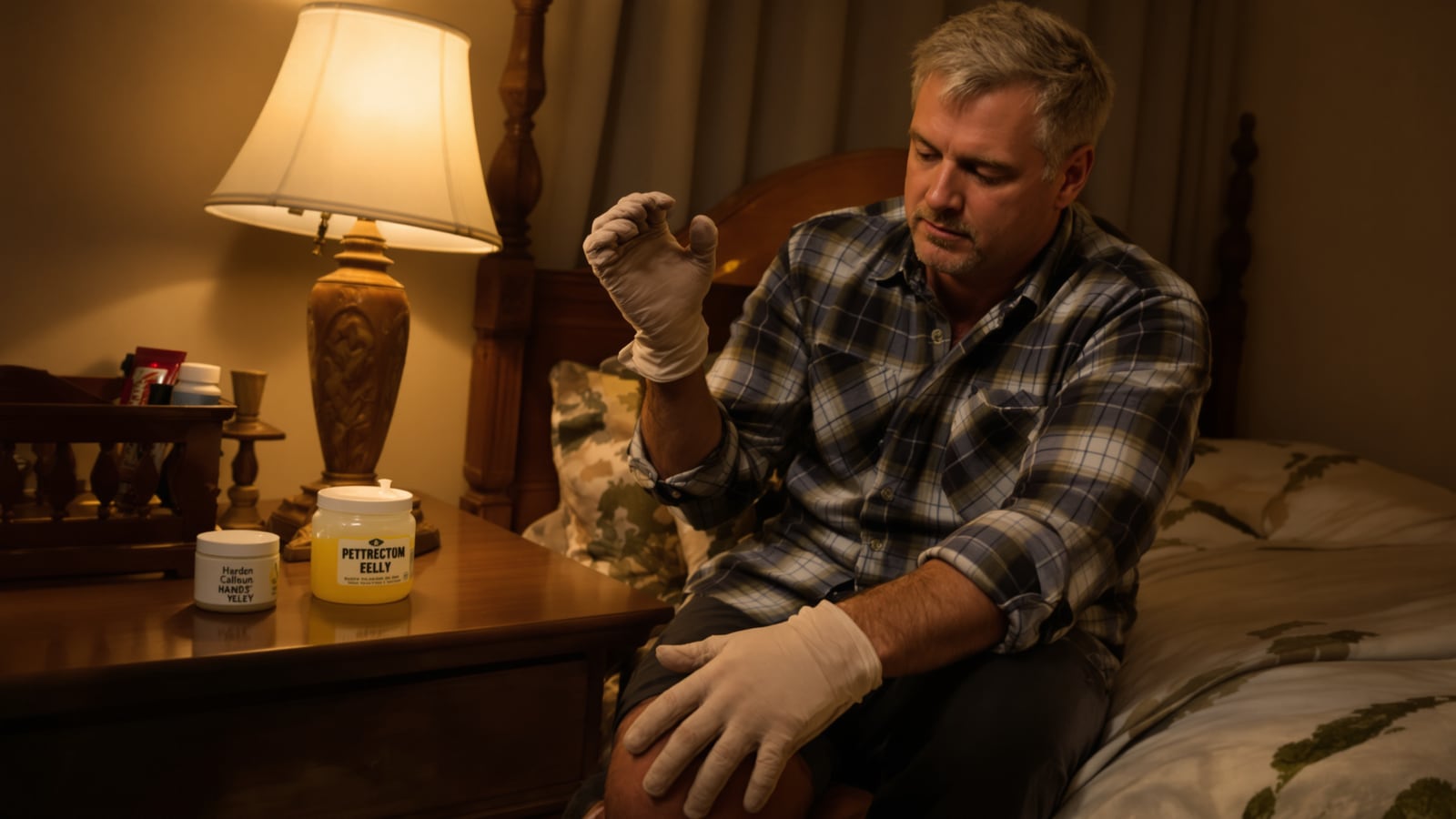
Quick answer: Leave your calluses alone and keep them flexible. Wash with lukewarm water, put a urea cream on while your hands are still damp, and seal your worst spots with petroleum jelly and cotton gloves at night. Total time: about ninety seconds a day.
The callus isn't your problem
A callus is skin doing its job. Friction from a hammer, a barbell, a shovel handle or a set of reins tells the outer layer to thicken, and it does. That's armor, and you earned it.
The trouble starts when the armor goes stiff. Thick, dry skin can't bend with your hand. Close a fist in January with cracked-dry fingertips and the skin doesn't stretch, it splits. The split lands at the edge of the callus, on the thumb pad, the side of the index finger, or across a knuckle. It runs deeper than it looks, and it opens every time you grip something.
So the goal isn't smooth hands. It's hands that bend without breaking.
What dries them out
Most guys blame the work. The work only sets it up. The real drying happens in a handful of small habits:
- Hot water. It strips oil faster than warm water does. Wash at the shop sink or in the shower at lukewarm.
- Solvents, degreasers and cleaners. Brake cleaner on bare hands is a bad trade. Nitrile gloves cost pennies a pair.
- Hand sanitizer. It's mostly alcohol. Fine in a pinch, rough as a daily habit.
- Wet gloves. Leather or fabric gloves soaked with sweat, worn all day, soften skin until it breaks down. Swap to a dry pair at lunch.
- Cold, dry air. Winter is when most guys see the first splits. Heated trucks and shops dry the air further.
You can't fix the work. You can fix the washing, and you can put something back when the day's done.
The routine that survives a real morning
Three steps. None of them needs a shelf in the bathroom.
1. Wash lukewarm, pat dry. Use plain soap. Skip the gritty hand cleaner except when you truly need it, and when you do, follow with the next step right away. Pat your hands. Don't rub them bone dry.
2. Moisturize while your hands are still a little damp. This is the step people skip, and it's the one that matters. Skin holds water best when you trap it right after washing. Keep a tube in the truck, one at the sink, one by the bed. If it's in your hand when the habit comes up, you'll use it. If it's in a drawer, you won't.
What goes in the tube matters more than the label. Look for urea, usually sold in 10 to 20 percent strengths. It pulls in moisture and gradually softens thick skin, which is what a callus needs. Lactic acid does something similar. Plain glycerin and petrolatum are both solid choices too. For what to look for and what to ignore on the ingredient list, three ingredients do the work and the rest is packaging.
One trade-off. Urea creams can sting on skin that's already split. If it burns on an open crack, use plain petroleum jelly there and save the urea for intact skin.
3. Seal it at night. Before bed, rub petroleum jelly or a thick ointment into the worst spots: fingertips, thumb pads, knuckles, heels of the hands. If it's bad, pull on a pair of thin cotton gloves. You'll look ridiculous for the ten seconds before you're asleep. By morning the skin has been softened for hours, and you'll see the difference within a week.
If you have a wife, she'll notice before you do. Hands she doesn't flinch from are worth ninety seconds.
Don't shave your calluses
Cutting or shaving a callus down with a blade is how guys end up with an infected cut and a week of bad grip. Skip it.
If a callus has gotten thick enough to catch on fabric or feel like a rock under the skin, here's the cautious way to thin it: after a shower, when the skin is soft, rub it gently with a pumice stone or a fine file for a few strokes. Moisturize afterward. Stop before it feels tender. The aim is to keep the callus, not to erase it.
Don't thin it before a heavy work week or a big lift day. Skin that's been freshly smoothed is the first to blister.
When a crack opens anyway
It'll happen at some point. Here's how to deal with it.
- Clean it. Lukewarm water and mild soap, then pat dry.
- Seal it. Cover the split with a liquid bandage made for skin, or a small adhesive bandage rated for fingers. Liquid bandage keeps dirt out and holds the edges together while it heals, and it holds up through a workday better than a plain strip.
- Keep it covered at work. An open split in a wet or dirty environment is an invitation for infection. A nitrile glove over a bandage works well.
- Moisturize around it, not in it, until it closes.
Most splits heal in a few days if you stop re-opening them. The ones that don't usually fail for the same reason: the hands never got a night to rest.
When it's not just dry skin
See a doctor or a dermatologist if you notice any of these:
- Cracks that keep coming back in the same spots despite a few weeks of the routine
- Redness, swelling, warmth or pus around a split, which can mean infection
- Itching, scaling or a rash that spreads past the callused areas, which can mean eczema or a fungal problem rather than plain dryness
- Cracks that bleed often or make it hard to use your hands
A professional can tell you what's actually going on and prescribe something stronger than a drugstore tube. That's general guidance, not a diagnosis, and your hands are your livelihood. Don't tough it out.
One more thing about scent
Lots of hand creams are heavily perfumed, and fragrance can irritate skin that's already split. Pick an unscented one for your hands. If you want to smell good, do it where it counts, and smelling good at arm's length, not across the room covers that.
The short version for tomorrow morning
Buy one tube of urea cream and one tub of petroleum jelly this week. Put the cream in the truck. Put the jelly on the nightstand. Wash lukewarm, moisturize damp, seal at night.
Do that for two weeks and the hard part is over. Your hands will still look like they've been working, because they have. They just won't hurt when you close them.
Dean Shaw
Gear & Garage
Reads the warranty, the parts list and the long-term owner reviews before anything else. Trucks, tools, watches, and the cheap version that costs more.

Watch
Worth an hour of your evening
More from Men's Grooming.
From channels we rate. Plays on YouTube.
Read next