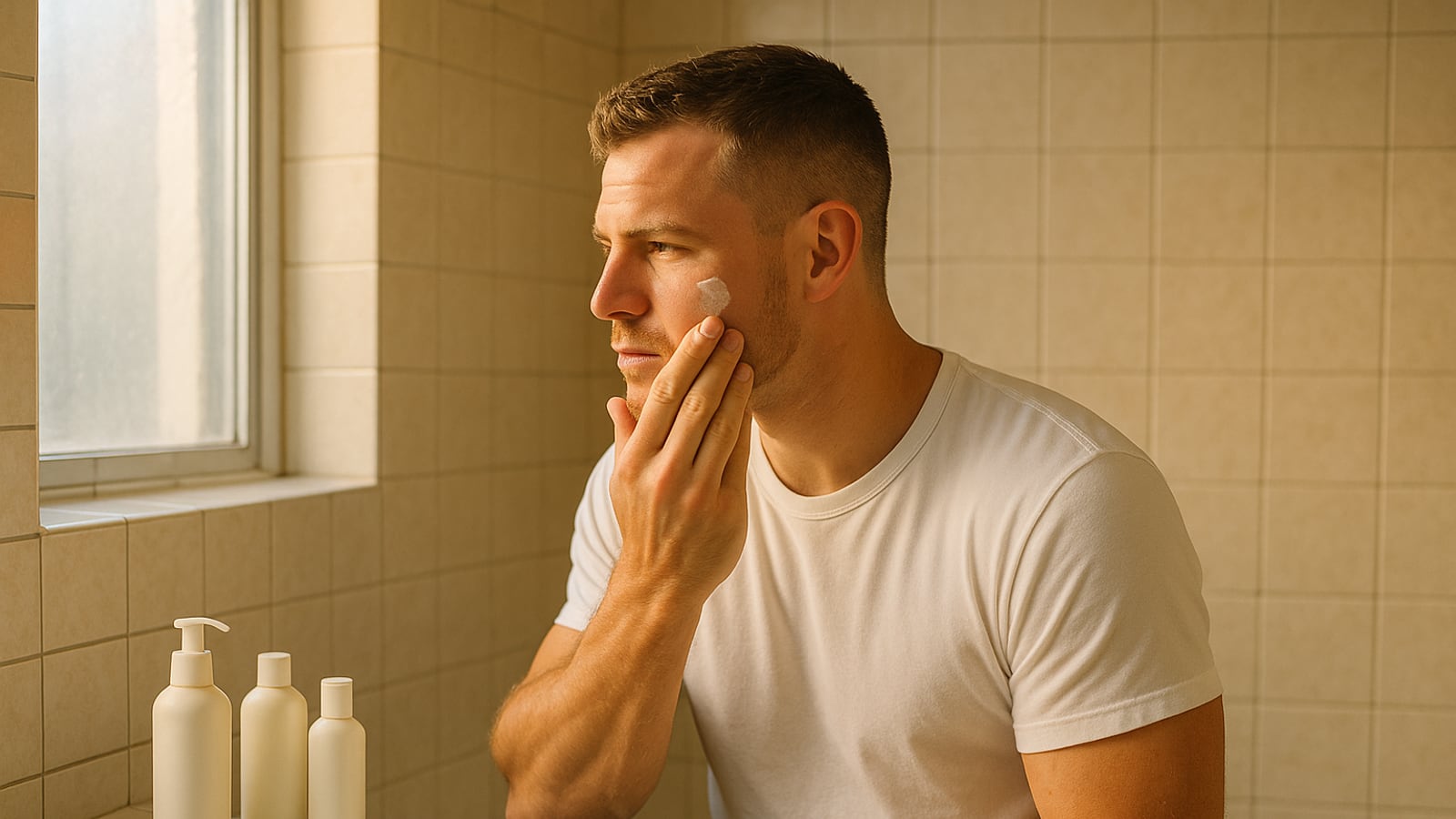
Sunscreen in the morning. A moisturiser that suits your skin. A retinoid at night, three or four times a week, if you care about how your face ages.
That's it. That's the part with real weight behind it. Everything else you've been sold — the charcoal scrub, the eye gel, the seven-step system with a black matte bottle and a name like a cologne — is somewhere between mildly useful and entirely decorative.
If you stop reading now, you've got the whole thing. The rest is how to make it survive a real morning, and how to tell which bottle is worth your money.
Why those three and not the other thirty
Sun exposure is the single biggest driver of how a face looks at sixty. Lines, leathering, uneven pigment, the blotchy patches on the tops of the ears and the back of the neck. That's cumulative ultraviolet damage, and it's the one input you can meaningfully control. Sunscreen also reduces skin cancer risk, which matters more than the cosmetic part and gets mentioned a tenth as often.
Retinoids — vitamin A derivatives — are the most studied topical ingredient in dermatology by a distance. Prescription tretinoin is the strong version. Adapalene 0.1% is available over the counter in most places and is genuinely effective, particularly if you get breakouts. Retinol, the version in most department store creams, is weaker and converts to the active form slowly. It still does something. It just does less, usually at a higher price.
Moisturiser isn't glamorous and it isn't doing anything clever. It's holding water in the skin and supporting the barrier so everything else is tolerable. Look for glycerin, ceramides, petrolatum, squalane, hyaluronic acid. These aren't exotic. They're in cheap products and expensive ones, and the ingredient lists are often close to identical.
The morning, honestly, is ninety seconds
Rinse your face with water. Not a foaming cleanser, not a scrub. If you slept, you didn't get dirty.
Moisturiser while the skin's still slightly damp.
Sunscreen. SPF 30 or higher, and enough of it. Underapplication is the universal failure here — most people use roughly a third of what the label testing assumes. Two fingers' worth, laid along your index and middle finger, covers face and neck. It'll feel like too much. It's the right amount.
If you use a moisturiser with SPF built in, that's one step instead of two, and it's better than skipping sunscreen entirely. Standalone sunscreen is generally easier to apply generously, because you're not trying to make a thin layer of moisturiser stretch.
Don't forget ears, neck and the top of the head if your hair's thinning. Those are the spots that give the game away.
The evening is where the work happens
Wash properly at night. Sunscreen and the day's grime need a cleanser, not water. A gentle one — if your face feels tight and squeaky afterwards, it's too harsh. Tight isn't clean. Tight is a stripped barrier.
Then the retinoid, on dry skin. A pea-sized amount for the whole face, which will look absurdly small and is, again, correct. Start twice a week. Build to four or five nights over a couple of months.
You will peel. Around week two or three, your skin will flake around the nose and mouth and you'll assume the product's wrong. It isn't. Back off to twice a week, keep moisturising, push forward again. If you want to soften the transition, apply moisturiser first and the retinoid over it — that slows absorption and reduces irritation.
Retinoids increase sun sensitivity, which is one more reason the morning sunscreen isn't optional.
If you're on prescription acne medication, have rosacea, or you're planning a family and unsure about topical vitamin A, ask a doctor or a dermatologist before starting. That's a genuine medical conversation, not a product question.
What you can put down
Scrubs with gritty particles. Physical abrasion doesn't improve skin texture. It causes micro-irritation and makes redness worse. If you want exfoliation, a chemical one — salicylic acid for oily and congested skin, lactic acid for dry — does it more evenly.
Collagen creams. Collagen molecules are far too large to cross the skin barrier. Rubbing collagen on your face doesn't add collagen to your face. Retinoids encourage your own skin to produce more. That's the mechanism that works.
Toner. A holdover from when cleansers were alkaline and the skin needed pH correction afterwards. Modern cleansers don't. Some toners contain useful actives, in which case buy the active, not the toner.
Eye cream. Usually a moisturiser in a smaller jar at four times the price. The skin around the eye is thinner, so a bland, fragrance-free moisturiser is fine there. Dark circles that are structural — hollowing, or genetics — won't be fixed by any cream.
Anything heavily fragranced. Fragrance is the most common cause of contact irritation in skincare. It's added because customers believe a product is working when it smells expensive. Your skin disagrees.
Shaving is skincare, whether you think about it or not
Most men's facial irritation is razor-related, not product-related.
Shave after a shower, or after a warm flannel on the face for a minute. Hydrated hair cuts more cleanly. Use a cream or gel that actually cushions — the thin clear gels do less than they claim. Go with the grain first. Chasing a closer shave against the grain is the main cause of ingrown hairs, particularly on the neck and particularly if your hair is coarse or curly.
Fewer blade passes beats more blade passes every time.
Replace the blade sooner than feels economical. A dull blade drags, and dragging is what produces the rash. If you're getting persistent bumps along the jaw and neck, switching to a single-blade razor or an electric trimmer that leaves slight stubble often solves it outright.
Skip the alcohol aftershave. It stings, which people read as effectiveness, and it strips a barrier you've just scraped a blade across. Moisturiser instead.
If your skin has an actual problem
Persistent acne past your twenties, redness that flushes and lingers, a mole that's changed shape or color, patches that won't clear — these aren't shopping problems. They're doctor problems, and the over-the-counter aisle will cost you a year of experimenting before you end up in the same chair anyway.
For ordinary breakouts, benzoyl peroxide (2.5% works about as well as 10% and irritates less) or adapalene will handle most of it, given eight to twelve weeks. Nothing in skincare works in a fortnight. The products that promise it are selling you the temporary plumping effect of water in the skin.
Buy the three things. Use them for six months without swapping anything. Then look in the mirror and judge.
The most expensive product in most bathrooms is the one bought in January and abandoned by February.
Tobias Reed
Style & Grooming
Spent a decade in menswear retail watching men buy the wrong size. Believes fit is ninety per cent of it and says so weekly.

Watch
Worth an hour of your evening
More from Grooming.
From channels we rate. Plays on YouTube.
Read next