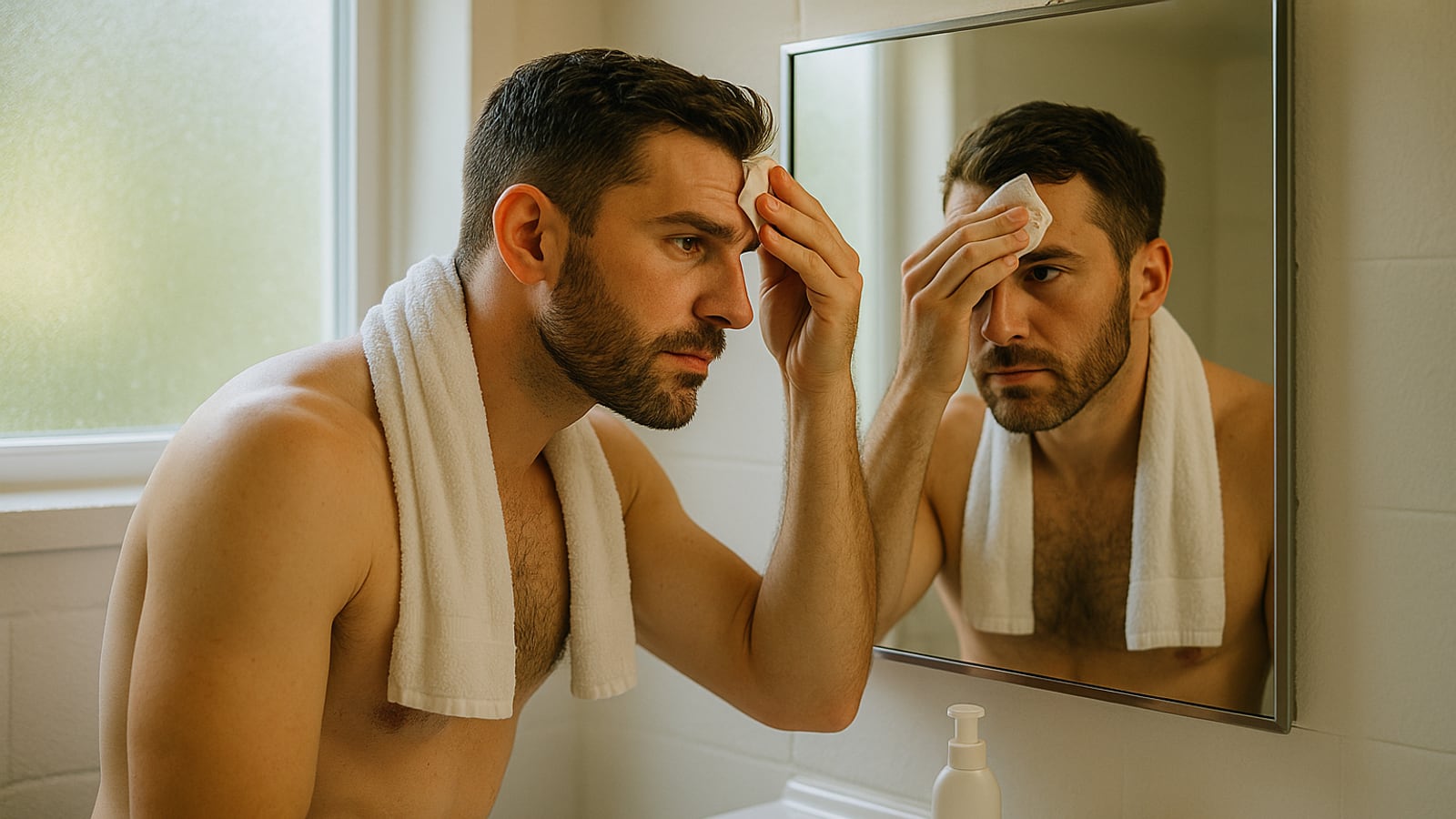
Do the tissue test before you buy anything. Rinse your face with plain water, pat dry, then leave it alone for 30 minutes. No moisturizer, no anything. Now press a folded tissue against your forehead and nose. Press a clean corner against your cheekbone. If the first spot turns translucent and the second one comes away dry and papery, you've got combination skin, and you've probably been treating your whole face like whichever half annoyed you most recently.
That's the mistake. A $14 bottle of foaming cleanser labeled "for oily skin" is being asked to fix a forehead and is quietly sandblasting a pair of cheeks at the same time. Then the cheeks get tight and itchy, you add a heavy cream to the whole face, and by 2 p.m. your nose looks like a cast-iron skillet. Round and round.
Your face isn't one thing. It's two neighborhoods with different weather.
Oil follows glands, not packaging
The reason the shine shows up in a T is boring anatomy. Sebaceous glands sit far more densely on the forehead, nose and chin than on the cheeks or along the jaw. Same face, different hardware. Nothing you put on your skin changes how many glands you were issued.
Which means the goal isn't to "balance" your skin. That word does a lot of work in advertising and almost none in a bathroom. The goal is to give the oily third a little help with oil, give the dry two-thirds a little help with moisture, and stop asking one product to do both jobs at once.
Worth knowing while you shop: "non-comedogenic" isn't a regulated, tested standard in the United States. Any company can print it. "Oil-free" tells you a formula skipped certain oils, not that it won't clog you. Read the finish instead, and read how your own skin looks at hour six. That's your evidence.
The 90-second morning
Morning isn't where the heavy lifting happens. Keep it stupid.
- Cleanse gently, or don't cleanse at all. If you washed your face last night, plain lukewarm water in the morning is genuinely enough for most people. If you want a cleanser, use a mild one and give it 20 seconds of fingertips, not 90 seconds of scrubbing.
- Moisturize the cheeks first, and most. Start your palms at the sides of your face and work inward. By the time you reach your nose there's barely any product left on your fingers, which is exactly right.
- Sunscreen over everything, including the shiny part. This is the one step you don't zone.
That's it. Three moves, and two of them take 15 seconds.
The part nobody tells you is that a moisturizer on your cheeks won't make your forehead oilier, and skipping moisturizer on your cheeks won't make them produce more oil to compensate. Stripping your skin doesn't dial oil down. It just breaks the barrier, and a broken barrier on your cheeks is what produces that flaky patch under your cheekbone that catches a razor.
The T-zone tool
One product, used sparingly, does most of the work: salicylic acid at 2 percent. It's oil-soluble, which is the whole point, because it can actually get down into a pore that's full of oil rather than sitting on top of it. The classic red-box medicated pads run about six dollars for 55 of them, and one pad is enough for a forehead, a nose and a chin.
Start at two or three nights a week, not every night. Wipe the T only. Don't "just blend it out" across your cheeks, because your cheeks didn't ask for this and will file a complaint within four days.
If your main problem is shine rather than clogged pores, try a niacinamide serum at 4 to 5 percent instead, a couple of dollars-per-ounce product from any of the basic brands. Evidence on it's decent for oil and for the look of enlarged pores, and it plays nicely with almost everything. Apply it the same way. T-zone, then stop.
If you're dealing with actual persistent breakouts in the T and along the jaw, over-the-counter adapalene gel, about $13 a tube, is the strongest thing you can buy without an appointment. It takes eight to twelve weeks and it will make you drier before it makes you better. Which is another reason to keep it off the cheeks for the first month.
The cheek tool
A moisturizer that's actually a moisturizer. Look for a short ingredient list built on glycerin, ceramides or plain old petrolatum, in a lotion or cream rather than a gel. The plain white tubs and pump bottles in the drugstore section, not the department store counter.
Apply it to damp skin. Not soaking, just not fully dry. Takes the same ten seconds and works noticeably better.
Cold months are when the split gets extreme. Forced-air heat in a truck cab or an office will pull your cheeks apart while your forehead carries on exactly as before. Two adjustments: go up a step in thickness on the cheeks only, and cut your salicylic acid to once or twice a week. Your T-zone in January isn't your T-zone in July, and treating it like a fixed setting is why people quit.
Where sunscreen goes wrong
Heavy mineral creams pill and slide on a forehead that's already producing oil, and by lunch you've got white streaks in your eyebrows and no protection where it counted. A lighter fluid or gel-cream formula stays put better on the T.
You've got two honest options. Use one lighter sunscreen across the whole face and put your richer moisturizer underneath the cheeks only, or run a fluid on the T and a cream everywhere else. The first is simpler and it's what I'd do on a workday. The second is better if your cheeks are genuinely rough.
And blotting papers aren't a defeat. Two seconds, no powder, no reapplication mess. Pressing, not rubbing.
What to stop doing
Scrubs with grit in them. They irritate the dry zone without touching the clogged pores in the oily one. Chemical exfoliation is the better tool and it's cheaper.
Alcohol-forward toners on the whole face. That instant squeaky feeling isn't cleanliness.
Double cleansing every night because a video said so. If you don't wear heavy sunscreen or work around grease and dust, once is plenty.
Treating a flaky cheek as dirt. Scrubbing at it makes the razor's job harder tomorrow.
Give any of this four weeks before you judge it. Skin turns over slowly and you can't see a trend from three days of looking in a mirror. Take a photo in the same light on day one, because your memory of your own face is a liar.
If you've got stubborn redness across both cheeks and the nose, a rash that burns rather than flakes, or breakouts that leave marks, that's a dermatologist's call and not an aisle's. One visit, one plan, and you stop buying things at random.
Otherwise, three products, two zones, and a tissue that told you the truth for free.
Dean Shaw
Gear & Garage
Tests things until they break, then reports what broke first. Trucks, tools, watches, and the cheap version that costs more.

Watch
Worth an hour of your evening
More from Grooming.
From channels we rate. Plays on YouTube.
Read next