

Teach your kid to find any tool in thirty seconds
Sort by type, size and job, and a kid learns to put a hand on the right tool fast. One Saturday, one toolbox, one skill that sticks.
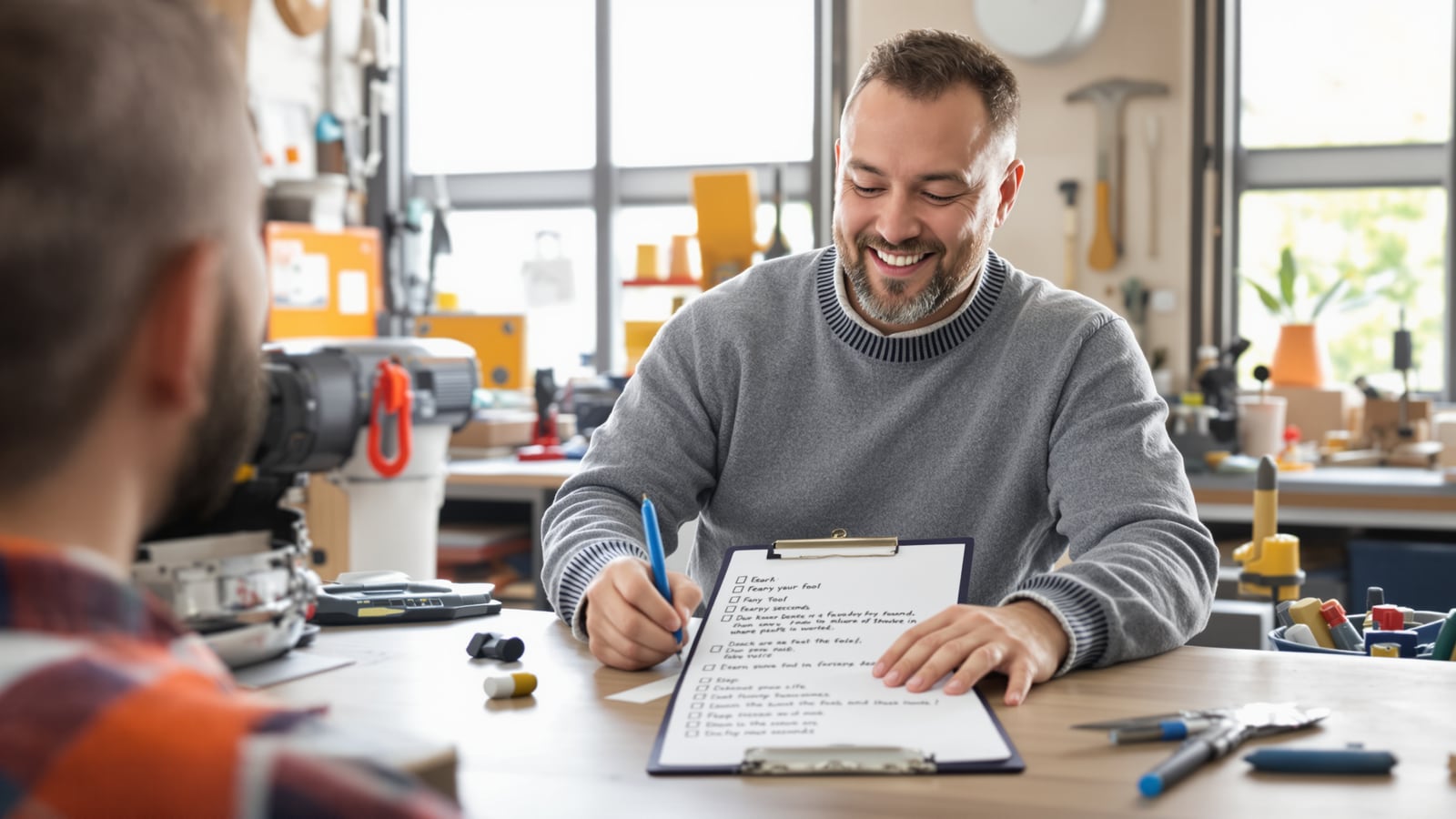
Quick answer: Dump the box on a tarp. Have your kid sort every tool three ways: by what it is, by how big it is, and by the job it does. Put the weekly tools on top. Finish with a thirty-second drill where you call out a job and they bring the tools.
What your kid will be able to do
By the end of one Saturday afternoon, your kid should be able to:
- Name the main tool families and say what each one does.
- Line up wrenches, sockets and screwdrivers from smallest to largest, and keep metric and standard apart.
- Group tools into job kits and decide what belongs on top.
- Clean a tool and put it back where it lives.
- Find the right tool for a named job in thirty seconds.
That's one skill. Not ten. Everything else you could teach about tools gets easier once this is done.
Ages 8 and up can do all of it with you standing there. Younger kids can sort the hammers, pliers and tape measures. You handle the blades.
Before you start: safety first
Set the rules before anything comes out of the box.
- Pull the batteries out of every cordless tool and unplug every cord. A drill can't hurt anybody if it can't spin.
- Cover or retract every blade. Utility knives get retracted and handed over handle first, always. Chisels and saws get their guards or a wrap of cardboard and tape.
- Safety glasses on both of you if anything gets wire-brushed or sprayed.
- Work gloves for sorting. Old tools have burrs and rust.
- Nobody walks around with a tool pointed forward. Tips down, carried at your side.
Read these out loud. Kids remember what they've heard you say twice.
Step 1: Empty the box on a tarp
Spread an old sheet or tarp on the garage floor. Dump everything. Every loose screw, every orphan socket, every dried-out tube of glue.
This is the step most parents skip, because it looks like making a mess on purpose. But a kid can't organize what they can't see. And you'll find out what you own. Most toolboxes hold at least one tool you forgot you had and three you've bought twice.
Throw out anything broken or unsafe: cracked handles, mushroomed chisel heads, frayed cords. Let your kid make that call with you and say why.
Step 2: Sort by type
Have your kid make piles by what each tool does with its hands:
- Striking: hammers, mallets, a hand sledge.
- Gripping: pliers, locking pliers, an adjustable wrench.
- Turning: screwdrivers, wrenches, sockets, hex keys.
- Cutting: utility knife, hacksaw, snips.
- Measuring and marking: tape, square, level, pencil.
- Everything else: clamps, files, stud finder, the odd stuff.
Make them say the name of each tool as they place it. A kid who can't name a tool can't ask for it, and can't tell you which one is missing.
Expect arguments. A kid will want to sort by color or by what looks cool. Let that go for about thirty seconds, then ask a better question: "If you needed to tighten something, which pile do you check first?" That's the whole lesson. The pile has to match the question you'll be asking later.
Step 3: Sort by size inside each pile
Now line each pile up from smallest to largest, left to right.
Do the screwdrivers first. Tip size makes it obvious, and it teaches why the right size matters: a screwdriver that's too small strips the screw, and one that's too big won't seat.
Then wrenches and sockets. Two rules go here.
- Keep metric and standard separate. A 9/16 inch socket and a 14mm look nearly identical. Use the wrong one and you round off the bolt head, which turns a ten-minute job into an afternoon. Mark one set with a strip of tape if you have to.
- Sockets travel with their drive size. Quarter-inch, three-eighths and half-inch drives each get their own row or case, and the ratchets live with their sockets.
Be honest with your kid about the annoying part. Sizes feel arbitrary until you've stripped a bolt once. You might let them find that out on a scrap piece of hardware, with you watching.
Step 4: Sort by job
This is the step that turns a tidy box into a useful one.
Ask your kid: "What do we reach for most?" They'll be right more often than you'd think. The tape measure, a Phillips and a flathead, pliers, a hammer and a utility knife are the weekly crowd. Those go on the top tray, in front, where a hand finds them without looking.
The once-a-year tools go on the bottom. Pipe wrench, hacksaw, the big pry bar. Heavy goes low so the box doesn't tip.
Then build two or three job kits from what's left:
- Hang-a-picture kit: hammer, level, tape, pencil, stud finder.
- Bike kit: hex keys, tire levers, a small adjustable wrench, a pump.
- Roadside kit: the lug wrench and gloves, riding in the truck. (Your car maintenance schedule will tell you what else belongs with it.)
Let your kid name the kits. They'll remember what they named.
Step 5: Clean it before it goes back
Here's the old code: you leave a tool cleaner than you found it.
Wipe every tool with a rag. Put one drop of light machine oil on bare steel, like pliers joints and the faces of wrenches, and rub it in. Knock the dirt out of the screwdriver tips. If you've got a flat file or a sharpening stone, show them how a dull chisel or a dull pair of snips gets its edge back.
Then teach the rule that keeps the whole system alive: a tool goes back where it lives, or it doesn't leave the bench. If a neighbor or a friend borrows one, it comes back cleaner and sharper than it left. And your kid is allowed to say no when somebody asks to borrow something without asking you first. Saying "let me check with my dad" isn't rude. It's a boundary.
Step 6: Load the box
Heavy tools on the bottom. Sharp ones covered and laid flat. Weekly tools on the top tray, with handles pointing the same way so you can grab by the grip. Small parts, like screws, anchors and nuts, go in a lidded tray or a labeled jar.
Stick a strip of masking tape on the lid with the sorting rule written in your kid's handwriting: Top is weekly. Bottom is heavy. Everything goes home.
Step 7: Run the thirty-second drill
Set a timer. Say a job. "Tighten the loose cabinet hinge." "Hang this frame." "Take the wheel off the bike."
Your kid brings back the tools. If they get it in thirty seconds, the box works. If they don't, don't fix it for them. Ask where they looked first and why, and let them move the tool to where their brain went. Their system only has to work for them.
And resist the urge to reorganize it afterward. You will want to. Don't. A box that's organized the way a kid thinks gets kept that way.
Once the box works, put it to use. The home maintenance checklist that actually gets done is a good first job list, and a kid with a thirty-second box can knock out half of it.
Printable checklist
☐ Batteries out, cords unplugged, blades covered
☐ Safety glasses and work gloves on
☐ Everything dumped on the tarp
☐ Broken and unsafe tools thrown out
☐ Sorted by type, with names said out loud
☐ Lined up small to large inside each type
☐ Metric and standard kept separate
☐ Weekly tools on the top tray
☐ Two or three job kits built and named
☐ Every tool wiped, oiled where bare, edges checked
☐ Heavy tools on the bottom, sharp tools covered
☐ Sorting rule taped inside the lid
☐ Thirty-second drill passed
Self-check
Ask your kid these. No prompting.
- Why do metric and standard sockets stay apart? A close fit that isn't exact will round off the bolt head.
- Which tools go on the top tray? The ones you use every week.
- How do you carry a screwdriver across the garage? Tip down, at your side.
- What happens before a tool goes back in the box? It gets wiped, and bare steel gets a drop of oil.
- A buddy asks to borrow the hammer. What do you say? "Let me check first." Then it comes back cleaner than it left.
Five out of five, and they own the box. Hand them the key to the garage cabinet and walk away.
Wes Dunbar
Country & Skills
Grew up on an acreage and never quite left. Covers trucks, trades, land, and how to do the thing yourself.

Watch
Worth an hour of your evening
More from Guides & Checklists.
From channels we rate. Plays on YouTube.
Read next