Bleeding gums aren't normal, and your heart may care
Gum disease and heart disease travel together more often than chance explains. What's proven, what isn't, and what to do at your next cleaning.
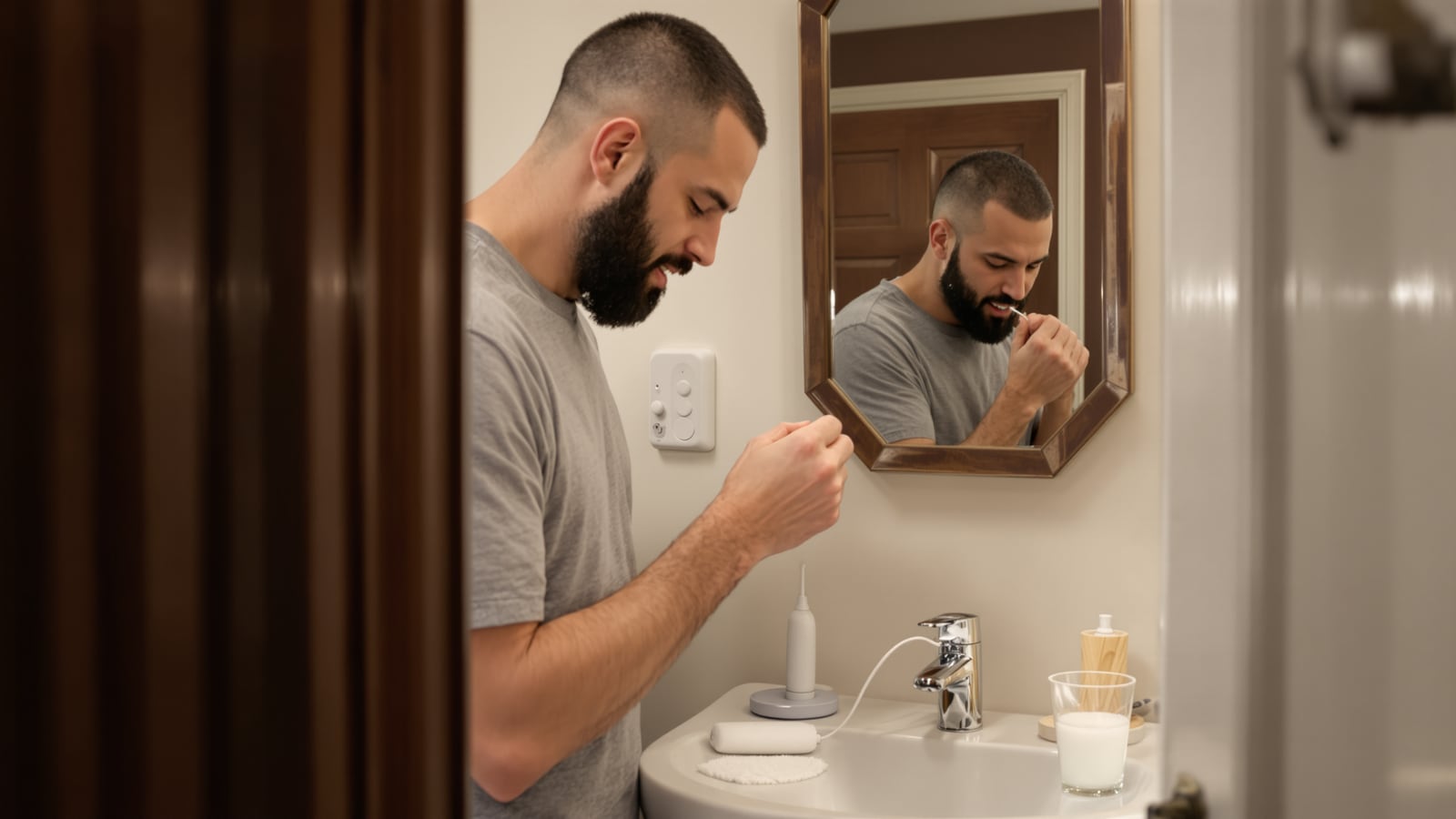
Quick answer: Gums that bleed when you brush are inflamed, and that's never normal. Gum disease and heart disease show up together often, though nobody has proven one causes the other. Treat your gums anyway, and tell both your dentist and your doctor what's going on.
The pink in the sink
Plenty of men spit pink into the sink every morning for a year and decide it's just how their mouth works. It isn't. Healthy gums don't bleed from a toothbrush. Bleeding means the tissue is inflamed, usually because plaque has been sitting along the gumline longer than it should.
At that stage it's gingivitis, and it's fully reversible. Clean the plaque out, keep it out, and the gums tighten back up in a couple of weeks.
Leave it alone and it can become periodontitis. Now the infection has worked down below the gumline and started eating at the bone that holds your teeth in. That damage doesn't grow back. Dentists can stop it. They can't undo it.
Most people don't catch it because it doesn't hurt. No ache, no warning, just gums that slowly pull back from the teeth.
What the heart connection really is
Study after study has found that people with gum disease are more likely to have heart and blood vessel disease. That's solid. Researchers have also found oral bacteria in the fatty plaque inside diseased arteries, and they know that chewing and brushing with inflamed gums can push bacteria into the bloodstream.
The reasoning is easy to follow. Chronic inflammation in the mouth may feed inflammation in the vessels. Both involve the body's immune response running hot for years.
Here's the part the glossy health headlines skip. In a 2012 scientific statement, the American Heart Association reviewed the evidence and concluded that it shows an association, not proof of cause. It also said that treating gum disease hasn't been shown to prevent heart disease or reverse it.
That's an honest limit, and it matters. Nobody should tell you flossing prevents a heart attack. Nobody knows that.
A lot of the overlap likely comes from shared causes. Smoking wrecks both gums and arteries. Poorly controlled blood sugar does the same. So does a life of skipped checkups. The man with bleeding gums and clogged arteries may simply have the same few habits showing up in two places.
So what's the practical conclusion? Gum disease is worth treating on its own merits, since it costs you teeth. And it works as a flag. If your gums are in bad shape, it's a good reason to look hard at the rest of you.
Diabetes runs both directions
This is the link with the clearest two-way traffic. High blood sugar makes gum infections harder to fight. Active gum infection can make blood sugar harder to keep down. If you've been told your numbers are creeping up, read Your A1C Came Back 5.9. Now What? and put a dental appointment on the same calendar.
A man who's been told he's prediabetic and also has loose, bleeding gums is looking at two problems feeding each other. Fix one and the other gets easier.
Smoking is the multiplier
Tobacco is one of the biggest risk factors for gum disease, and it hides the warning sign. Smokers' gums often bleed less than they should because nicotine narrows the blood vessels, so a smoker can have real damage with little to see. If that's you, What Actually Works When You Quit Tobacco is the better place to start than any mouthwash.
What to do this month
Nothing here is exotic. Most of it is the stuff your dentist has been saying for years.
- Brush for two full minutes, twice a day, with fluoride toothpaste and a soft brush. Hard scrubbing wears gums down. Angle the bristles toward the gumline and go gently.
- Clean between your teeth once a day. Floss, floss picks, or small interdental brushes all work. The best one is the one you'll actually use. Yes, it's tedious. Do it at night, standing at the sink, before you do anything else.
- Expect some bleeding for the first week or so if you're starting after a long layoff. If it hasn't settled in two weeks of steady cleaning, call your dentist.
- Book the cleaning you've been putting off. Ask them to measure your gum pockets. The hygienist runs a small probe along each tooth. Roughly 1 to 3 millimeters is healthy. Deeper readings, especially with bleeding, are a sign of disease. Ask for your numbers and write them down so you can compare next time.
- Don't wait on loose teeth, gums pulling back, or breath that won't clear up. Those get a dental visit soon, not eventually.
If the dentist finds periodontitis, the usual treatment is a deep cleaning, called scaling and root planing, which clears plaque and hardened deposits from below the gumline. Some cases need a periodontist, a gum specialist. It costs more than a regular cleaning, and your insurance may cover part of it. Ask the office before you book.
Tell both your doctors
Most people keep their dentist and their doctor in separate boxes. They shouldn't.
Mention your gum health at your next physical, especially if you have high blood pressure, diabetes, high cholesterol, or a family history of heart trouble. Tell your dentist about every condition you have and every medication you take, blood thinners especially. Those can change how they handle your care.
One more point worth raising. A small group of people with certain heart conditions, such as a prosthetic heart valve or a history of infection of the heart lining, are sometimes advised to take antibiotics before certain dental work. That's a decision for your cardiologist and dentist together. Don't make it yourself, and don't skip it if they've told you to do it.
If you've got other warning signs, like chest pressure or shortness of breath, don't wait on a dental visit. What a Heart Attack Actually Feels Like covers what to watch for, and the answer to those is medical help right away.
The household version
Kids copy what they see at the bathroom sink. A father who flosses without being nagged, and who keeps his own checkups, teaches it faster than any lecture. The same goes for a mother who books her own cleaning while she's booking everybody else's.
The odds that a bleeding gum is the first sign of something big are low. But it's one of the few warning signs that shows up in a mirror, costs you almost nothing to fix, and takes two minutes a night to prevent.
Your next cleaning is the cheapest checkup you'll get all year. Make the call.
Cal Brennan
Fitness
Strength coach. Trains fathers, tradesmen and desk workers, which means programs that survive a bad week.

Watch
Worth an hour of your evening
More from Health.
From channels we rate. Plays on YouTube.
Read next