Teddy Roosevelt Quit a Safe Job to Go and Get Shot At
He was 39, had six kids and a corner office. The way Roosevelt got to Cuba tells you more than the charge up the hill.
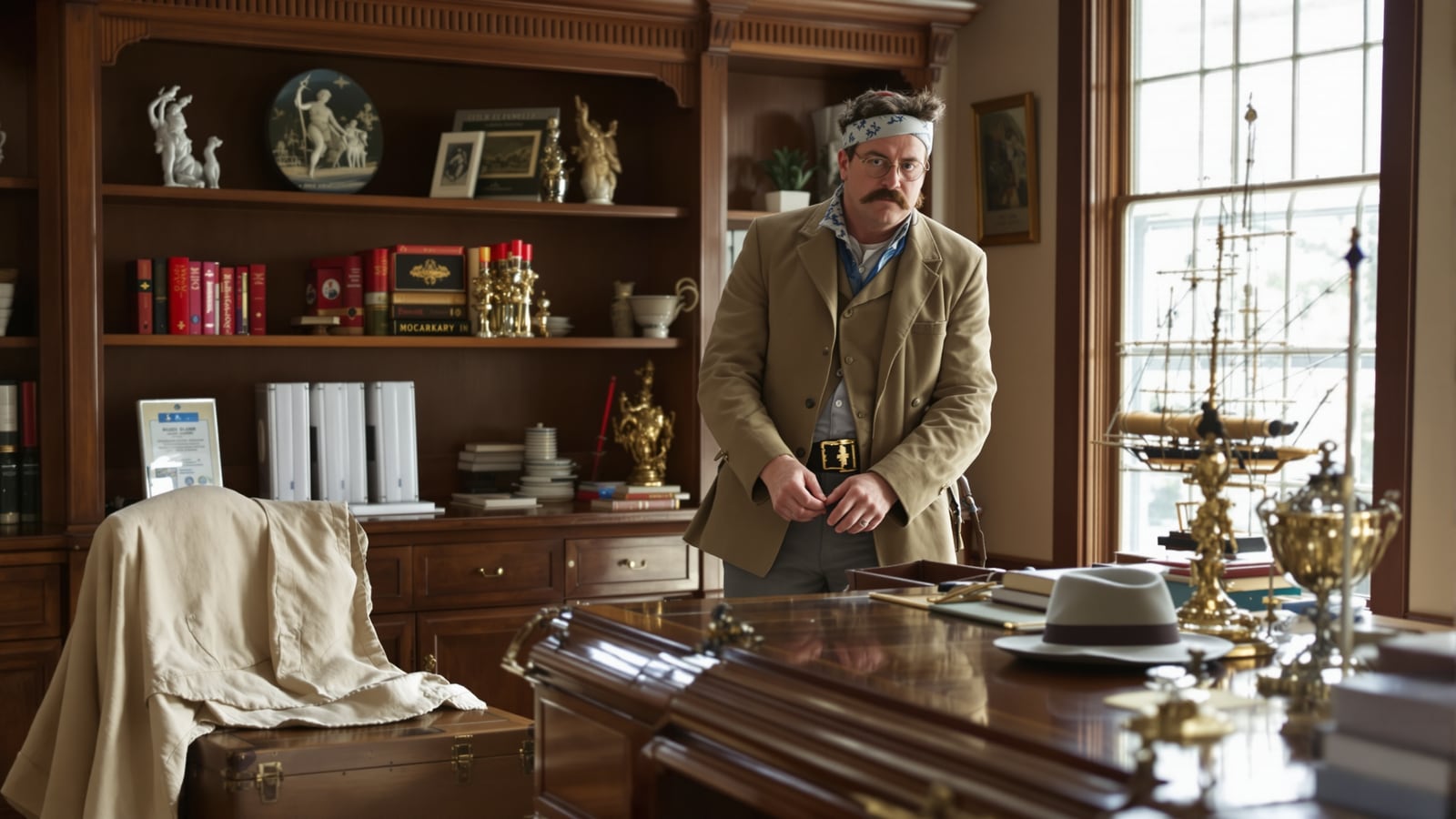
In the spring of 1898, Theodore Roosevelt was 39 years old, with six children, a wife at home, and a job as Assistant Secretary of the Navy. It came with a big office, a government salary and no chance of getting shot.
He quit it anyway.
The popular version says a New York police commissioner woke up one day as a war hero. That's backward. The police job was over by 1897, and the war hero was the end of a long habit. Roosevelt had spent a year in Washington arguing that the country should fight Spain over Cuba. Then the USS Maine blew up in Havana harbor on February 15, 1898, Congress declared war in April, and he had to decide whether he meant it.
The boy who wasn't supposed to
Start earlier. Roosevelt was a sickly kid with asthma who was told, in effect, to take it easy. He didn't. He lifted weights, boxed, and built himself into somebody who could keep up with anyone.
In 1884, his wife Alice and his mother died in the same house on the same day. He went west to the Dakota Badlands, ran cattle, rode herd and worked beside men who didn't care about his Harvard degree. He came back to New York a different man.
As police commissioner from 1895 to 1897, he walked the beats at night to see whether his patrolmen were awake. Some weren't. That was the reputation he carried to Washington: he checked his own work, and he checked yours.
The colonel who said no
Secretary of War Russell Alger offered Roosevelt command of a new volunteer cavalry regiment. Roosevelt turned it down. He told Alger he didn't know enough to be a colonel and wanted to serve under someone who did.
That someone was Leonard Wood, an army surgeon who had already earned a Medal of Honor in the Apache campaigns. Wood got the regiment. Roosevelt took the number two spot as lieutenant colonel.
Hold onto that. The man everybody remembers for swagger started by admitting what he didn't know. He asked for a month to learn the drill, and he got to work learning it.
Cowboys, Ivy Leaguers and a lot of mud
The First U.S. Volunteer Cavalry gathered in San Antonio, Texas. The press called them the Rough Riders, a name borrowed from Buffalo Bill's show, and the men grew to like it.
The roster was strange. Cowboys, miners and lawmen from Arizona, New Mexico, Oklahoma and Indian Territory stood next to college athletes and polo players from the East. Far more men applied than there were slots. Roosevelt had written about the West. Now he had a regiment full of the real thing.
Then came the Army's logistics, which were a mess. At Tampa, Florida, transport was short. Only eight of the twelve troops could sail. The horses stayed behind, so the cavalry would fight on foot. Roosevelt brought a handful of mounts for the officers and a dozen pairs of spare spectacles, some of them sewn into his hat.
Las Guasimas
The regiment landed at Daiquirí, Cuba, around June 22. Two days later, near a place called Las Guasimas, it walked into an ambush on a jungle trail.
Eight Rough Riders were dead by nightfall. Two of them were Captain Allyn Capron, a career soldier's son, and Hamilton Fish, an Ivy League athlete from one of New York's best-known families. Cowboys and college men died in the same brush, which settled any argument about whether the regiment had real soldiers in it.
Kettle Hill
On July 1, 1898, the Army attacked the San Juan Heights, a line of Spanish defenses outside Santiago. Roosevelt's regiment was ordered up Kettle Hill.
Roosevelt rode a borrowed horse named Little Texas, because everybody else was on foot and he wanted his men to see him. Spanish rifle fire was heavy. A wire fence stopped his horse, and he got off and kept going. Alongside the Rough Riders went the Black regulars of the 9th and 10th Cavalry, the Buffalo Soldiers, plus the 1st Cavalry. Lieutenant John Parker's Gatling guns hammered the Spanish trenches from the flank. Without them, the charge could have gone badly.
Roosevelt later wrote that he shot a Spanish soldier with a revolver recovered from the wreck of the Maine. After Kettle Hill fell, he pushed on toward San Juan Hill and the Heights. By nightfall, the Americans held the ridge above Santiago.
The famous name is a little wrong. The Rough Riders took Kettle Hill, not San Juan Hill. Newspapers rolled the day into one story, and it stuck.
The hard parts
An honest version has to include the rest.
Disease did more damage than the Spanish. Malaria and yellow fever tore through the American camps. More U.S. soldiers died of sickness in that war than of combat. In August, Roosevelt signed a blunt letter that reached the newspapers, warning that the army would be destroyed by disease if it stayed in Cuba. Within days the troops were ordered home. It cost him no friends in the ranks and plenty in the War Department.
The credit wasn't shared evenly. The Buffalo Soldiers fought and bled on the same hill, and Roosevelt praised them at first. His later remarks were less consistent, and veterans of the 9th and 10th disputed some of what he said. He was also, plainly, a man who knew how to promote himself. He wrote the story of the regiment himself the next year, and the Rough Riders got the headlines.
The Medal of Honor didn't come. Roosevelt was recommended for it. The War Department turned it down, and the country forgot. It was awarded posthumously in January 2001. His son Theodore Jr. earned his own on Utah Beach in 1944. Both are on the roll. If you want to know who else stands there, start with the Medal of Honor men you should be able to name.
What it cost and what it bought
Roosevelt came home to Montauk, Long Island, in August. The regiment disbanded in September. In November, New York elected him governor. In 1900 he was Vice President. In September 1901, after McKinley was shot, he was President.
Cynics say he went to Cuba to build a résumé. Maybe. But a man building a résumé doesn't pick the most dangerous seat when a safe one is offered, and he doesn't ask to serve under somebody else. He'd also spent a year telling the country what it should do. He wasn't going to be the man who said "somebody should" and stayed at his desk.
George Washington had the same instinct about sharing the hardship: he slept in a tent until his men had roofs. Different century, same test.
Roosevelt gave up a good job at 39 and rode toward the guns. The rest of his career was built on it.
Marcus Vale
Editor-in-Chief
Twenty years in magazines, most of it deciding what to cut. Writes about work, discipline and the decisions that compound.

Watch
Watch how it's done
Picked for this article.
From channels we rate. Plays on YouTube.
National Geographic
Who Were the Rough Riders? | Explorer
NMPBS Originals
Rough Riders | New Mexico PBS
Read next