Easy Company From Currahee to the Eagle's Nest
They ran a Georgia mountain until they hated it, then jumped into Normandy in the dark. What happened to Easy Company, and what the legend leaves out.
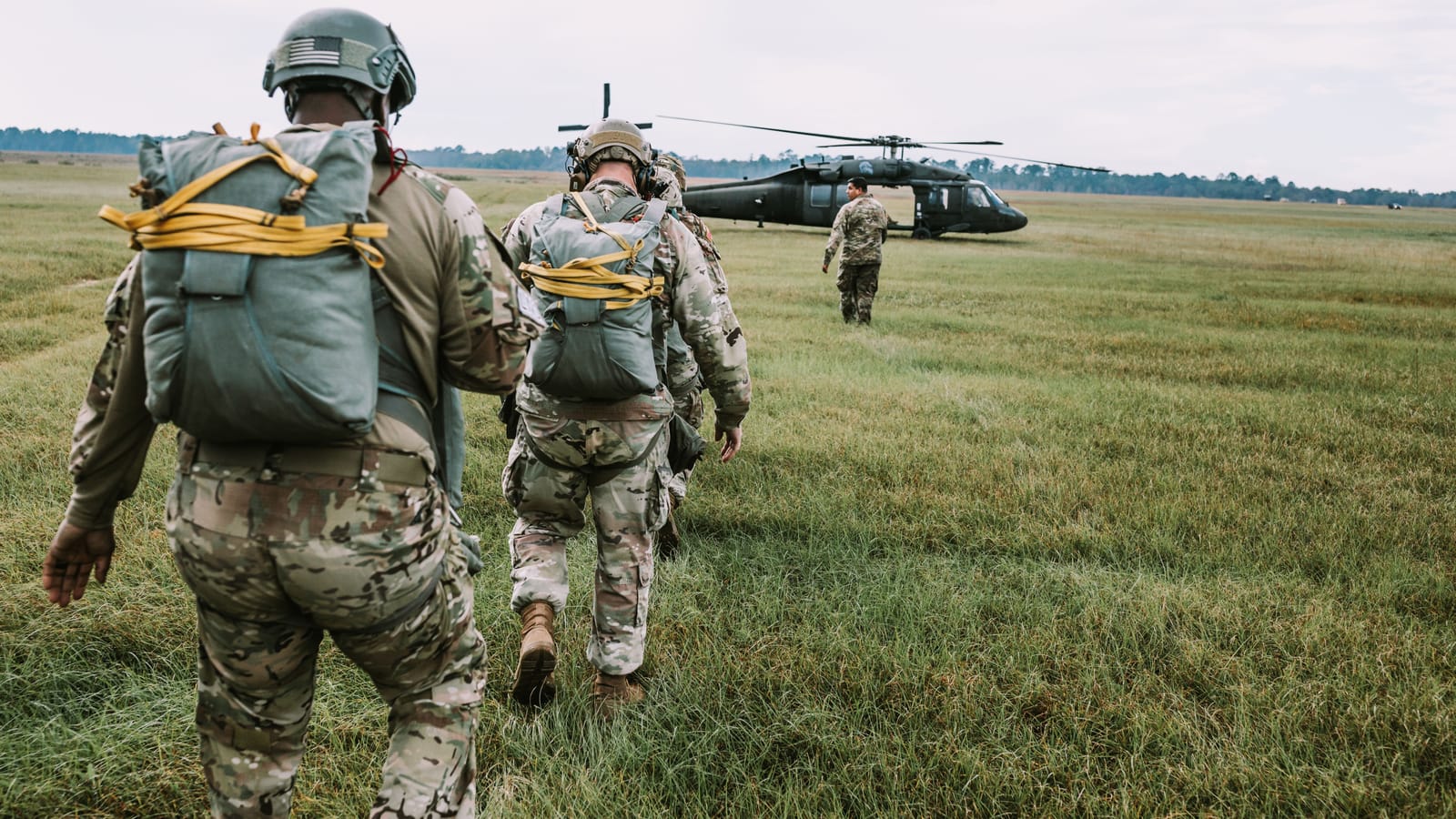
Three miles up, three miles down. That was Currahee, a scrub-covered hump of Georgia mountain outside Camp Toccoa, and in the summer of 1942 the men of Easy Company, 2nd Battalion, 506th Parachute Infantry Regiment ran it until they could taste blood. Sometimes after a full day of training. Sometimes after the spaghetti dinner they'd just eaten, which came back up on the way.
The regiment was activated July 20, 1942. It was an experiment: an airborne outfit built from scratch, no cadre of old-line infantry, officers and enlisted men trained together from zero. Volunteers only. Of the thousands who tried out for the 506th, most washed out before they ever saw a parachute.
The man running Easy Company was Captain Herbert Sobel, and to hear his men tell it decades later, they hated him with a purity most people never feel about anything. He canceled weekend passes over a speck of rust on a bayonet. He confiscated food from care packages. He revoked furloughs on the eve of Christmas. He was also, by the honest admission of the officer who replaced him, the reason Easy Company was the hardest company in the regiment.
The mutiny nobody talks about
By the fall of 1943 the company was in Aldbourne, England, waiting for the invasion, and a problem had become impossible to ignore. Sobel was brutal in garrison and shaky in the field. He got lost on maneuvers. He gave orders that would have gotten men killed. The sergeants talked among themselves and reached a conclusion that, in an army at war, is a very serious thing: they wouldn't follow him into combat.
Most of Easy's NCOs turned in their stripes in protest. Colonel Robert Sink, the regimental commander, could have court-martialed the lot of them and would have been within his rights. Instead he busted a couple of the ringleaders, and he moved Sobel out, to a jump school for support troops. Easy got a new commander, Lieutenant Thomas Meehan.
Around the same time, First Lieutenant Richard Winters, Sobel's executive officer, was hit with a punitive charge over a latrine inspection he'd never been properly notified of. Winters refused the punishment and demanded a court-martial. Sink transferred him to battalion mess instead, then quietly sent him back to Easy once Sobel was gone.
Hold onto that. A 25-year-old from Lancaster County, Pennsylvania, who didn't drink, didn't chase, and read his Bible, staked his career on a latrine.
Normandy, and thirteen men against four guns
Just after midnight on June 6, 1944, Easy Company jumped into a black sky over the Cotentin Peninsula through flak so thick that pilots scattered and ran. Men landed miles from their drop zones, alone, in flooded fields, with their leg bags torn away and half their gear gone. Winters hit the ground with a knife and no rifle.
Lieutenant Meehan's C-47 went down in flames near Beuzeville-au-Plain. Everyone aboard was killed, including most of Easy's headquarters section. Winters took command of the company without knowing for days that he had it.
By mid-morning at a place called Brécourt Manor, a battery of German 105mm howitzers was firing onto Causeway 2 behind Utah Beach, where American troops were trying to move inland. Winters was handed roughly a dozen men and told to take care of it. He put two machine guns on the flank, moved his assault teams down the connecting trench, and took the guns one at a time, using the Germans' own trench system as cover. Three guns destroyed in about an hour; a fourth by another unit shortly after. He came away with a map of German artillery positions across the whole peninsula.
Winters got the Distinguished Service Cross. Compton, Guarnere, and Lorraine got Silver Stars. The action has been taught since as a model of what a small unit can do against a fixed position when somebody thinks instead of charging. A long campaign to upgrade Winters' DSC to the Medal of Honor never succeeded.
Holland, and a dike at Randwijk
Then Carentan, where Winters took a ricochet in the leg. Then England, replacements, and on September 17, 1944, a daylight jump into Holland for Operation Market Garden. The drop was clean. The operation wasn't. The single road to Arnhem became a shooting gallery, and the British armor that was supposed to be over the Rhine in days never got there.
Easy ended up on "the Island," the flat wet ground between the Waal and the Lower Rhine, holding a line nobody could really hold. On October 5, near Randwijk, Winters found himself alone on top of a dike looking down at a full company of SS troops. He waved his men up, opened fire, and led about 35 paratroopers into an assault that broke roughly 300 Germans. He called it the single greatest moment of his time as a soldier. He also wrote, later, about a young German soldier who stood up in front of him, and about seeing that boy's face for the rest of his life.
That's the part the posters leave off.
Bastogne
In December they were pulled back to Mourmelon in France to refit. They never finished. On December 18, trucks took them north in the open cold toward a Belgian crossroads town called Bastogne, and men went into the Ardennes short of ammunition, short of winter clothing, short of overcoats, some without helmets, picking up gear from retreating units on the road in.
They dug in east of town in the Bois Jacques, the woods outside Foy. German artillery used the trees: shells burst in the canopy and sprayed splinters and steel straight down into foxholes, which meant you were safest with a log roof and there weren't enough logs. Rations ran out. Medic Eugene Roe scrounged bandages and plasma from anybody who'd give them up.
On January 3 a barrage cost Joe Toye and Bill Guarnere their legs in the same few minutes. A week later a direct hit killed Skip Muck and Alex Penkala in their hole. Men who'd survived Normandy and Holland came apart in those woods, and nobody who was there ever held it against them.
The attack on Foy came January 13. The company commander, Lieutenant Norman Dike, halted the assault in the open, mid-field, under fire. Winters, now a battalion officer and forbidden to lead the attack himself, grabbed Lieutenant Ronald Speirs and sent him in. Speirs took over, got the company moving, and then ran straight through the town and through German positions to link up with I Company on the far side, and then ran back. Men watched him do it and decided he was something other than mortal.
What they found in April
Winter patrols on the Moder at Hagenau. Then the collapse. In late April 1945, near Landsberg in Bavaria, an Easy patrol came on a barbed-wire enclosure full of starving men in striped rags. It was one of the Kaufering camps, a satellite of Dachau. Winters ordered the gate opened and the town's civilians turned out to bury the dead and feed the living.
The men had spent three years being told what they were fighting. That day they saw it.
On May 5 they rolled into Berchtesgaden and took Hitler's mountain retreat, drank Göring's wine, and sat in the sun on the terrace of the Berghof like tourists. VE Day came three days later. Then came the point system, the slow trickle home, and the strange business of going back to being a mail carrier in Pennsylvania.
Honest accounting
Stephen Ambrose's 1992 book counted 366 men who served in Easy Company across the war and 49 killed. Nearly every original Toccoa man was killed, wounded, or captured.
The book made them famous and the 2001 miniseries made them legend, and legend sands off edges. Ambrose was later criticized by historians for loose sourcing, and some of Easy's own veterans disputed details and portrayals. Some of the wilder Speirs stories, including the one about shooting prisoners in Normandy, were passed along as rumor and never confirmed by anyone who saw it. Treat them that way.
As for Sobel: he never got the war he wanted. Reports say he shot himself in 1970, survived blind, and died in 1987 with no military funeral. Winters always said the man's cruelty in Georgia was why Easy survived Bastogne. There's a story the men told about running into him after the war, when Winters outranked him, and Sobel hesitated over the salute. Winters said, "We salute the rank, not the man."
Both things were true at once. That's usually how it goes.
Marcus Vale
Editor-in-Chief
Twenty years in magazines, most of it deciding what to cut. Writes about work, discipline and the decisions that compound.

Watch
Watch how it's done
Picked for this article.
From channels we rate. Plays on YouTube.
The Operations Room
Easy Company Assaults the Guns at Brecourt Manor on D-Day - Animated
Read next