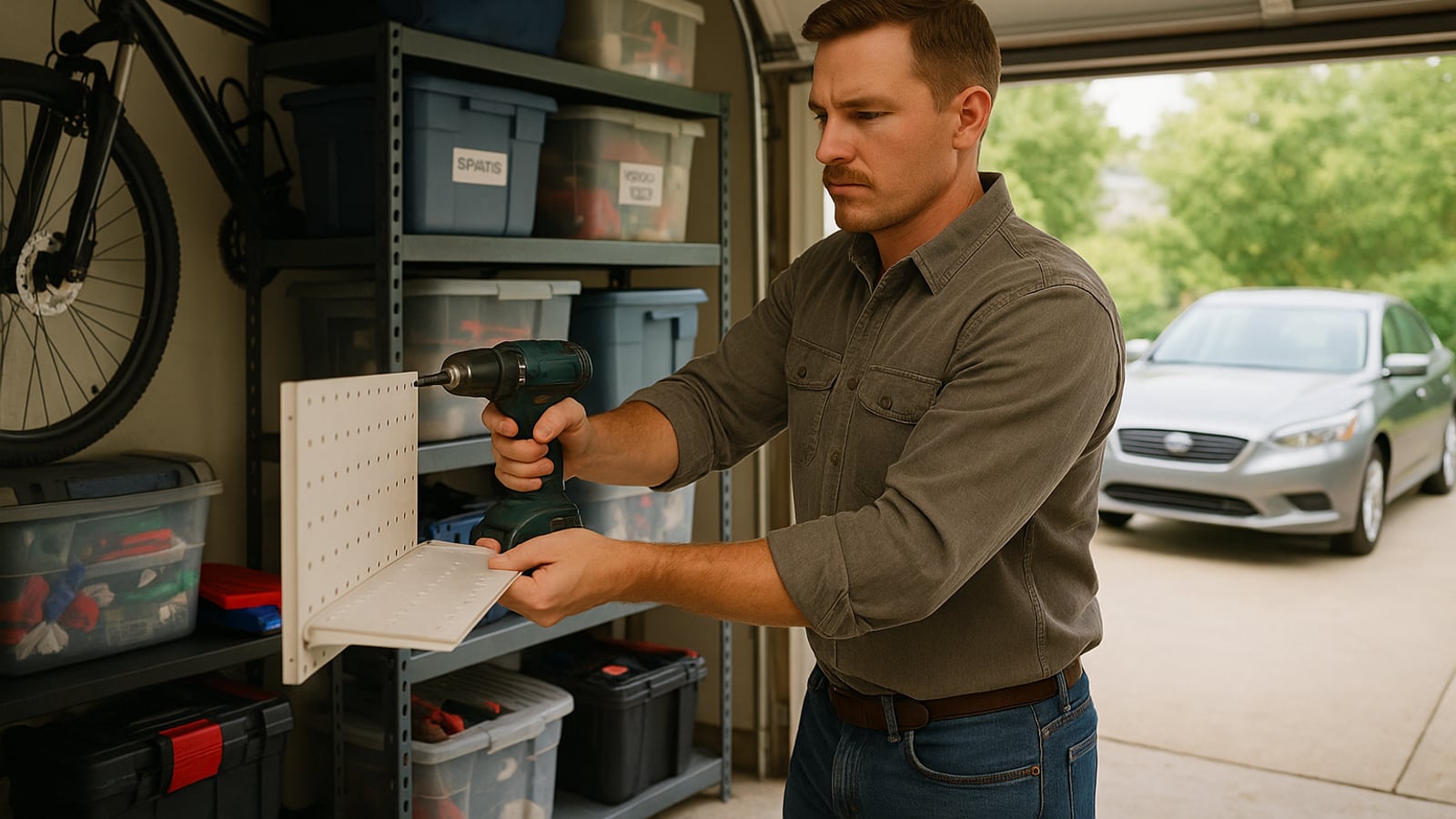
Your garage didn't fill up because it's too small. It filled up because stuff arrives faster than it leaves, and because most of what's in there has never been assigned a place to live. Fix those two things and a two-car garage holds two cars, a workbench and a family's worth of gear without strain.
Start with the second one, because it's the cheaper fix.
Everything needs an address
Walk in and look at the floor. Every single item sitting on concrete is an item that has no home. That's the whole diagnosis. The bag of fertiliser, the folded camp chairs, the box of cables, the paint cans, the bike with the flat tire — none of them have a place, so they live where they were last put down.
Give each one a wall, a shelf, a hook or an exit. Nothing else. If you can't name where something goes in under three seconds, it goes in the exit pile.
The rule that keeps the floor clear afterwards is simple and slightly annoying: nothing lives on the floor except vehicles, the rubbish bins, and anything too heavy to lift alone. A table saw on a mobile base qualifies. A cooler doesn't. A cardboard box never does, because cardboard on concrete wicks moisture, attracts insects, and quietly becomes permanent.
Decide the zones before you buy a single bin
The most common mistake is driving to the store first. You come home with plastic totes and a shelving unit, and you've now stored the problem rather than solved it.
Sketch the space instead. Mark where the car doors swing open, because that band of floor is dead space you can't shelve. Mark the path from the car to the house door, because groceries travel it. Then block out zones:
- Vehicle bays. Walls behind them take flat storage only — rakes, brooms, hoses on reels.
- Work zone. Bench, tools, power, light. Put it where you can stand back from a project.
- Wet and dirty. Lawn gear, fuel, fertiliser, salt. Nearest the big door.
- Active family gear. Bikes, balls, helmets, the wagon. Near the pedestrian door, at a height kids can reach, or they won't put anything back.
- Deep storage. Seasonal decorations, camping gear used twice a year. Overhead or highest shelf.
Buy containers only once you know what goes where and how much of it there's.
Walls, then ceiling, then cabinets
Floor-standing shelves eat the thing you're short of. Work upward in that order.
Walls carry the most per dollar. A French cleat rail — a strip of plywood cut at 45 degrees, screwed into studs — will hold hooks, brackets and shelf boxes you can rearrange in seconds. Pegboard is fine for light hand tools and terrible for anything with mass. Screw any wall system into studs, not drywall anchors, and treat that as non-negotiable once you're hanging a bicycle or a ladder.
The ceiling is where people get hurt. Overhead racks are excellent for light, bulky, rarely used items. They're a genuine hazard when overloaded, and the load rating printed on the box assumes correct installation into structural members. Two things to understand before you drill:
Roof trusses aren't designed to store your possessions. An engineered truss is sized for the roof and the ceiling, not for four hundred pounds of holiday bins hanging from the bottom chord. Traditional stick-framed ceiling joists usually have more margin, but not always. If you can't tell which you have, or the span is long, ask a licensed contractor or a structural engineer before you load it. That's a short phone call versus a sagging ceiling.
Nothing heavy goes overhead. Sleeping bags, luggage, seasonal decorations, yes. Tile, paint, tools, anything you'd hate to catch with your head, no.
Enclosed cabinets come last, and they're worth it for exactly two things: chemicals you want out of children's reach, and fine tools you want out of dust.
The exit matters more than the storage
A garage is a one-way valve unless you build a way out. Four exits, and you should know which one every unwanted item is taking before you touch it.
Donate. Sell. Landfill. Household hazardous waste.
That last one traps people, so they keep the item instead. Old gas, paint, solvents, pesticides, car batteries and lithium batteries don't go in the household bin and absolutely don't go down a drain. Most counties run a hazardous waste drop-off, often on set weekends. Look up the next date, put it in your calendar, and stage everything in one milk crate labelled for that trip.
Set a standing rule for the future too. When something enters the garage without a home, it gets thirty days on a marked square of floor. If nobody's used it or found it a place by then, it leaves. Write the date on the box with a marker. Sentiment fades fast when there's a date on it.
Safety items worth doing this month
A garage collects the most flammable things you own and the least attention.
- Fuel goes in approved, sealed containers only, never milk jugs, and codes cap both container size and total quantity. Check your local limit. Store away from ignition sources.
- Propane tanks stay outside. Not in the garage, not "just for winter". Outside, upright, shaded.
- Gas water heaters and furnaces in garages generally need their ignition source elevated off the slab, and need clear space around them. Don't stack storage against one, and don't box one in with new shelving.
- Extension cords are temporary. If a cord has powered your freezer for two years, you need an outlet, and that means a licensed electrician. Garage receptacles typically need GFCI protection, and adding a circuit properly means a permit in most places.
- Fire extinguisher on the wall by the door you use, not buried behind the mower. Check the gauge.
- The garage door is the heaviest moving object in the house. Springs are under enormous tension and aren't a homeowner repair. Cables, springs and drum adjustments are a service call. Testing the auto-reverse with a board on the floor, oiling rollers, and tightening the door's hardware are yours.
Twenty minutes a week keeps it
The reset is the whole game. Pick a day — Saturday morning works because the bins go out anyway — and spend twenty minutes putting the week's arrivals back where they live, sweeping, and moving one thing to the exit pile.
Do a real purge once a year, in autumn, before things go indoors for winter. Pull everything off one wall at a time rather than emptying the whole garage, because a half-finished whole-garage purge is how a garage ends up worse than it started.
Bring the family in for the reset, not the purge. Kids are useless at deciding what to keep and very good at putting bikes on hooks they can reach. Which is the real test of the hook height, and of the system generally.
A garage you can park in on a rainy Tuesday, walk through with both arms full, and find a screwdriver in within ten seconds is a garage doing its job. Everything else is a storage unit with a door you own.
Wes Dunbar
Country & Skills
Grew up on an acreage and never quite left. Covers trucks, trades, land, and how to do the thing yourself.

Watch
Worth an hour of your evening
More from Home.
From channels we rate. Plays on YouTube.
Read next