Hang a shelf straight on the first try, no help needed
Most crooked shelves come from trusting a tape measure over a level. Fix that one habit and the rest is easy.
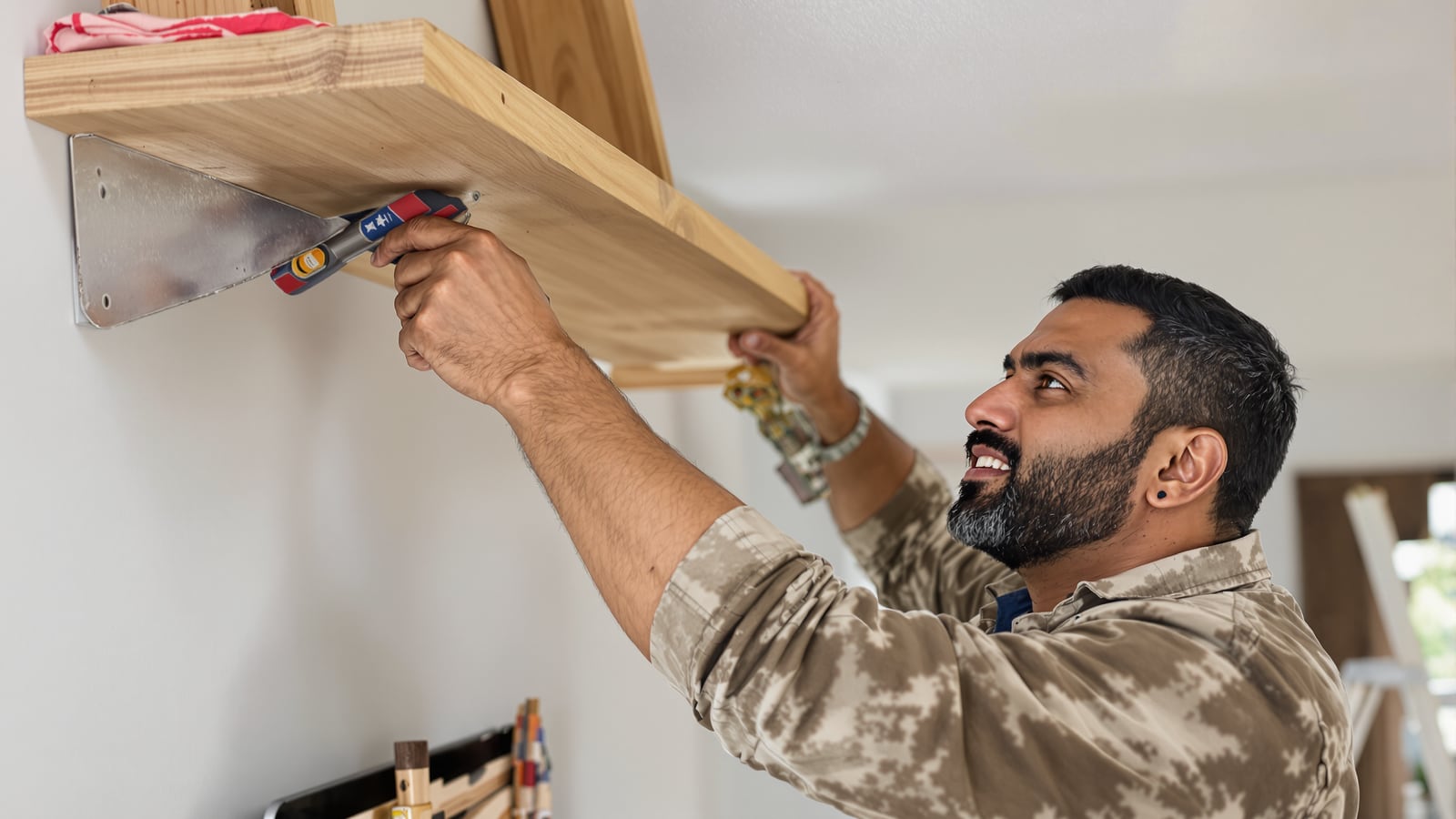
Quick answer: Mark your holes with the level sitting on the bracket itself, not with measurements from the floor. Drill into a stud when you can. Leave the first screws loose, check the bubble once more, then snug everything down.
Floors lie. So do ceilings. In plenty of houses the floor drops half an inch across a single room, and if you measure 48 inches up from it at both ends of your shelf, you've just copied that slope onto your wall. The shelf will look drunk, and you'll be the only guy who knows why.
The level doesn't care about the floor. It only cares about gravity. That's why it's the boss of this whole job.
What you need
- A drill and a bit slightly smaller than your screws
- A level, 24 inches if you can get one (a phone app works in a pinch, but a real one is cheap and doesn't drift)
- A pencil and a tape measure
- Painter's tape
- A stud finder, or at least a steady knuckle
- Safety glasses
- The screws and anchors that came with the shelf, plus a look at whether they're any good
That last one matters. The little plastic anchors in the bag are often the weakest part of the whole setup. More on that below.
Tape it up before you drill anything
Cut four strips of painter's tape and make the outline of the shelf on the wall. Step back across the room. Look at it from the doorway, where you'll actually see it most.
Too high? Too low? Crowding a window frame or light switch? Fixing it now costs you a strip of tape. Fixing it later costs you a patched wall and an awkward conversation.
Here's the annoying part. If the shelf sits close to a ceiling or a doorframe, your eye will compare it to those lines instead of to the true horizontal. A perfectly level shelf can look crooked next to a ceiling that isn't. Check it from across the room, and if it truly bothers you, split the difference by a hair. Level is still the default. Just know why you might cheat.
Find the studs
Behind most interior walls are wooden studs, usually spaced 16 inches apart center to center. Drywall alone won't hold much. Studs will.
Run the stud finder across the wall and mark both edges of each stud with pencil, then find the middle. Screws go in the middle.
Before you drill, think about what else lives in that wall. Outlets and switches mean wires, and wires usually run straight up and down from them, so stay off that line. Bathroom and kitchen walls can hide water pipes. If you're not sure what's behind a spot, ask a parent where the pipes and wiring run, or pick another wall. That's not calling for help. That's checking the map.
Put on your glasses. Drywall dust in the eye ruins an afternoon.
Mark it with the bracket in place
This is the trick that makes the whole job work.
Hold the first bracket (or the mounting rail, if your shelf has one) against the wall where the tape says it should go. Lay the level on top of it. Move the bracket until the bubble sits dead center between the lines. Then mark the screw holes right through the bracket with your pencil.
Don't mark a height and hope the holes line up. Mark through the holes while the bubble is centered.
For a shelf with two brackets, set the first one and drive its screws. Then lay the level so it rests on that first bracket and stretches out to where the second one goes. Slide the far end until the bubble centers, and mark the second bracket's height along the level's edge. Now both are tied to the same true line, no matter what the floor is doing.
Drill smart
Pilot holes first. A hole slightly smaller than the screw lets it bite instead of splitting the wood or chewing up the drywall.
Wrap a flag of painter's tape around the bit at the depth you want, so you know when to stop. Hold a folded sticky note just under the spot, or have a vacuum hose nearby, and the dust never hits the floor.
If a hole lands a quarter inch off, don't panic. A dab of spackle, a swipe with a putty knife, a light sanding, and a touch of paint, and nobody will ever know. Own the mistake, fix it, and move on.
When there's no stud
Sometimes the spot you want is just hollow wall. Then the anchor does the work.
Plastic expansion anchors are fine for a picture frame or a light shelf with a couple of small things on it. For anything heavier, step up to toggle bolts, which spread the load behind the drywall. Read the weight rating on the box, then cut it in half. That number assumes perfect drywall and perfect installation, and your wall is neither.
And books are heavy. A row of hardcovers weighs far more than it looks like it should. If it's going to hold books, tools, or a stack of game cases, find a stud or use real toggles.
Snug, check, then tighten
Drive the first screws until they're almost tight, with the bracket still able to shift a hair. Put the level back on. Bubble centered? Tighten down. Bubble off? Nudge and recheck.
Don't crank screws until the drill whines. Overtightening strips the hole, and a stripped hole holds nothing. Stop when the bracket is firm and flush.
Set the shelf on, then push down hard with your hand before anything goes on it. If it flexes or creaks, fix it now. Load the heaviest stuff low and close to the wall, the lightest at the outer edge.
Leave it better than you found it
Vacuum the dust. Wipe the wall. Put the drill back where you found it, with the battery charged, and the bit holder tidy. If you borrowed it from your dad's bench, return it cleaner than it left. That's the old code, and it's why he'll say yes next time.
Speaking of which, that's really what this job builds. Doing it yourself isn't about proving you never need anybody. It's about showing up to the question with the work already done. Someone who can hang a shelf in an hour is someone people hand bigger jobs to later. If that idea interests you, reliability is built in the house you already live in, and reliable men are built at fifteen, not at thirty.
Ask your dad for advice if you want it. Just let the shelf do the talking when he walks in and sees it dead level.
Cal Brennan
Fitness
Strength coach. Trains fathers, tradesmen and desk workers, which means programs that survive a bad week.

Read next