
Your $2,400 repair quote versus a $634 car payment
The shop hands you a number and your stomach drops. Before you trade up, run the arithmetic on both cars. It's closer than the showroom wants you to think.
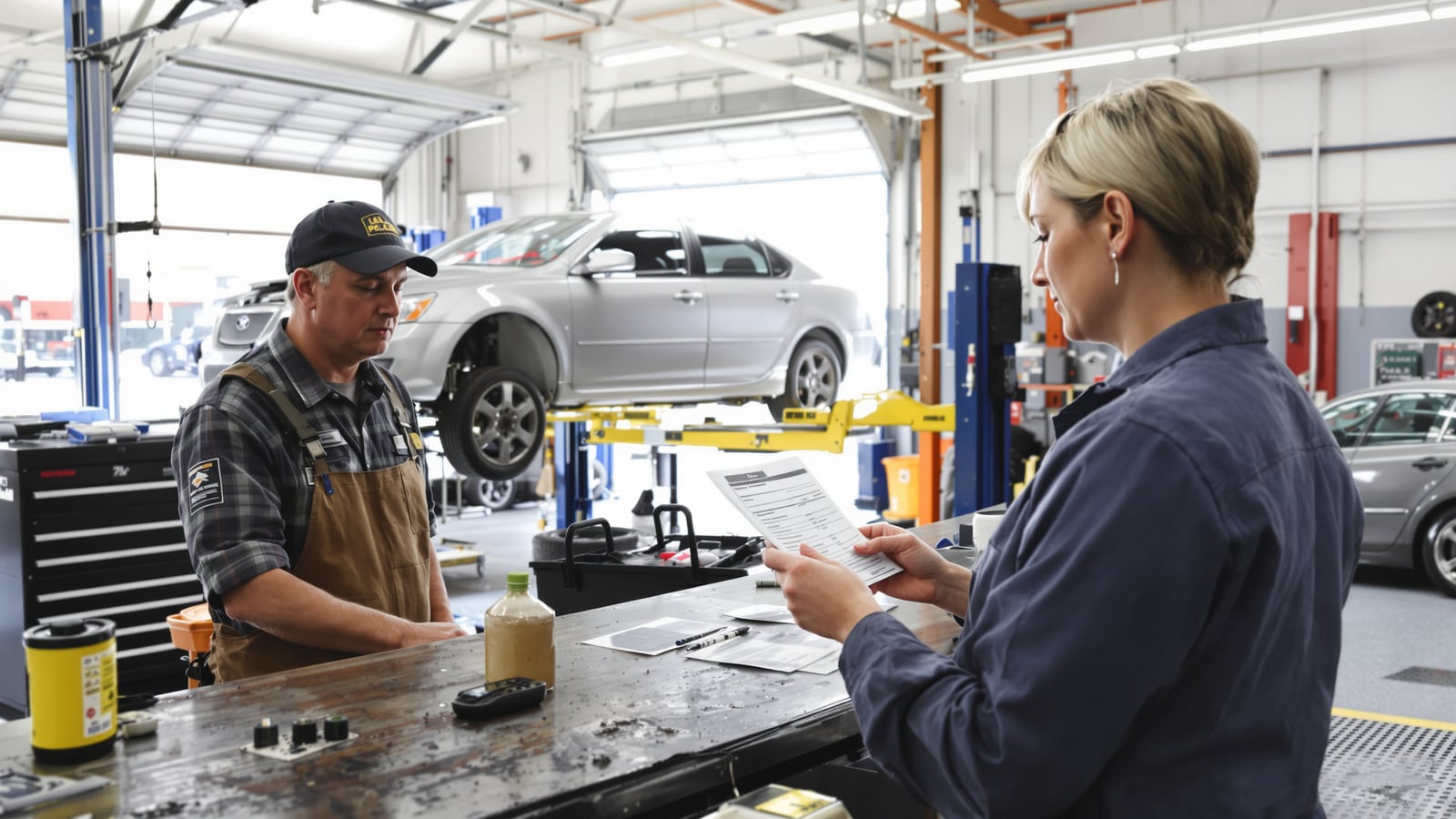
Quick answer: Compare the yearly cost of owning each car, not the monthly payment against zero. In the example below, the old car wins until repairs pass about $3,900 a year. Swap in your own numbers and you'll know in ten minutes.
This is general education, not individual financial advice. The numbers below are made-up examples to show the method, not market data.
The quote
You're standing at the counter. The service writer says $2,400 for the transmission work, or the axle, or whatever it is this time. Your car is twelve years old and worth maybe $6,000.
The instinct is to hear "$2,400 gone" and start browsing listings on your phone. That instinct has a price tag too. It just doesn't arrive in one painful lump, so it doesn't feel like money.
Let's put them side by side.
The new car, honestly priced
Say you trade up to a $32,000 vehicle. Nothing down, 60-month loan at 7 percent. The payment comes to about $634 a month. Over five years you'll pay roughly $38,000 for a $32,000 car, so about $6,000 of that's interest.
That's the cash view. Now the ownership view, which is fairer to the new car, because at the end you still own something.
Assume the new vehicle is worth $18,000 after five years. That's an assumption, and you should check real resale values for the model you're looking at. Then your five-year cost is:
- Depreciation: $14,000
- Loan interest: about $6,000
- Sales tax at 6 percent (yours will differ): $1,920
That's about $21,900, or roughly $4,400 a year. And that's before the insurance bump. Get a quote on both cars from your agent. The newer one usually costs more to cover, and a lender will require full coverage for as long as you owe.
The old car, honestly priced
Same method. The old car is worth $6,000 today. Assume $3,500 in five years. That's $2,500 of depreciation, or $500 a year.
Now add repairs. Take the $2,400 quote and pretend it's the average for every year. That's generous to the new car, because you won't get a $2,400 bill every year. But run it anyway:
$500 + $2,400 = $2,900 a year.
The gap is $1,500 a year in the old car's favor, about $125 a month. And that's with a repair bill assumed at its ugliest, every single year.
The number to know
Take the new car's yearly cost, subtract the old car's yearly depreciation. In our example, $4,400 minus $500 is $3,900.
If your old car will eat more than that in repairs, year after year, trading wins on pure cost. Under it, keep driving.
Adjust for the real differences. If the new car gets noticeably better mileage, subtract your yearly fuel savings from its cost. If insurance runs $50 a month higher, add $600. Make the line items honest and the answer gets honest.
Why the "half the car's value" rule is wrong
You've heard it. If the repair costs more than half of what the car is worth, walk away.
It sounds disciplined. It ignores the alternative. A $3,000 fix on a $2,500 car feels absurd. But if the replacement runs $6,000 to $7,600 a year, you can buy a lot of $3,000 fixes before the arithmetic turns.
The car's resale value tells you what you'd get if you sold it. It tells you nothing about what it costs to keep running. Those are different questions.
When the old car should go
Run the math, then check what the math can't see.
- Safety. If the brakes, steering or structure are failing and your family rides in it, that settles it. No spreadsheet outranks your kids' car seats.
- A pattern, not a bill. One big repair that fixes a known problem is a different animal from the third unrelated failure in eight months. Ask the mechanic directly: is this the end of the list, or the start of one? Get a second quote on anything over $1,000.
- Your work depends on it. If a dead car costs you a shift or a job site day, price in the lost pay. That cost is real, and it can tip the math.
- The family outgrew it. A third child and a two-door coupe is a fact, not a feeling.
None of that is "the new car feels nicer." Nice is allowed. Just don't call it arithmetic.
The move that beats both
Keep the old car and act like you have the payment anyway. Send $300 a month to a separate account. Over 60 months that's $18,000, before a dime of interest.
Now your next car is a cash purchase. No interest, no lender, no full-coverage requirement, and nobody holding the title but you. You've turned $6,000 of interest into $6,000 of buying power. That's the old way, and it still works.
Your repair costs come out of that same account first. The first call on it's the shop. What's left builds toward the next car. And keep your real emergency fund separate, so a $2,400 quote is an inconvenience and not a crisis.
If you still owe on the old car, sort that first. The order matters, and paying off debt in the order the arithmetic says lays it out. And if you're looking at a monthly payment as the whole price of a new vehicle, read the car payment isn't the price before you sign.
If you do trade
Do it clean. Sell the old car privately if you have the patience, since you'll usually get more than a trade-in offer. Wash it inside and out. Fill the tank. Hand over every service record you've saved in the glovebox. Whoever buys it should find it better than they expected.
And when the new one comes home, keep it long enough to outrun its worst years. The expensive part of a car is the first five. After that, you're finally getting paid back.
Ten minutes, right now
- Write down the repair quote and what you expect to spend yearly after it.
- Price the replacement: loan interest, sales tax, insurance quote, and a realistic five-year resale value.
- Subtract each car's depreciation from its total cost.
- Find your break-even repair number.
- Ask the mechanic whether this is the last big fix or the first.
Then decide with a pencil, not a showroom. For your own situation, a fee-only financial planner or a credit union counselor can run your actual numbers.
Ray Okonkwo
Money & Business
Former commercial banker turned small-business owner. Covers salary, credit, margins and the arithmetic nobody does before signing.

Watch
Watch how it's done
Picked for this article.
From channels we rate. Plays on YouTube.
The Ramsey Show Highlights
Keep Making Car Repairs or Just Buy a New One?
Money For the Rest of Us
Should You Fix Your Old Car or Buy a New One? (The $8,000 Subaru Outback Repair)