The Saturday my grandfather walked the whole place with a notepad
Once a year he looked at everything he owned before it broke. The habit fits in one Saturday, and a twenty-five-year-old can start it this month.
Quick answer: Pick one Saturday a year. Walk your home, your car and your paperwork with a notepad. Fix nothing until the walk is done. Then work the list from the cheapest fix to the most expensive. You're hunting small problems while they're still small.
The first Saturday of October
My grandfather called it "the inspection." He said it like a man announcing a court date. Every year, the first Saturday of October, before the cold came, he'd put a pencil behind his ear, tuck a spiral notebook in his back pocket and walk the property from the mailbox to the back fence.
He didn't carry a toolbox. That was the rule that confused me as a kid. A man with a notepad and no wrench, staring at a gutter for two full minutes, looked like he was doing nothing.
He was doing the cheapest work of the year. "Looking is free," he'd say. "Fixing is where they get you."
His reasoning was simple. If you grab the wrench the moment you spot a loose bracket, you'll lose the morning to that bracket and never see the rotted board behind it. So you look first, write everything down and sort it afterward. By noon he knew what the house needed. By supper he knew what it would cost. Nothing surprised him in February.
What he looked at, in the order he walked
You don't need his acreage. An apartment and a used sedan will do. The order is what matters: outside in, top to bottom, then the machines, then the paper.
Where water gets in. Water is the most expensive thing that happens to a building, and it's patient. He checked the gutters for sagging and for sprouting weeds. He checked the downspouts to see whether they dumped water at the foundation or away from it. He eyeballed the roof from the ground for lifted or missing shingles. He pressed a screwdriver tip into window sills and the bottom of door frames. Soft wood means water has already been there.
Renters, this is your section too. You can't fix the roof. You can find the brown ring on the ceiling, photograph it and send your landlord a dated message. Put it in writing. A verbal complaint is gone by spring.
The things that can hurt you. Test every smoke detector. Press the button and listen. Write the date on a strip of tape inside the cover. Same for any carbon monoxide detector. Look at the fire extinguisher gauge and make sure the needle sits in the green. Pull the dryer away from the wall and clear the lint from the hose and the vent. He said a dryer fire starts the same way every time, with someone who figured it was probably fine.
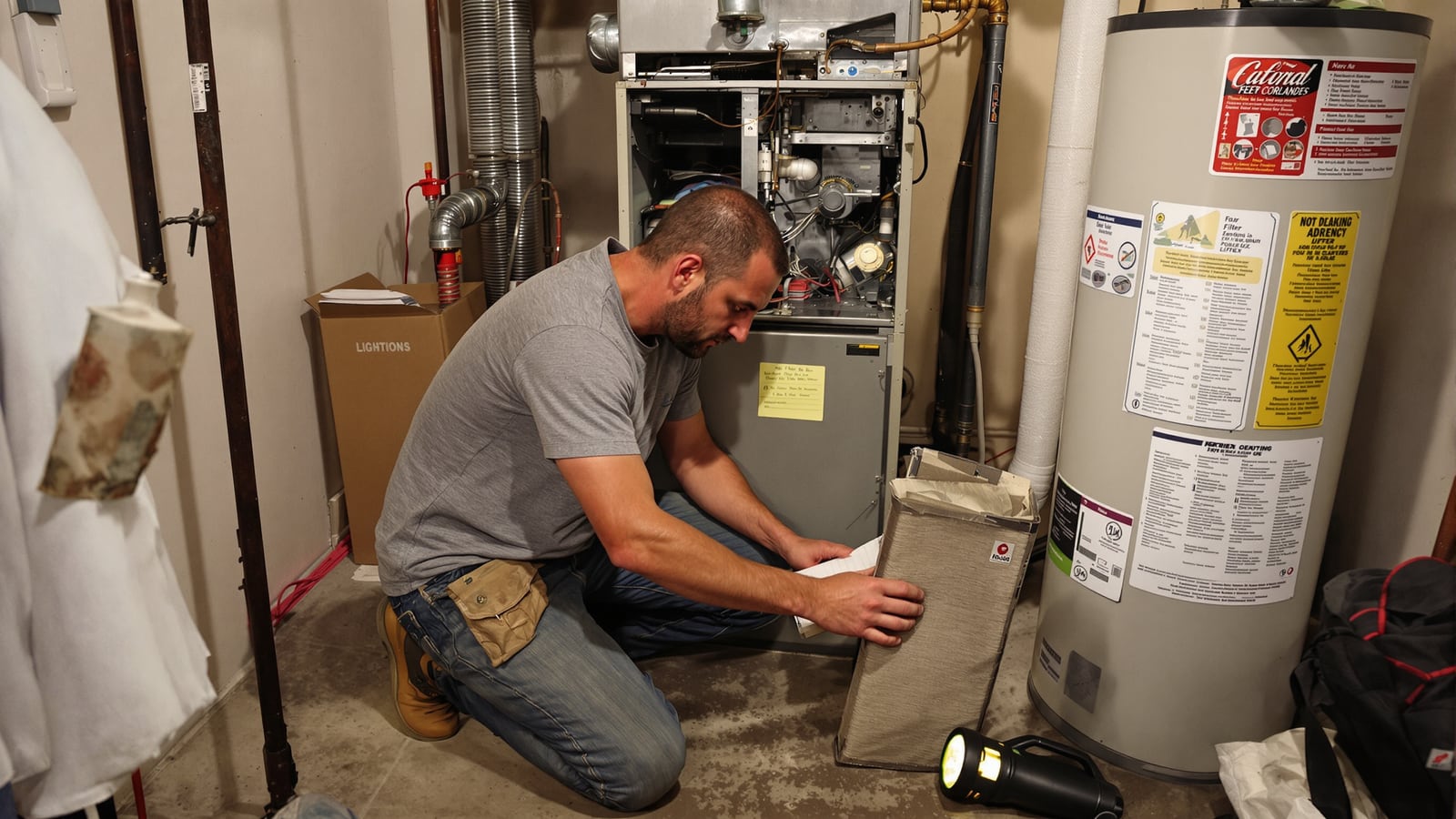
The quiet machines. Furnace filter: change it, and write the size on the notebook page so you stop guessing at the store. Water heater: look at the base for rust or a damp spot. Under every sink: run your hand along the pipes and the shutoff valves. Wet fingers mean a slow leak. A slow leak becomes a ruined cabinet floor long before it becomes a flood.
Then find your main water shutoff. Know where it is, and turn it once to make sure it moves. A valve you've never touched is a valve that might not turn the day you need it. Same with the breaker panel. Check that the labels are right while the lights are on and nobody's panicking.
The car gets its own hour
He treated the truck like a hired hand: feed it, check its work, and listen when it complains.
He'd check the oil level and color, the coolant, the washer fluid and the brake fluid. He'd run his thumb along the belts looking for cracks or shine. Then the tires. He pushed a penny into the tread with Lincoln's head down. If he could see the top of Lincoln's head, the tires were done. He checked the pressure against the number on the driver's door sticker, not the number printed on the tire sidewall. He checked the spare, too, because a flat spare is a joke only the highway finds funny.
He'd also sit in the driver's seat and test every light while my cousin and I walked around the truck calling out which ones worked. That was our job, and we took it seriously, partly because he paid in pie.
If you want a modern version, it's an oil dipstick, a tire gauge that costs a few dollars and your phone's flashlight. That's most of it. If you're buying a used vehicle, the same walk-around catches half of what you'd regret. We've covered that in more detail in the used-truck guide.
The tools and the toolbox
Last on the outdoor walk was the shed. He wiped down every tool that had rust blooming on it and rubbed a little oil on the metal. He sharpened the shovel and the mower blade. Anything he'd borrowed went back to its owner, cleaner than it came and usually with something extra on top, a jar of pickles or a bag of tomatoes. Anything he'd lent out and never gotten back went on the list too. He'd ask for it, politely, in person.
That's the same habit my grandmother ran in the kitchen, and it's worth reading about if you want the whole philosophy in one place: Waste Nothing, Feed Everyone, Clean As You Go.
The paper inspection
This was my favorite part as a kid, because he did it at the kitchen table with coffee.
He pulled the insurance policies and read the renewal dates. He pulled the folder with the warranties and the receipts for anything big. He looked at the checkbook register and the monthly bills, and asked whether every one of them still earned its keep. Anything he'd quit using, he cancelled that day. He wrote down what he'd paid for the year's repairs, so he'd know what the house cost to keep.
None of that is advice for your particular situation. The point is the habit. For specifics on coverage, taxes or investing, ask a licensed agent, a tax preparer or an adviser. But the habit of looking once a year at what you pay for and why is free. If you want the bigger picture on how he thought about cash, the old cash rule, tested against a modern paycheck picks up right where this leaves off.
Then, and only then, you fix things
Back at the table, he'd sort the list into three piles by underlining. One line meant "this week." Two lines meant "before winter." Three lines meant "save up for it, and now we know."
Most of the list was small. A tube of caulk. A new filter. A downspout extension. A loose step he'd have tripped over eventually. The expensive items were few, but he saw them eight months early, which gave him time to save, shop around and say no to the first guy who quoted a price.
That was the whole trick. He didn't spend less money because he was cheap. He spent less because nothing ever showed up as an emergency.
Your Saturday
Put it on the calendar now. Pick a date that sticks: the first Saturday of October, the weekend after the clocks change, whatever you won't forget. Buy a notebook that stays in the kitchen drawer so you can flip back and compare year over year. Keep the pencil on a string if you have to.
And bring a helper if you can. My cousin and I learned the whole house on those Saturdays, without ever being lectured. We just got handed a flashlight and a job.
He's gone now, and the house has had two owners since. I'd bet money the gutters are sagging.
Nina Castellan
BRO for Her
Runs the women-facing desk. Same standard, same tools, written for a different reader — not a softer one.

Watch
Worth an hour of your evening
More from Old School.
From channels we rate. Plays on YouTube.
Read next