Your First Family Camping Trip Should Be One Night
Pick a site 45 minutes from home, bring more socks than you think, and decide in advance what makes you drive home.
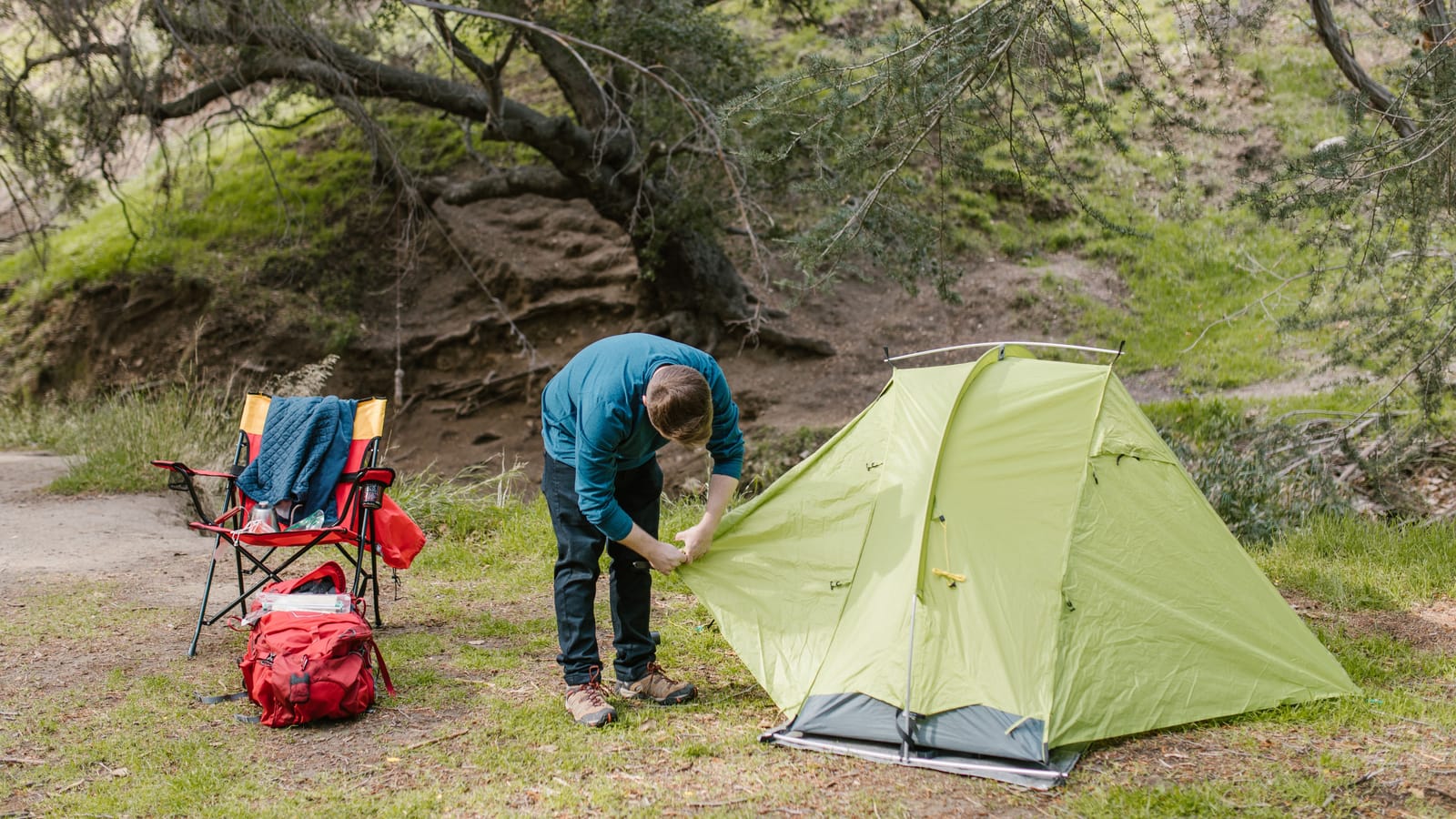
Book one night. Forty-five minutes from your driveway. A state park with flush toilets and a site you can park a car next to.
That single decision fixes about eighty percent of what goes wrong on a family's first camping trip. You're not testing your wilderness credentials. You're testing whether your four-year-old sleeps in a tent, whether your wife thinks this was a good idea, and whether you actually packed the lighter. Find out close to home, on a Friday night, with a short drive back to your own beds if it falls apart.
The families who quit camping forever usually quit after a three-night trip four hours out, in the rain, with one air mattress that went flat at 2 a.m. Don't be that guy.
Pick the site, not just the park
Most state park systems and Recreation.gov let you see individual sites on a map, often with photos. Use them. A campground isn't one experience, it's forty different ones.
What you want for trip number one: a drive-in site, reasonably level, within sight of the bathhouse but not next to it. Bathroom-adjacent sounds smart until you learn that everyone's flashlight sweeps your tent all night and the door slams until midnight. Two or three sites down the loop is the sweet spot.
Avoid the sites right at the loop entrance, where headlights point directly into your tent door. Avoid the low spot at the bottom of the hill, because that's where the water goes. Shade matters more than you'd think in July and costs you nothing in October.
Call the park office and ask two questions: is there cell service at the campground, and where's the closest hospital or urgent care. The ranger answers that one all day long and won't think it's strange.
The gear that decides whether anyone sleeps
Sleep is the whole ballgame. Every other piece of gear is optional by comparison.
Buy the tent one size up from the number on the box. A "four-person" tent means four adults lying shoulder to shoulder with no gear. A family of four wants a six-person tent. A Coleman Sundome in a six-person size runs well under a hundred bucks and will cover a dozen trips before you know whether you want something better.
Pads beat air mattresses. A big queen air mattress feels luxurious in the store and turns into a cold slab at 40 degrees, because all that air under you carries heat away. Closed-cell foam pads cost around twenty dollars each, never puncture, and can be thrown at a kid without consequence. Self-inflating pads are a step up in comfort and a step down in reliability.
Read the second number on the sleeping bag. A bag rated to 20 degrees is usually rated for survival at 20, not comfort. The comfort rating is the one you care about, and it's often fifteen degrees warmer. For a summer trip in most of the country, a 30-degree bag plus a fleece blanket from the closet is plenty.
Wool or synthetic socks, and two pairs per person per night. Cotton socks soak up dew and body moisture and stay wet. Cold feet wake kids up.
Then the small stuff that people forget and regret: a headlamp for every single person, including the six-year-old. A 5-gallon water jug with a spigot. A cheap 10x12 tarp and fifty feet of paracord to rig over the picnic table. A roll of paper towels. A lighter and a backup lighter, because the first one always lives in the pocket of the jacket you left home.
Cook one real meal, not five
Ambition kills camp kitchens. Plan exactly one meal you actually cook, and make everything else assembly.
Dinner is the cooked one. Foil packets are the easiest win in outdoor cooking: sliced potatoes, onion, sausage, a pat of butter, salt and pepper, double-wrapped in heavy-duty foil, set on coals for about 25 minutes. Kids can build their own. Nobody washes a pan.
Breakfast is instant oatmeal and a percolator or a kettle. Lunch on the way home is a gas station sandwich, and that's fine.
Do the chopping at home. Every onion you dice on your own kitchen counter is an onion you're not chasing across a picnic table in the dark. Freeze whatever you can, so it doubles as ice in the cooler.
One hard rule with no exceptions: no stove, lantern, grill or coals inside the tent. Not to warm it up, not to dry it out, not for one minute. Carbon monoxide has no smell and it has killed campers who were just trying to knock the chill off.
Firewood stays local
Buy your wood at the park or from a vendor within a few miles. Hauling firewood from home moves emerald ash borer, spotted lanternfly and a handful of other pests into forests that don't have them yet, which is why most state agencies now ask you not to do it. It's a rule with an obvious reason behind it, and it's worth explaining to your kids while you stack the wood.
Start the fire before dusk, not after. Keep a full bucket of water on the ground next to the ring the entire time. When you're done, pour it on, stir the ashes with a stick, and pour again until you can hold your hand a few inches above the ashes.
Give every kid a job
A bored kid at a campsite finds the fire ring. A kid with a job finds out he likes camping.
Youngest one gathers small sticks for kindling and keeps the pile stocked. Middle kid hauls water and hands out headlamps. Oldest helps set the tent poles and is responsible for the trash bag hanging off the tree. Assign the jobs in the driveway before you leave, not at the site.
The thing that makes the night stick in their memory isn't the gear anyway. It's an hour with no screens, a fire going down to coals, and somebody's dad telling a story or reading out loud. Camp is one of the few places left where a family sits in a circle and looks at each other. Say grace over the foil packets. It lands differently outside.
Decide your bailout before you leave
Write down, out loud, in front of everyone, what sends you home. Sustained rain past a certain hour. A forecast low below your gear's comfort range. A kid running a fever. Anything that makes your wife say she's done.
Then look up one motel within thirty minutes of the campground and put the number in your phone. You're not going to use it. You will feel enormously better knowing it's there, and that feeling is what lets you relax enough to enjoy the evening.
Leaving early isn't failure. Turning one miserable night into a family story about how Dad wouldn't quit is how you never get to go camping again.
Leave it cleaner than the last guy
Pack out everything, and then walk the site with a headlamp looking low for the microtrash: bottle caps, twist ties, wrapper corners, bits of foil that survived the fire. That stuff is what makes a campsite look used.
Wash dishes at least 200 feet from any lake or stream, strain the food bits into your trash bag, and scatter the gray water. Keep tents and chairs on the pad instead of spreading onto the vegetation at the edges. Food and toothpaste go in the car or the bear box overnight, never in the tent, and that holds in black bear country and raccoon country alike.
Sunday, when the gear's spread across the garage floor drying out, hand every kid a notepad and ask what should go in the bin next time and what was missing. Write it down. Tape the list inside the tote.
That list is your second trip. And the second trip is the one that makes you a camping family.
Wes Dunbar
Country & Skills
Grew up on an acreage and never quite left. Covers trucks, trades, land, and how to do the thing yourself.

Watch
Worth an hour of your evening
More from Outdoors.
From channels we rate. Plays on YouTube.
Read next