
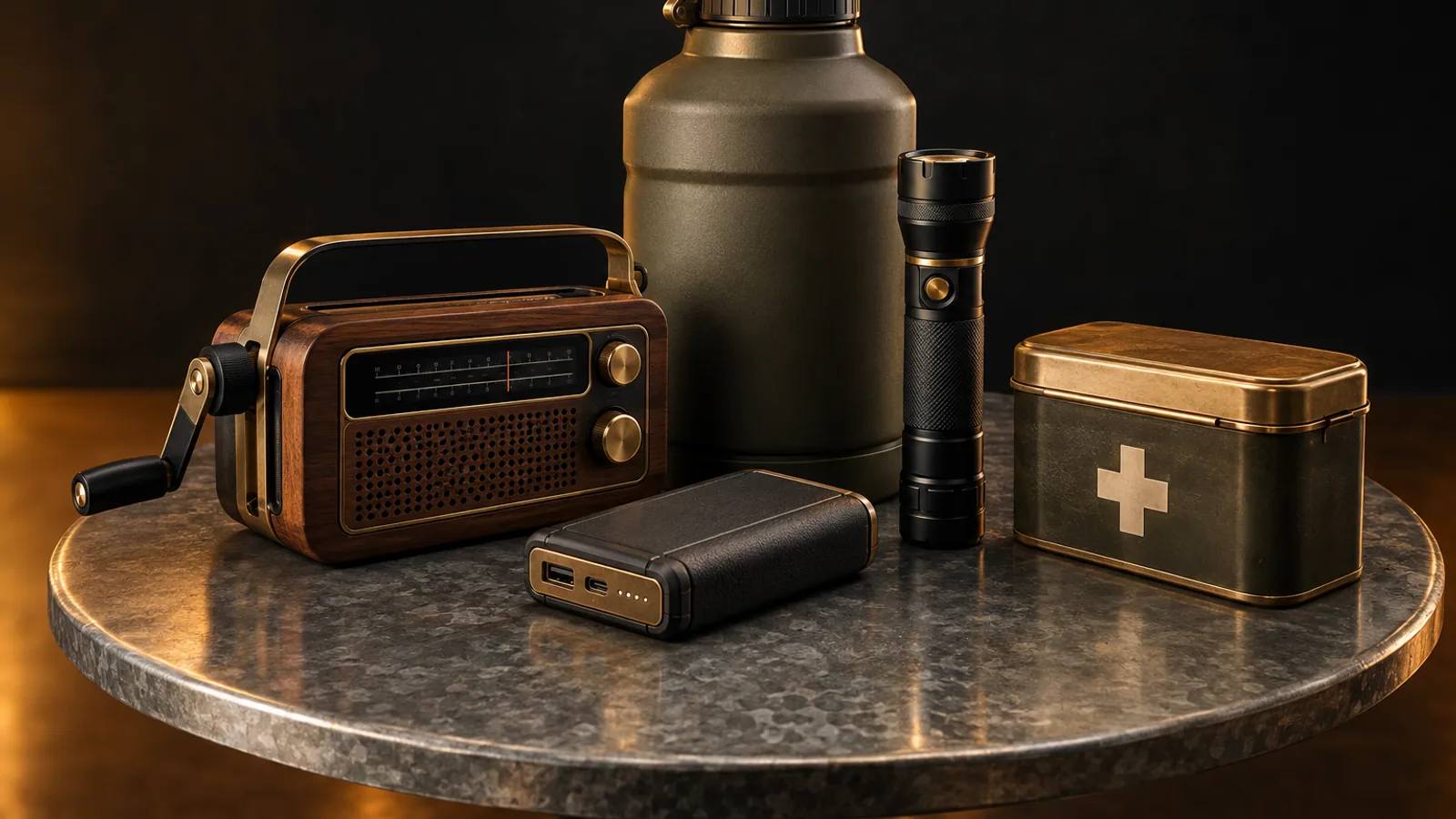
The job
Get your household through the first night of a long outage with everyone warm, fed, safe and speaking to each other. Nothing exotic. Just the part where it's dark, it's quiet, and the clock on the stove has quit.
How the rookie does it
6:42 p.m. The lights go out mid-sentence. I flip the kitchen switch four times. Science demands a retest.
6:45 p.m. I open the refrigerator "to check if it's still cold." It is. I'll check again eleven more times tonight.
6:51 p.m. I search the junk drawer for the flashlight. I find it. The batteries died around a Halloween I can't identify.
7:15 p.m. I light candles. Nine of them, which feels cozy and also like a fire marshal's training video. My wife quietly moves the one next to the curtain. She was right. She's about to be right several more times.
8:00 p.m. The phone is at 31 percent because I've spent ninety minutes refreshing the utility company's map. The restoration estimate keeps saying "assessing." So do I.
9:30 p.m. I tell the kids we're camping. They love it for forty minutes, then ask when camping ends.
10:20 p.m. The power returns all at once. Every light, the TV at full volume, the furnace, the dryer I forgot was loaded. The house sounds like a stadium. Then it all goes dark again.
How the veteran does it
6:42 p.m. The lights go out. He says, "Well." That's the whole reaction.
6:43 p.m. He walks to the hook by the back door and puts on a headlamp. Both hands free. The lantern goes on the kitchen table, the second one in the hallway where a kid will walk at midnight.
6:46 p.m. He slides an appliance thermometer into the fridge, shuts the door, and doesn't open it again until morning. He turns one lamp's switch to ON so he'll know when power returns, and unplugs the big stuff.
6:55 p.m. Phones go on low-power mode. Texts to family, short ones. He writes the utility's outage number on a pad. It's already on the fridge, because the veteran has a pad.
7:30 p.m. He walks next door with a spare lantern and a thermos to check on a neighbor who lives alone.
9:30 p.m. Everybody's in one room with the doors closed and an extra blanket each. He's asleep before the rookie finishes his fourth map refresh. Total effort: fifteen minutes. Total drama: none.
What the veteran knows
- The fridge is a cooler. Keep the lid on. A closed refrigerator holds food safe for about four hours. A full freezer holds about 48 hours with the door shut, about 24 if it's half full. Every peek spends cold you can't buy back. Perishables that sit above 40°F for more than two hours get thrown out. That's USDA and FDA guidance, and the thermometer is how you know.
- A generator never goes in the garage. Not with the door open, not "just for an hour." Carbon monoxide kills quietly. Run it outdoors, well away from the house and every window and door, exhaust pointed away. The rules are laid out in Twenty Feet From the House and Other Generator Rules. Own a battery-powered CO alarm, too. The same goes for a charcoal grill or camp stove: never indoors, for heat or for cooking.
- Use flashlights, not candles. Official guidance says flashlights and battery lanterns. Candles start house fires, and an outage is when you're tired and distracted. A headlamp beats a handheld. Store the batteries in a labeled bag next to it, and swap them when you change your smoke alarm batteries.
- Treat every downed line as live. Stay far back, keep kids and pets back, and call the utility and 911. Don't move one with a stick. Don't drive over one.
- Save the phone for what matters. Turn on low-power mode and dim the screen. Text instead of calling. Keep calls for real emergencies, and keep 911 clear. Charge from a power bank, or from the car parked outdoors, never in a closed garage.
- Leave one lamp on and unplug the big loads. When power surges back, it can damage electronics and appliances. Bring things back one at a time, a few minutes apart. Your furnace and refrigerator will thank you.
- Have a way to hear the news. If the internet is down and the cell tower's overloaded, a battery or hand-crank radio still works. When the Internet Goes Down, the Radio Still Works covers what to buy and how to use it.
- Check on someone, and bring something. The neighbor who's elderly, alone or on a medical device needs to hear a knock more than they need a lantern. Bring the lantern anyway. You'll leave a street better than you found it.
Your first time, done like a veteran
- Put a headlamp on a hook by the door. Check the batteries tonight.
- Put an appliance thermometer in the fridge and another in the freezer.
- Write the utility's outage number on paper and tape it somewhere visible.
- Test your CO alarms and smoke alarms. Replace the batteries if you can't remember the last time.
- Charge a power bank and keep it in the same drawer as the cables.
- Keep a little cash on hand. Card readers don't work in the dark. Your Emergency Fund and the Cash You Can Actually Reach explains how much.
- Pick the one room you'd all sleep in, and know where the extra blankets are.
- Tell the kids it's camping. Then make sure it actually is.
The rookie learns all this at 6:42 p.m. on a Tuesday. The veteran learned it from the same night and set up the hook by the door the next morning.
Sam Ortiz
Dads & Family
Father of three. Writes about presence, discipline and the long game, without pretending any of it's tidy.

Watch
Worth an hour of your evening
More from Preparedness.
From channels we rate. Plays on YouTube.
Read next