
The flood map is a lending tool, not a weather forecast
A zone X label doesn't mean dry. Check the map, ask the right questions, and price the policy before you make an offer.
Quick answer: Look up the address on FEMA's Flood Map Service Center. Then get a flood insurance quote before you write the offer, and count the premium as part of the monthly payment. Your homeowners policy won't pay for flood damage.
What the map actually tells you
Go to msc.fema.gov and type in the address. You'll get a Flood Insurance Rate Map panel and a zone letter.
Zones that start with A or V are Special Flood Hazard Areas. FEMA's line for those is a 1 percent chance of flooding in any given year. People call it the "100-year flood," which makes it sound like something that happens once a century. It isn't. Over a 30-year mortgage, a 1 percent annual chance works out to roughly one in four of seeing at least one flood. That's simple arithmetic, not a forecast, and it's worth sitting with before you sign a 30-year note.
Zone X is the other big category. Shaded X means moderate risk, unshaded X means minimal.
Here's the part that surprises people. The map exists mainly so lenders and insurers know when coverage is mandatory. If the property sits in a Special Flood Hazard Area and your loan comes from a federally regulated or federally backed lender, flood insurance is required. Outside that line, nobody requires it, and a lot of buyers hear "not required" and think "not needed."
Those are different sentences.
What the map misses
Maps are drawn from modeling and surveys at a point in time, and they're revised slowly. A subdivision built upstream, a paved-over field, or a storm drain that was sized for 1985 can change where the water goes long before the paper catches up.
The map also handles some kinds of flooding better than others. Rivers and coastlines are its strength. A heavy downpour that overwhelms local drainage, runs down a hill and pools at your back door is harder to capture. FEMA itself has said that a meaningful share of flood claims come from properties outside the high-risk zones.
A line on a map is also a line. A house 40 feet outside it has the same weather as one 40 feet inside it.
Ask these before you write the offer
Do this work during the earliest stage, when walking away costs you nothing.
- Ask the seller in writing whether the home has ever taken on water, even a little, and whether there's ever been a flood claim. Disclosure rules differ by state, and some states require more than others. Don't count on the form to volunteer it.
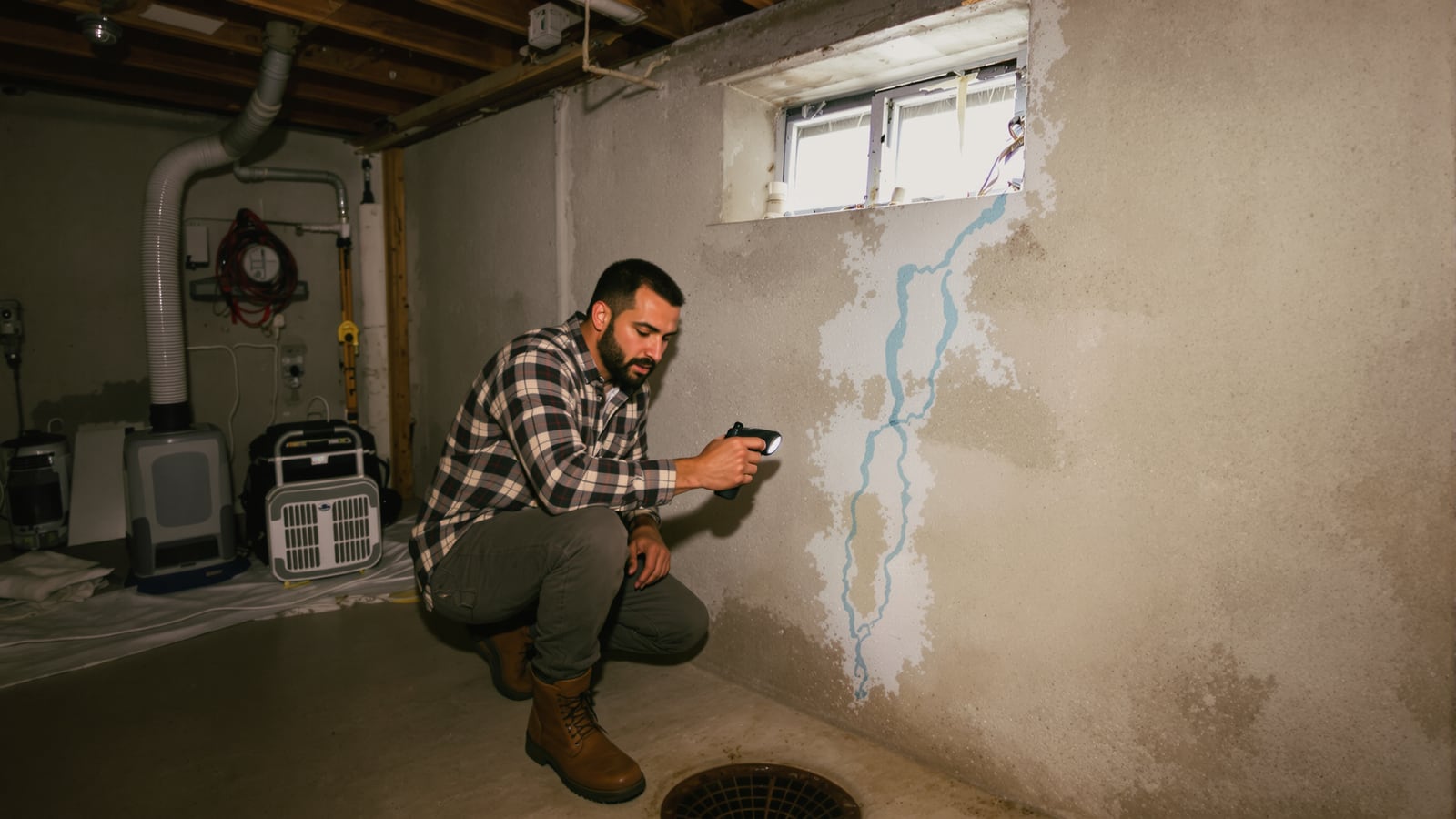
- Look at the property. Water stains on the lower drywall, a sump pump with a dedicated discharge line, fresh paint on only the bottom three feet of a basement wall, and a musty smell in a closed-up garage all tell you something.
- Talk to a neighbor. Five minutes on the sidewalk beats an hour of online research. Ask about the last big rain.
- Call the county floodplain administrator. Most counties and cities have one, usually in the planning or public works office. They know the local history, the drainage projects and the permit rules.
- Check the elevation of the house against the base flood elevation for the area. That's the number the insurance pricing leans on.
Your inspection window is the cheapest exit you'll have. The home inspection is your last cheap exit covers how to use it, and a flood quote belongs in that same window.
The paperwork you'll run into
Standard Flood Hazard Determination Form. Your lender orders this to decide whether the property needs flood insurance. You'll see it in the closing stack.
Elevation Certificate. A licensed surveyor prepares it, and it documents the home's elevation relative to the base flood elevation. If the seller already has one, ask for it. If not, the cost of getting one varies by area, so ask a surveyor for a quote. In some situations it can lower your premium enough to pay for itself.
Letter of Map Amendment. If you believe the property is mapped into a flood zone but actually sits on higher ground, you can apply to FEMA to have it removed. It takes paperwork and a survey, and it isn't guaranteed.
The flood policy itself. Read the declarations page. It lists building coverage, contents coverage and the deductibles.
What it really costs
The cost of flood insurance depends on the property, and that's the point. FEMA's National Flood Insurance Program moved to a pricing system called Risk Rating 2.0, which prices each home on its own risk factors. Elevation, distance to water, flood type and rebuilding cost all play a role. Two houses on the same street can have very different premiums. Private insurers also write flood policies in many states, and their quotes can be higher or lower.
Here's a worked example, with made-up numbers for illustration only. Say you're looking at two similar houses, each with the same loan payment. House A gets a flood quote of $1,200 a year. House B quotes $4,800. That's $100 a month against $400 a month. Your lender will usually collect it in escrow with your taxes and homeowners insurance, so it counts against your debt-to-income ratio. The extra $300 a month is the difference between a comfortable budget and a tight one.
Run your own numbers with real quotes. And remember what the bank will approve you for may be more than the house costs to own.
Check these coverage facts with your agent:
- Limits. NFIP residential policies have caps, currently $250,000 on the building and $100,000 on contents. Check the current figures. A house worth more than that has a gap, and some buyers add private excess coverage.
- Basements. Coverage for finished basements is limited under NFIP. Don't assume your new rec room is covered.
- The waiting period. Most NFIP policies take 30 days to start. A policy bought in connection with a loan closing is generally an exception. Don't wait until the forecast turns ugly. It will be too late.
- Renters. If you rent the house out, your landlord policy covers the structure, not your tenant's belongings. Tenants can buy contents-only flood coverage, and you can tell them so.
If you own land or rent houses
Landowners should know that building in a mapped floodplain usually triggers local permit requirements, and elevation rules can raise construction costs. Call the county before you buy the lot, not after you've drawn the plans.
Landlords should price a flood policy into the numbers from day one. A house that looks fine on paper at $1,600 a month in rent may not clear the bar once insurance goes up. The math your first rental house has to pass shows where to put that line.
Plan like you're the one paying
After a disaster, some help is available. A lot of it comes as a loan you have to repay, and it usually isn't enough to rebuild what you lost. Government aid shouldn't be your plan for the family's biggest asset.
Laws, rates and disclosure rules differ by state and county. This is general education, not insurance, legal or tax advice. Before you buy, talk to a licensed insurance agent who writes flood policies, your lender, and a real estate attorney in your state. A CPA can tell you how the costs fit your taxes.
Get the quote early. It costs nothing, and it could be the cheapest information you collect on the whole house.
Ray Okonkwo
Money & Business
Former commercial banker turned small-business owner. Covers salary, credit, margins and the arithmetic nobody does before signing.

Watch
Worth an hour of your evening
More from Real Estate.
From channels we rate. Plays on YouTube.
Read next