
Mud in, drinking water out: inside a water treatment plant
A river goes in brown and comes out clean in a few hours. The plant does it with gravity, a little chemistry, and sand. The last 50 feet are on you.
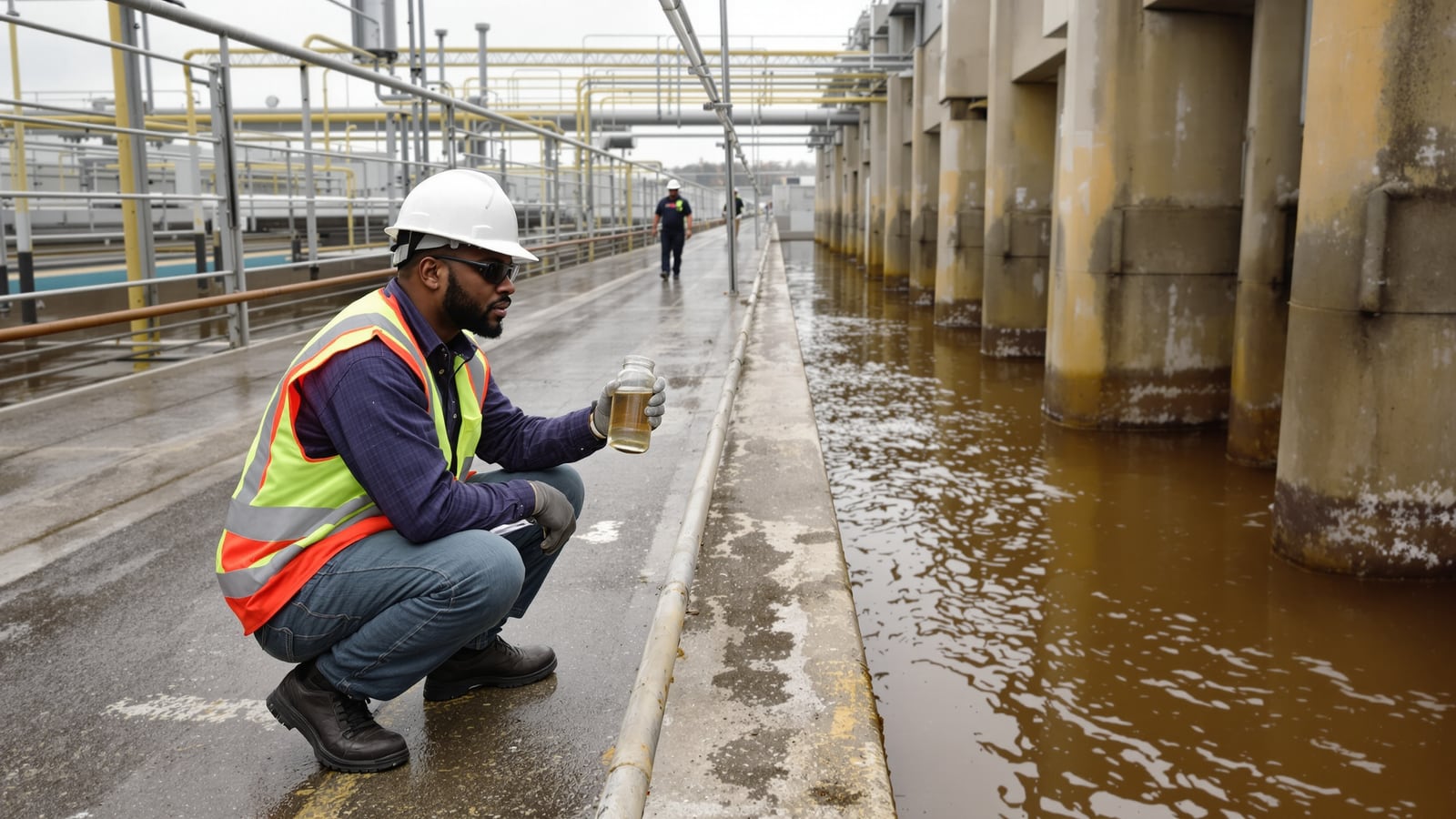
Quick answer: Most city plants clump the dirt together, let it settle, filter what's left through sand, then kill whatever survived with a disinfectant. Most problems start after the plant, in the pipes.
In 1908, Jersey City, New Jersey, started adding chlorine to its drinking water. It was among the first big American cities to do it continuously, and typhoid deaths fell. Cholera and typhoid had been routine killers of city dwellers. Within a few decades they were mostly gone from American life.
Your faucet runs the descendant of that system. It's less glamorous than a rocket and it has saved more lives.
Step one: take out the big stuff
Water comes in from a river, a lake, a reservoir, or a well. Surface water arrives with sticks, leaves, silt, and the occasional fish.
Coarse screens catch the debris first. Then the water heads for the part that surprises people, because nothing in it looks high-tech.
Step two: make the dirt clump
Clay and silt particles are tiny and carry a slight negative charge. They repel each other, so they hang in the water indefinitely. You can let a jar of muddy creek water sit for a week and it'll still be cloudy.
Plants fix this with a coagulant, usually aluminum sulfate (alum) or an iron salt. It neutralizes the charge. The particles stop pushing apart and start sticking together.
Then comes slow stirring. Big paddles turn the water gently for 20 to 30 minutes, which is flocculation. The specks collide and grow into fluffy clumps called floc, about the size of snowflakes. Stir too hard and you shred them. Too soft and they never meet. Operators tune this by eye and by instrument, and it changes with the season, because cold snowmelt water behaves differently than warm summer water.
Step three: let gravity work
The water drifts into a big, quiet basin. Nothing moves for hours. The heavy floc sinks to the bottom as sludge, and clearer water spills off the top.
This is the cheapest step in the plant and it does a huge share of the work. No pumps, no chemicals, just time and a tank.
Step four: the sand
What's left still carries fine particles. So the water trickles down through a filter bed, typically a few feet of sand, often topped with crushed anthracite coal. Particles get trapped in the gaps between grains. Some of the trapping is mechanical and some is sticking, which is why the bed works on things smaller than the gaps.
The standard for filtered water is strict. Under federal rules for conventional plants, at least 95 percent of cloudiness readings must be at or below 0.3 NTU, a measure of how much light the water scatters, and none may exceed 1 NTU. Plants watch this continuously because cloudiness is a stand-in for the things that can make you sick.
Over a day or two the sand clogs. Operators reverse the flow and blast it clean, called backwashing, and the dirty wash water goes to be treated or settled out.
Some modern plants use membranes instead of sand. They're basically very fine screens, and they can catch even the small stuff.
Step five: kill what's left
Filtration removes a lot of germs but not all of them. Disinfection finishes the job.
Chlorine is the workhorse. It's cheap, it works, and it's the one thing that keeps working after the water leaves the plant. A small leftover amount stays in the pipes and keeps fighting contamination on the way to your house. That's the faint pool smell some people notice. Many utilities use chloramine, a chlorine and ammonia mix, because it lasts longer in a big system. One catch: if you keep fish, chloramine will kill them, and a dechlorinator made for aquariums handles it.
Chlorine has a weakness. Cryptosporidium, a parasite that causes serious stomach illness, shrugs off normal doses. Plants deal with it through good filtration and often with ultraviolet light, which scrambles the parasite's DNA so it can't reproduce. Others use ozone, a stronger oxidizer that's expensive but effective.
Before it leaves, operators adjust the pH and add corrosion control, usually a phosphate, so the water doesn't eat the pipes it's about to travel through. Some systems also add fluoride at a level set by the community.
Think of it like airplane design. No single part gets trusted alone. Plants stack barriers, so when one slips, another catches it. It's the same logic behind why airplanes survive turbulence.
Where it actually goes wrong
The plant is usually the strongest link in the chain. Then the water travels through miles of buried pipe, some of it a hundred years old, and finally through your house.
Lead is the best-known example. It rarely comes from the plant. It comes from old lead service lines and from solder and fixtures in older plumbing. In Flint, Michigan, in 2014, the city switched water sources without proper corrosion control. The water ate into the old pipes and lead went into homes. The treatment steps weren't the failure. The chemistry in the pipes was.
Aging infrastructure fails slowly, the way a neglected overpass does. What holds a bridge up, and what eventually takes one down covers the same pattern: the failure is rarely sudden, and it's rarely a surprise to the people who maintain it.
What you can do about it
You don't need a fancy filtration system on your kitchen counter. Do these instead.
- Read your water report. Every community water system has to send customers an annual Consumer Confidence Report, due by July 1. It lists what was detected and how it compares to the legal limits. Your utility's website has it.
- Know what your house was built with. If it predates the late 1980s, ask about lead. Federal law banned lead pipes and solder in 1986, but older houses can still have it.
- Run the cold tap for a bit after the water's sat for hours, like first thing in the morning. Use cold water for drinking and cooking, since hot water pulls more metal out of pipes.
- Buy a filter certified to NSF/ANSI Standard 53 if you want one for lead. A pitcher that doesn't carry that certification may do nothing about it.
- Test, don't guess. If you're worried, a state-certified lab can check your tap. Your utility or health department can point you to one.
If you're on a well
Nobody treats your water but you. There's no plant, no operator, and no annual report in the mail. The EPA doesn't regulate private wells, so the testing is up to you. Test at least once a year for bacteria and nitrates, and any time something changes, like a flood, a nearby spill, or a funny taste. Your county health department can tell you what else to look for in your area.
It's self-reliance in the plainest form. Own the well, own the testing.
When the notice comes
If you ever get a boil-water advisory, bring water to a full rolling boil for one minute. At elevations above about 6,500 feet, boil it for three. Let it cool, and store it in clean containers. That's the CDC's guidance, and it works because boiling kills the germs a broken main might let in.
Then fill a few jugs ahead of time next time. It costs you a couple of dollars and an hour of mild annoyance. And you'll be the neighbor who isn't scrambling at the grocery store.
Dean Shaw
Gear & Garage
Reads the warranty, the parts list and the long-term owner reviews before anything else. Trucks, tools, watches, and the cheap version that costs more.

Watch
Worth an hour of your evening
More from Science & Space.
From channels we rate. Plays on YouTube.
Read next