Nuclear Power Is Just a Very Fancy Way to Boil Water
A uranium pellet the size of a pencil eraser, a steam turbine older than the automobile, and the reason utilities are restarting reactors they already closed.
Pick up a fuel pellet from a commercial reactor and it fits in the palm of your hand with room left over. It's a ceramic cylinder of uranium dioxide, a little under half an inch tall, gray, unremarkable. The industry's standard line is that one of those pellets holds about as much energy as a ton of coal. Stack a few hundred of them in a sealed metal tube twelve feet long, bundle a couple hundred tubes together, load a couple hundred bundles into a steel vessel the size of a grain silo, and you've built something that will run a city for eighteen months without refueling.
And what does all that do? It boils water.
That's the part people find deflating and I find wonderful. The most sophisticated energy technology humans have ever deployed at scale ends in a steam turbine, a machine invented by Charles Parsons in 1884. Splitting atoms is the exotic part. Everything downstream is Victorian plumbing.
What's actually happening inside the pellet
Natural uranium is about 0.7 percent uranium-235, the isotope that splits easily. Commercial fuel gets enriched to somewhere between 3 and 5 percent. That number matters: it's nowhere near the 90 percent you'd need for a weapon, which is why the enrichment step is the thing international inspectors watch like hawks.
Fire a slow-moving neutron at a U-235 nucleus and it doesn't bounce. It gets absorbed, the nucleus wobbles like a water balloon and tears itself into two lighter atoms. The pieces weigh slightly less than what you started with. That missing mass leaves as energy, and it leaves fast. The fragments fly apart, slam into neighboring atoms, and the whole thing turns into heat.
The split also throws off two or three fresh neutrons. Those go hit other U-235 atoms. That's the chain reaction, and left alone it would run away from you in microseconds.
It doesn't, for two reasons. First, the neutrons come out too fast to be useful. They need to be slowed down, and in most reactors ordinary water does the slowing. Second, control rods made of boron or cadmium hang in the core, and those materials eat neutrons. Push the rods in, the reaction dies down. Pull them out, it picks up. An operator is essentially riding a dimmer switch.
Water is the safety feature, not just the coolant
Here's the elegant bit in a pressurized water reactor, the most common design in America. Water is both the coolant and the moderator, the substance that slows neutrons down enough to cause fission.
So if the core overheats and the water boils off or expands, you lose the moderator. Fewer neutrons get slowed. The reaction throttles itself back. The physics pushes toward shutdown rather than away from it, without a computer or a human deciding anything.
That property has a name engineers care about a great deal: a negative void coefficient. Chernobyl's RBMK design had a positive one. It used graphite as the moderator and water only as coolant, so boiling the water made the reaction stronger. Combine that with no real containment building and a test run badly at night, and you get April 1986.
From steam to your outlet
In a pressurized water reactor the primary water loop is held around 2,200 psi so it stays liquid at over 600 degrees Fahrenheit. That water never leaves the containment building. It runs through a steam generator, which is a heat exchanger, and boils a completely separate second loop of clean water.
That second loop's steam spins the turbine. The turbine spins a generator. Copper coils move through a magnetic field and you get alternating current at 60 hertz.
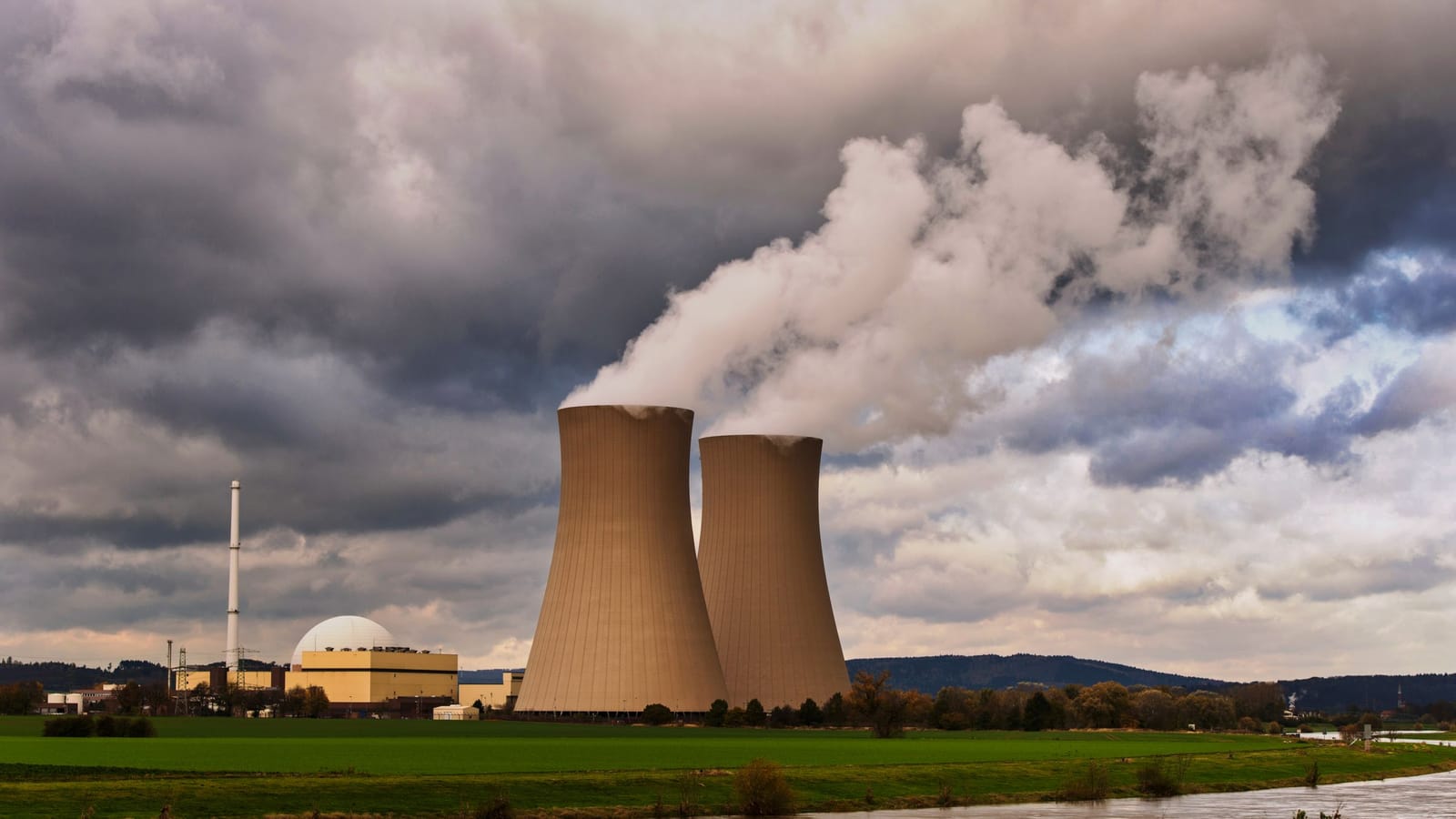
Then the steam has to be condensed back into water, which is why plants sit on rivers, lakes or coastlines, and why those hyperbolic cooling towers exist. The white plume coming off them is water vapor. Not smoke. There's no combustion anywhere in the building.
The number that explains the comeback
Capacity factor. It's the percentage of a year a plant actually produces at full output, and it's the least glamorous statistic in energy.
American nuclear plants run at roughly 93 percent. Wind runs about a third of the time, solar about a quarter, depending on where you put it. A nuclear plant stops for refueling, usually in spring or fall, usually for about a month, usually scheduled years ahead.
That's why a data center developer will sign a twenty-year contract with a reactor. Server racks don't care about your values. They care about electricity at 3 a.m. in February when there's no wind.
So why did we stop building them?
Money, mostly. Not fear.
Vogtle Units 3 and 4 in Georgia came online in 2023 and 2024, the first new American reactors in a generation. The original estimate was around $14 billion. The final figure landed north of $30 billion, and the contractor went bankrupt partway through.
Some of that was regulatory. A lot of it was that we forgot how. Every American plant was essentially a custom build, each one a first-of-its-kind, and the welders and pipefitters who knew the work had retired or moved to petrochemicals. Then cheap shale gas arrived after 2008 and nobody needed to figure it out. Plants started closing early because they couldn't compete with $2 natural gas.
What changed
Demand did, after two decades of flat electricity growth. Data centers, chip fabs and electrified industry all showed up at once, and utilities started looking at their own retirement schedules with alarm.
Palisades in Michigan shut down in 2022. It's now been authorized to restart, the first time a closed American reactor has been brought back. Three Mile Island Unit 1, the undamaged twin of the reactor that partially melted in 1979, is being restarted under a power deal with Microsoft. California reversed itself on Diablo Canyon. The ADVANCE Act passed in 2024 with bipartisan margins that don't happen anymore, trimming licensing fees and pushing the NRC to move faster.
Small modular reactors are the other half of the story. NuScale got a design certified by the NRC in 2023. TerraPower broke ground in Kemmerer, Wyoming, on a sodium-cooled plant at the site of a retiring coal station. The pitch is factory-built modules instead of bespoke megaprojects, so the tenth one costs less than the first. That's a promise, not yet a track record. Judge it in 2032.
The waste question, straight
Spent fuel is intensely radioactive and stays hazardous for a long time. Nobody serious disputes that.
What surprises people is the volume. Sixty-plus years of American commercial nuclear power has produced spent fuel that would cover a football field to a depth of roughly ten yards. It sits in concrete and steel dry casks on plant sites, outdoors, guarded, and it has done so without incident. Yucca Mountain was supposed to take it and politics killed the project. So the casks stay put.
You can consider that unacceptable. You can also notice that every other thermal generation source disposes of its waste by putting it in the air.
What to do with this
Go find your own grid mix. Your utility is required to disclose its fuel sources, usually on the bill insert or a page on its website, and the EIA publishes state-level profiles free. If you live in Illinois, South Carolina or New Hampshire, a large share of your power already comes from atoms and you've never noticed, because that's what a well-run plant looks like.
Then watch your state legislature. The live fights are over whether utilities can recover construction costs from ratepayers before a plant produces anything, and whether decades-old bans on new nuclear construction get repealed. Those votes decide your bill in 2040.
The thing worth holding onto is the pellet. Half an inch of ceramic, no flame, no smoke, running a hospital for a year and a half. We figured that out in the 1940s, built it in the 1970s, and then talked ourselves out of it.
We appear to be talking ourselves back in.
Dean Shaw
Gear & Garage
Reads the warranty, the parts list and the long-term owner reviews before anything else. Trucks, tools, watches, and the cheap version that costs more.

Watch
Watch how it's done
Picked for this article.
From channels we rate. Plays on YouTube.
TED-Ed
How do nuclear power plants work? - M. V. Ramana and Sajan Saini
Kurzgesagt – In a Nutshell
Nuclear Energy Explained: How does it work? 1/3
Read next