What a Chainsaw Chain Is Really Doing, and What Dulls It
Wood is softer than you'd think on steel. Dirt is the real enemy, and the sawdust tells you whether your chain is sharp.
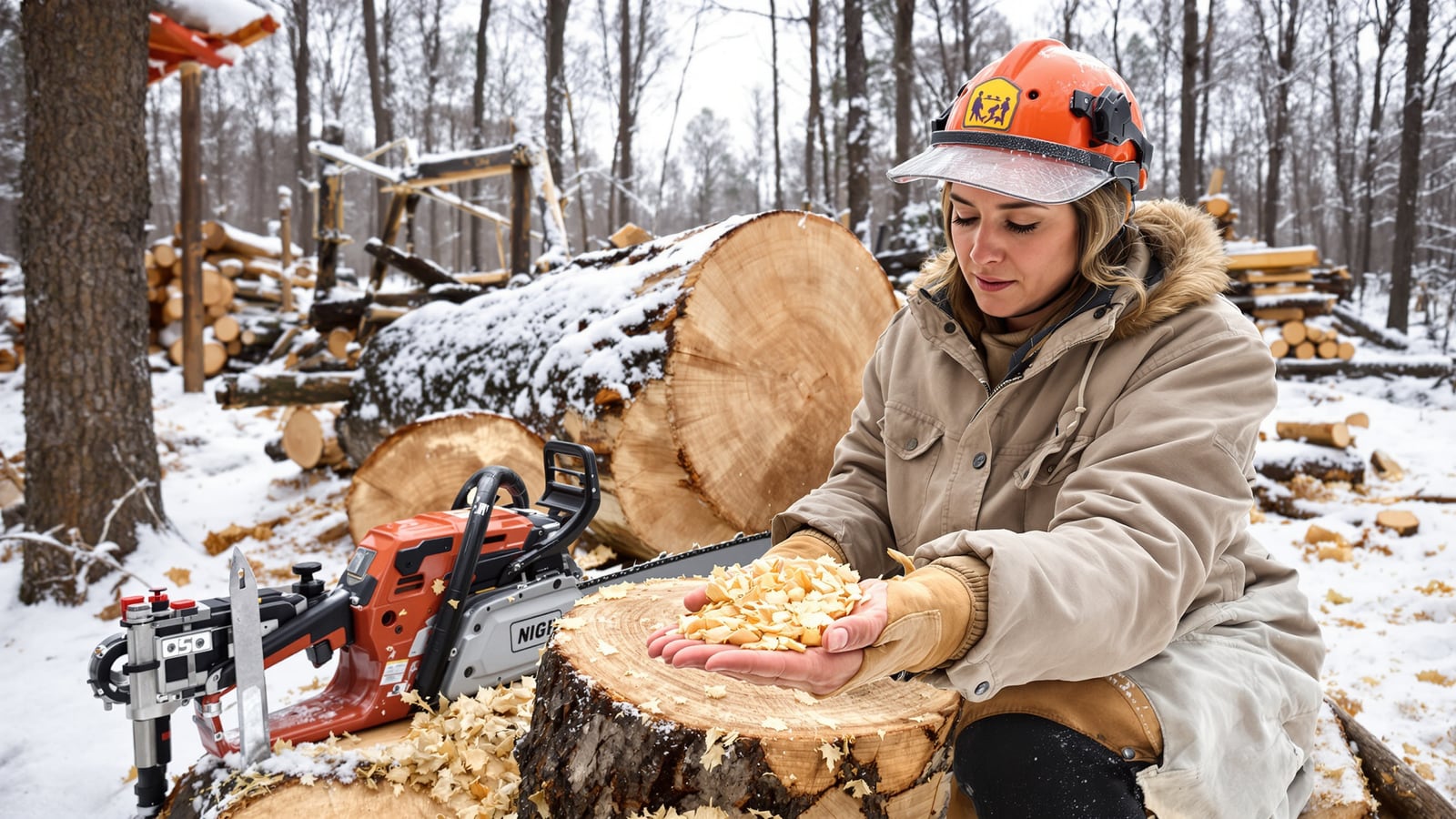
Quick answer: Each tooth on a chain slices the wood fibers on both sides, then lifts out the chip between the cuts. Clean wood is easy on that edge. Dirt and grit ruin it. Look at the sawdust. Chips mean sharp. Fine powder means dull.
It's a row of tiny planes
Look closely at one cutter. It's shaped like an L. The top plate is the horizontal part. The side plate is the vertical part. Where they meet is the corner that does the work.
Cutting across the grain, think of the wood as a bundle of drinking straws laid side by side. The corner of the tooth hits first and severs the fibers at the edge of the cut. That's the same idea as scoring a line with a knife before you pare along it. Then the top plate rides in and shaves under the severed fibers, and the chip curls up and out.
The teeth alternate, one cutting left and the next cutting right. Two scored walls, a chip lifted out between them, and the gap that's left is the kerf. The saw is carving a slot, not tearing through.
Ahead of every tooth sits a small hooked ramp called the depth gauge, or raker. It rides on the wood and limits how far the tooth can dig in. On a common 3/8-inch chain it's set around 0.025 inch below the cutter, less than the thickness of a nickel. That tiny number decides how big each chip is. Too low and the saw grabs and chatters. Too high and the teeth skate over the wood, barely cutting.
At full throttle the chain moves at something like highway speed. Every tooth takes a bite that small, over and over, and the bites add up to a log in two pieces.
Wood barely wears steel
This is the part that surprises people. Dry oak, green pine, even frozen ash are all soft next to hardened steel, and many chains also have a hard chrome plating on the cutting edge. Run a chain through clean wood and the edge holds up far longer than most people expect.
What kills it is everything that isn't wood.
- Soil and sand caught in the bark of a log that's been lying on the ground.
- The dirt itself, if the bar tip touches it at the end of a cut.
- Rock, nails, wire and old fence staples buried in a tree that grew around them.
The cutting edge is thinner than a hair. One pass through a grain of sand rounds it over. A single touch of the ground can take a chain from sharp to useless in a second, and the wood you cut afterward gets the blame.
Picture a downed oak that's been on the ground three winters. The top is clean. The underside is crusted with soil, and the bark is full of grit. You cut down through the top, finish the cut, and the bar nicks the dirt below. Now the next cut feels like work. The saw hasn't worn out. You've sanded the edge off six teeth in about a second.
So the habits that keep a chain sharp are mostly about dirt:
- Roll the log or prop it up so the bar finishes the cut in open air.
- Knock the loose dirt and mud off the bark before you cut, or cut the cleaner side first.
- Stop and look when you hear a ping or see a spark. Find the nail before you find it again.
Read the sawdust
You don't need to touch the chain to know its condition. Look at what lands on the ground.
A sharp chain throws chips. Real ones, curled, sometimes as long as your thumbnail on soft wood. A dull chain throws fine dust, almost flour. The teeth are scraping instead of cutting.
A sharp saw pulls itself into the wood. You guide it. A dull one makes you lean on it, and leaning is how people get hurt. If you're forcing the cut, stop, because the saw is telling you something. A chain that smokes, or a cut that drifts off to one side, says the same thing. So does a saw that makes you lean in just to get it to bite.
Drifting usually means one side's teeth are duller than the other's. The sharper side cuts faster and pulls the saw into a curve.
Sharpening is a short job
Filing a chain in the field takes about as long as drinking a coffee.
- Shut the saw off. Set the brake. Wear gloves, because the edge is still sharp.
- Clamp the bar, or brace it in a stump vise. A steady saw gives a steady file.
- Match the round file to the chain. The size is printed in the manual or on the chain's package. A file that's too small or too large changes the shape of the edge.
- Hold the file level and at the angle marked on the guide, commonly 30 degrees. Push it across the cutter from the inside out. A few strokes per tooth.
- Count your strokes. Do the same number on every tooth, then turn the saw around and do the other side. Even teeth cut straight.
- Every few sharpenings, check the depth gauges with a flat file and a gauge tool. As the cutter gets filed down, the raker gets relatively taller and the saw stops biting. This is the step most people skip and the reason a freshly filed chain sometimes still cuts poorly.
Concede the trade-off. If you hit a rock, or if the cutters are chipped or filed down to the end of their life, a file won't save the chain. That's a new chain. A pro shop with a grinder can reset one that's badly out of shape, but it's usually cheaper to replace than to repair.
Oil, heat and the stretch you can't see
Sharp isn't the only thing that keeps a chain cutting. The bar oil is the other half. The chain flings it as it runs, and it carries away friction heat. A saw that runs dry heats the bar until it turns blue and the chain stretches loose. Check the oil level every time you fuel up. If the saw's a battery model, the principle's the same, and it's why the battery piece matters when you're deciding how much runtime a job needs.
The chain itself is a loop of hardened steel pulled around a bar hundreds of times a minute. Metal that bends and flexes that often wears at the rivets and links long before anything looks wrong, a slower cousin of what the engineers worry about in a bridge. Check the tension. A cold chain should sit snug on the bar and still pull around by hand.
Dress for the job, too: chaps, eye and ear protection, a helmet if you're felling. Keep the bar tip out of contact with anything you don't mean to cut, because that's where kickback comes from.
Leave it better than you found it
If you borrow a neighbor's saw, you know the code. Fill the gas and the bar oil. Wipe the sawdust off. And hand it back sharper than it came, with a few strokes of the file on every tooth. A man who returns a tool in better shape than he got it is a man who gets asked to borrow it again.
Dean Shaw
Gear & Garage
Reads the warranty, the parts list and the long-term owner reviews before anything else. Trucks, tools, watches, and the cheap version that costs more.

Watch
Worth an hour of your evening
More from Science & Space.
From channels we rate. Plays on YouTube.
Read next