
What a metal detector actually hears when it beeps
It doesn't find metal. It finds anything that answers a magnetic field, which is why a pull tab can fool you and wet beach sand can too.
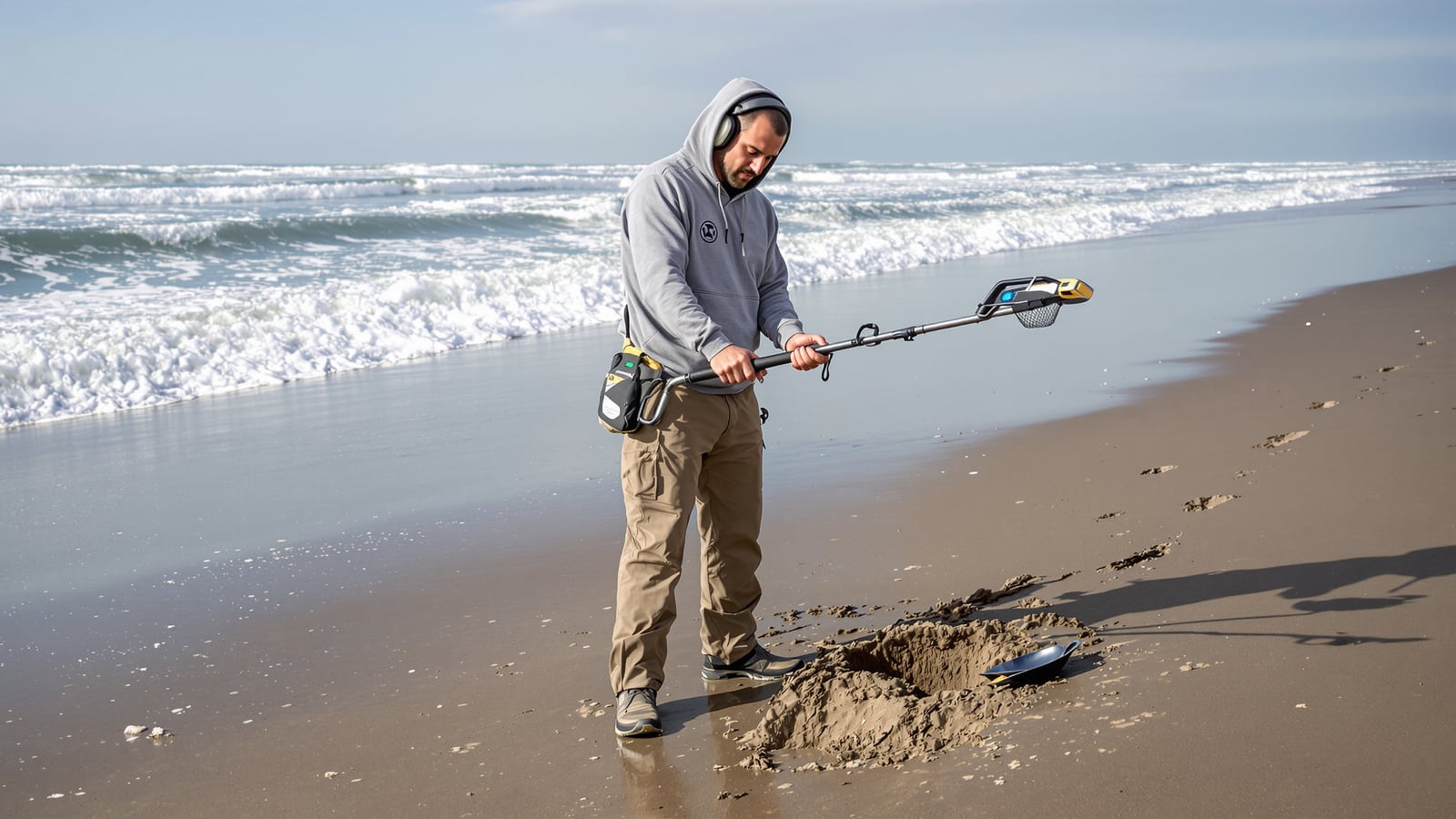
Quick answer: A detector sends out a changing magnetic field and listens for the echo a conductive object throws back. It can find coins, jewelry and iron at depths from a few inches to a couple of feet. It can't see plastic, stone, wood or bone.
In July 1881, President Garfield was lying in the White House with an assassin's bullet somewhere in his body. Alexander Graham Bell hurried over with a new device built to find it. The thing kept squealing. Bell's trouble was the bed itself. Garfield was lying on a mattress with metal coil springs, and the detector couldn't tell the springs from the bullet.
Same physics, 140-plus years later. Your detector still can't tell what a piece of metal is. It can only tell how the object answers.
Two coils and a changing field
The flat disc on the end of the shaft, called the search coil, holds a wire loop. Run alternating current through it and it throws out a magnetic field that flips direction thousands of times a second. Most hobby detectors work somewhere in the range of roughly 5 to 20 kilohertz. That's why the common type is called VLF, for very low frequency.
When that field sweeps through a coin, it pushes small circular currents around inside the metal. They're called eddy currents. Those currents create a magnetic field of their own, a faint echo of the first one.
A second wire loop in the coil, the receiver, listens for that echo. If it hears one, the electronics beep. Everything else the machine does is a way of interpreting how the echo sounds.
How it tells a nickel from a nail
The echo doesn't come back in perfect step with the signal you sent. It lags a little, and the amount of lag depends on the target.
A good conductor like silver or copper lags one way. A poor conductor lags differently. Iron is trickier, because it's magnetic as well as conductive, and its echo comes back shifted the opposite way. Measure that shift and you get a rough identity. The number on the screen, usually 0 to 99 or something close, is a guess at what's down there based on that lag.
That's discrimination. Dial out the iron range and the nails go quiet. Dial out a few more notches and the pull tabs go quiet too.
Here's the annoying part. A modern aluminum pull tab sits in nearly the same spot as a gold ring. Gold is a modest conductor. So is a thin curl of aluminum. If you reject one, you reject the other, and a lot of experienced hunters dig the tabs rather than risk skipping a ring.
Size matters too. A big, thick object gives a stronger echo than a small thin one, and a coin standing on its edge gives a weaker one than a coin lying flat. The machine doesn't know any of that. It only reports what comes back.
The ground is the real opponent
Dirt isn't empty. Many soils carry iron minerals, and wet salty sand is a conductor in its own right. Your detector's field passes through all of it, and the ground answers back, sometimes louder than the coin you're hunting.
Better machines include ground balance. You pump the coil toward the dirt, the machine measures how the soil answers, and it subtracts that signal. That's why a detector that behaves perfectly in a backyard can chatter like a chipmunk on a mineral-heavy field until you balance it.
Coil size is a trade-off. A big coil pushes the field deeper and covers more ground per swing. A small coil is more sensitive to little targets and does better in ground littered with junk. A 15-inch coil on a field full of bottle caps is a long, frustrating afternoon.
Pulse induction and the beach problem
A second design works differently. Pulse induction detectors, or PI, don't run a steady signal. They fire a strong burst of current through the coil, shut it off, and listen to how the field collapses. In bare ground the field dies in a flash. If a piece of metal is down there, its eddy currents die off a little more slowly, and the machine catches the lingering signal.
PI pays for its strengths. It largely ignores mineralized soil and salt water, so it's the tool for ocean beaches and gold country. But it can't discriminate well. It tells you something metal is down there, and you dig to find out what.
Walk-through security gates use the same family of ideas, tuned to a different job. Concrete work does too. A detector run over a poured slab can find the rebar, and a good engineer wants to know where it is before drilling. That steel is also what decides how a bridge holds up and what eventually takes one down.
What it can't find, and what it'll lie about
It can't find anything that doesn't conduct. Plastic, glass, wood, bone, pottery and stone are invisible to it. A buried gas line made of plastic is invisible too, which is why utilities use tracer wire.
It also won't find anything very deep. Manufacturers' depth claims usually come from waving a coin through open air. Buried in real dirt, most hobby machines find a coin at about six or seven inches on a good day. Larger objects show up deeper, and a car-sized chunk of iron a few feet down can still raise a signal.
And it'll lie to you in these ways:
- Masking. A nail beside a coin can hide the coin's signal.
- Hot rocks. Some stones carry enough iron to read as metal.
- Tangled targets. Two objects close together can blur into one wrong number.
- Trash. The most common find in nearly every park is trash, and the machine can't help it.
If you're going to try one
A detector in the few-hundred-dollar range is plenty to learn on. Spend your first month on ground you can search, and learn what your tones mean before you chase depth.
Get permission before you walk onto private land. Check the rules for parks. Federal land is generally off limits for digging, and the law protects archaeological resources on federal and tribal land, so look up the local rules before you head out, not after.
Then follow the old code. Fill every hole so the turf looks untouched. Take every pull tab and bottle cap with you, because the park is cleaner than you found it and your pouch is full of junk instead of the ground. If it's somebody's yard, bring the lost earring back to them.
It's a good hobby for a dad and a kid, and a close cousin to the quiet patience of a first telescope. You wait, you listen, and sometimes the ground answers.
The beep is only a question. Dig the answer, then leave the place better than you found it.
Dean Shaw
Gear & Garage
Reads the warranty, the parts list and the long-term owner reviews before anything else. Trucks, tools, watches, and the cheap version that costs more.

Watch
Watch how it's done
Picked for this article.
From channels we rate. Plays on YouTube.
Huygens Optics
Metal Detector Discrimination Explained (with a Garret AT Pro)
Read next