
Concrete Is Designed to Crack. Engineers Just Pick the Spot.
Those lines every few feet in your sidewalk are cracks someone put there on purpose. Here's why concrete splits, and how engineers keep it from mattering.
Quick answer: Concrete shrinks as it dries and it's weak when pulled apart, so it will crack. Engineers plan for that. They steer cracks into straight cuts, hold them shut with steel, and keep water and rust out. The failures come when someone skipped that plan.
The lines in your sidewalk are cracks
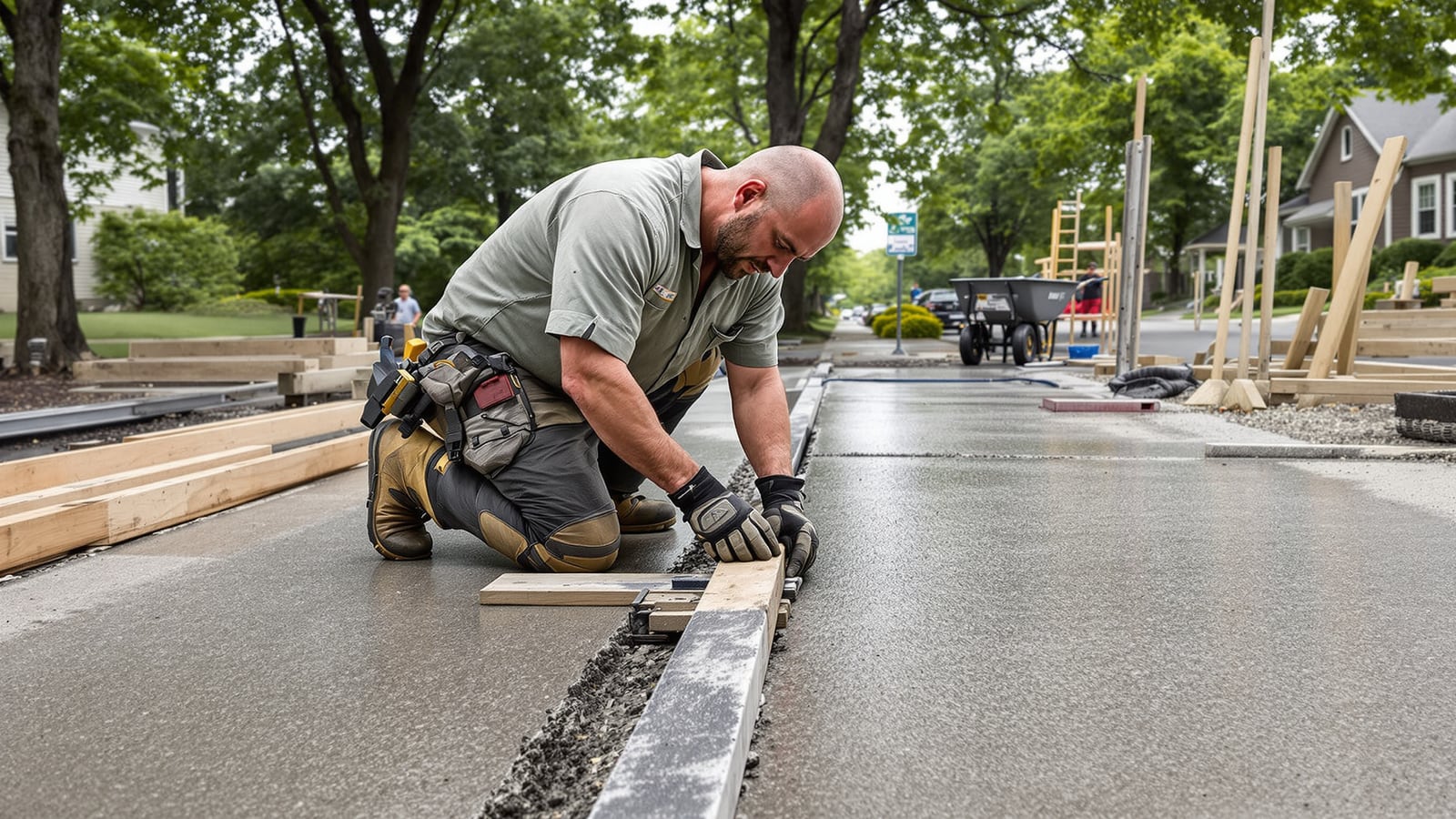
Walk down the street and look at the pavement. Every five feet or so there's a straight groove. Those are control joints, and a crew cut them with a saw or a grooving tool hours after the pour.
Here's the reason. Fresh concrete is a wet mix of cement, sand, gravel and water. As it hardens, the extra water leaves and the slab shrinks. A slab sitting on the ground can't slide freely, so it's held in place while it tries to get smaller. That builds tension. Concrete can't take much tension, so it splits.
You can't stop that. You can choose where it happens. The groove is a deliberately weak line, usually cut about a quarter of the way through the slab. The concrete cracks at the bottom of the groove, where it's thinnest, and the crack stays tidy and out of sight.
A common rule of thumb for spacing is two to three times the slab's thickness in inches, expressed in feet. A four-inch driveway slab gets a joint every eight to twelve feet. Skip the joints, or space them too far apart, and the slab picks its own lines. They're usually ugly.
Strong in a squeeze, weak in a pull
A concrete column can hold up a building. Pull on that same concrete and it gives up at a fraction of the load. Engineers commonly work with tensile strength somewhere around a tenth of compressive strength.
That lopsidedness drives almost everything about how concrete gets used. Picture a beam spanning a gap. Under load it bends. The top of the beam gets squeezed, which concrete handles fine. The bottom gets stretched, which it doesn't.
So the stretched side gets steel.
What rebar actually does
Most people think rebar makes concrete uncrackable. It doesn't. The concrete still cracks under load. The steel carries the tension across the crack and keeps it narrow, often too thin to see without squinting.
Two details make this work, and one of them is luck.
The luck: steel and concrete expand and contract with temperature at nearly the same rate. If they didn't, every hot afternoon and cold night would tear the bond apart from inside. Nobody designed that match. Builders just got to use it.
The design: rebar has ribs rolled into its surface. A smooth rod would slip. The ribs lock into the concrete like threads on a bolt, so the steel and the concrete act as one piece.
If you're curious how these loads travel through a whole structure, what holds a bridge up and what eventually takes one down covers the bigger picture.
The slow killers: ice and rust
Most old concrete doesn't fail from being overloaded. It fails from water.
Water gets into tiny pores. When it freezes, it expands by about nine percent. Do that a few hundred winters' worth of nights and the surface flakes off in sheets. That's why a driveway looks fine for years and then sheds its top layer.
The fix is invisible. Engineers add an air-entraining admixture that fills the concrete with billions of microscopic bubbles. When ice forms, it has somewhere to push into instead of pushing the concrete apart. If you live somewhere with real winters, concrete for exterior work should be specified as air-entrained. Ask the supplier.
Rust is the other one. Steel that rusts swells to take up more room than the metal it came from. Inside concrete, that swelling pushes outward until the cover layer pops off. It's called spalling, and you'll see it on old parking decks and bridge undersides, with rusty rebar showing like bones.
Road salt makes it worse by helping carry chloride down to the steel. So engineers fight it three ways:
- Cover depth. They set a minimum thickness of concrete over the steel, and they keep the rebar off the forms so it stays buried.
- Dense concrete. A lower water-to-cement ratio means fewer pores for salt water to travel through.
- Coated or alternative steel. Epoxy-coated and stainless rebar show up on bridge decks where salt is a constant.
Squeezing it before it's ever loaded
For long spans, engineers go one better. Prestressed concrete runs high-strength steel cables through the member and pulls them tight before the structure carries any load. The cables squeeze the concrete in advance.
Then when the load shows up and tries to stretch the bottom of the beam, it first has to undo that squeeze. The concrete never goes into tension at all. It's the same trick as a row of books you can lift by pressing the ends together. Overpasses and parking garages are often built this way.
Heat from the inside
Setting concrete gives off heat. Curing is a chemical reaction, not just drying. In a thin slab the heat escapes. In something like a dam, it can't.
The Hoover Dam is the famous case. Poured as one solid mass, it would have taken decades to cool, and it would have cracked badly as the outside cooled and shrank around a hot core. So the builders poured it in separate blocks and ran pipes through them, circulating river water and later chilled water to pull the heat out.
The truck driver and the water hose
The most common way to wreck a good pour is also the cheapest. Someone asks the driver to add water because the mix is stiff and hard to spread.
Every extra gallon makes it easier to place and weaker once it's hardened. More water means more pores, more shrinkage and more cracking. Stiff, hard-to-work mix is usually the right mix. If it needs to flow better, the answer is a chemical plasticizer, not a hose.
Curing matters just as much. Concrete keeps gaining strength as long as it has moisture. Keep a new slab damp, or covered, for about the first week. A slab that dries out in the first two days will be weaker and craze across the surface.
Which cracks to worry about
Most of what you'll see in a driveway, patio or garage floor is harmless. Hairline cracks from shrinkage are normal. A crack that follows a control joint is the joint doing its job.
Call a structural engineer, not just a concrete contractor, when you see any of these:
- A crack where one side sits higher than the other.
- Diagonal cracks near the corners of doors and windows, or stair-step cracks in block walls that keep getting wider.
- A horizontal crack along a basement wall, especially if the wall bows inward.
- Rust stains or flaking with exposed steel on a beam, deck or balcony.
- A crack you can put a coin in, or one that's visibly growing.
A cheap trick is to mark the ends of a crack with a pencil and the date. Check in a few months. A crack that hasn't moved is a very different problem from one that has.
Concrete has been cracking since the Romans were pouring it. The engineers who do it well never promised a crack-free structure. They promised that the cracks would be small, in the right place, and shut tight by steel before anyone noticed. That's the whole job. Check your sidewalk on the way out. Somebody planned every line in it.
Dean Shaw
Gear & Garage
Reads the warranty, the parts list and the long-term owner reviews before anything else. Trucks, tools, watches, and the cheap version that costs more.

Watch
Worth an hour of your evening
More from Science & Space.
From channels we rate. Plays on YouTube.
Read next