Your First Telescope Should Probably Be an 8-Inch Dobsonian
Aperture and a steady mount beat everything else. Skip the 675x box-store special and buy the thing you'll actually carry outside.
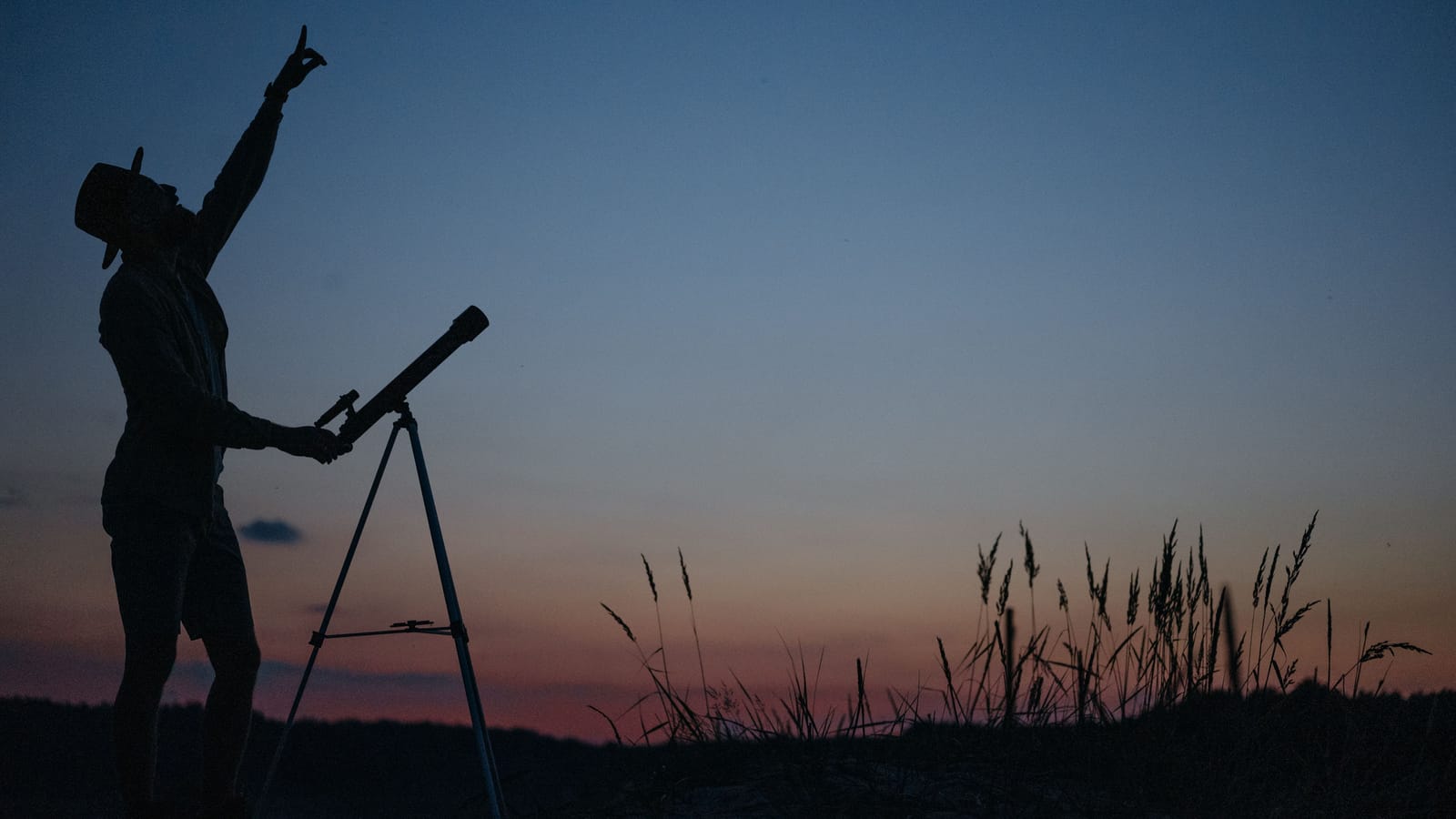
If you buy one thing and never read another word about optics, buy a 6- or 8-inch Dobsonian reflector. Expect roughly $400 for the 6-inch and somewhere north of $600 for the 8-inch, depending on the brand and what the season's doing to prices. It's a tube on a plywood box that pivots. No motors, no tripod legs to level, no software update. You point it, you look.
Now the thing you should not buy: any telescope whose box brags about magnification. "675x!" on the front of a 60mm refractor is the optical equivalent of a car ad promising 300 miles per hour in a hatchback. Technically the math happens. The result is a dim, smeared blob shaking in a breeze, on a tripod with the rigidity of a folding music stand. That telescope is the single biggest reason people decide astronomy isn't for them.
Aperture is the whole game
A telescope does one job better than your eye: it collects light. The width of the main lens or mirror, the aperture, decides how much. An 8-inch mirror gathers roughly four times the light of a 4-inch, because you're comparing areas, not widths. More light means fainter objects become visible and detail holds together when you push the power up.
Magnification is a knob, not a spec. You get it by dividing the telescope's focal length by the eyepiece's focal length. A 1200mm telescope with a 25mm eyepiece gives 48x. Swap in a 10mm and you get 120x. Any telescope can be made to magnify 600x. Very few can do it and still show you anything.
The working rule is about 50x per inch of aperture as an absolute ceiling, and the atmosphere usually decides long before the optics do. On a typical night in most of the country, somewhere around 150x to 200x is where the image stops improving and starts boiling. That's still plenty. Saturn at 170x in a 6-inch is a moment you remember.
Why the mount matters more than you think
Half of a bad telescope experience is the mount. At 150x, everything is magnified, including the wobble from your hand on the focuser. If the image takes four seconds to settle every time you touch it, you'll stop touching it, and then you'll stop going outside.
A Dobsonian mount is a lazy Susan with a cradle on it. It's crude and it's nearly perfect for visual use: rock solid, zero setup, no counterweights. You nudge the tube and the object stays put in the eyepiece.
The alternative you'll see everywhere is the equatorial mount, the one with the two knobs and the weight on a bar. It's built to track the sky's rotation on one axis, which matters enormously for photography and barely at all for looking. For a beginner it mostly adds cost, weight, and a polar alignment step in the dark.
What you'll actually see, honestly
Set your expectations now, because the Hubble pictures have ruined a generation of first nights.
- The Moon is the showstopper and nobody warns you. Crater walls, mountain shadows, terraced rims. Look along the terminator, the line between light and dark, where the shadows are longest. A full moon is the worst time to look at the moon.
- Jupiter gives you two dark cloud belts and four moons that visibly change position from one night to the next. Those are the moons Galileo saw in 1610 that broke the idea of everything circling the Earth.
- Saturn is a pale gold disk with a ring around it, small and sharp and unmistakably real. First-timers go quiet.
- The Orion Nebula is gray. So is everything else in deep space. Your eye's color receptors don't work at that light level, so nebulae and galaxies come through as luminous gray-green smoke. Andromeda, our nearest big galaxy neighbor, looks like a thumbprint on glass.
That last one disappoints people, so I'll say the part out loud: it shouldn't. You're looking at photons that left a trillion-star system while mammoths were still walking around, landing on your retina in your backyard. Gray is fine.
The trade-off nobody mentions in the reviews
An 8-inch Dob is around 40 to 50 pounds in two pieces. The base is awkward, the tube is long, and if you live three flights up or you're carrying it past a car seat every time, you will use it less. That's not a hypothetical. It's the most common way a good telescope ends up in a closet.
So be honest about your setup. If it lives in a garage and goes out the door onto a driveway, get the 8-inch. If it has to travel, look at a 6-inch, or a tabletop 130mm reflector you can set on a picnic table and carry with one hand. A smaller scope used forty nights a year beats a bigger one used twice.
And if what you actually want is photography, stop and reconsider the whole purchase. Astrophotography is a different hobby that happens to share a name. There, the tracking mount is the expensive part and the telescope is an afterthought. A Dobsonian will take a decent phone snap of the Moon and essentially nothing else.
Spend your accessory money here
Kit eyepieces are usually a 25mm and a 10mm, and the 25mm is typically fine. The 10mm is typically where the manufacturer saved money.
- One good mid-power eyepiece, somewhere in the 6mm to 9mm range depending on your focal length. This is the upgrade you'll notice.
- A Telrad or similar zero-power finder. It projects a bullseye on the sky so you can aim by looking, not by squinting through a tiny inverted scope. It changes the hobby.
- A red flashlight. Your eyes take about 20 to 30 minutes to fully dark-adapt and about half a second of white light to lose it.
- A free planetarium app. Stellarium runs on a desktop and your phone, and it'll show you what's actually up tonight from where you're standing.
Skip the colored planetary filter set. Skip anything sold as a "magnification kit."
Two habits that do more than any upgrade
Let the telescope cool. A mirror carried from a 70-degree house into 35-degree air throws heat currents right through the light path. Give it 30 to 45 minutes outside before you expect sharp views at high power.
And learn to collimate, which just means aligning the two mirrors in a reflector. It takes five minutes, the tools cost less than a tank of gas, and an uncollimated 8-inch performs like a well-aligned 4-inch. There are a dozen good walkthroughs online. Learn it once.
One more piece of advice that costs nothing: find the nearest astronomy club and show up to a public star party. They're everywhere, they're free, and the members are delighted when somebody new asks questions. You'll look through six telescopes in one night and learn more about what you want than from a month of reading specs.
Then take your kids out on a cold clear night, let them find Jupiter themselves, and watch what happens to a ten-year-old who realizes the sky has depth.
Dean Shaw
Gear & Garage
Reads the warranty, the parts list and the long-term owner reviews before anything else. Trucks, tools, watches, and the cheap version that costs more.

Watch
Worth an hour of your evening
More from Science & Space.
From channels we rate. Plays on YouTube.
Read next