A dead battery isn't empty. It's finished falling.
Your battery never held a tank of electricity. It held chemistry that wanted to react, and a dead one is just a battery where the reaction ran out of road.
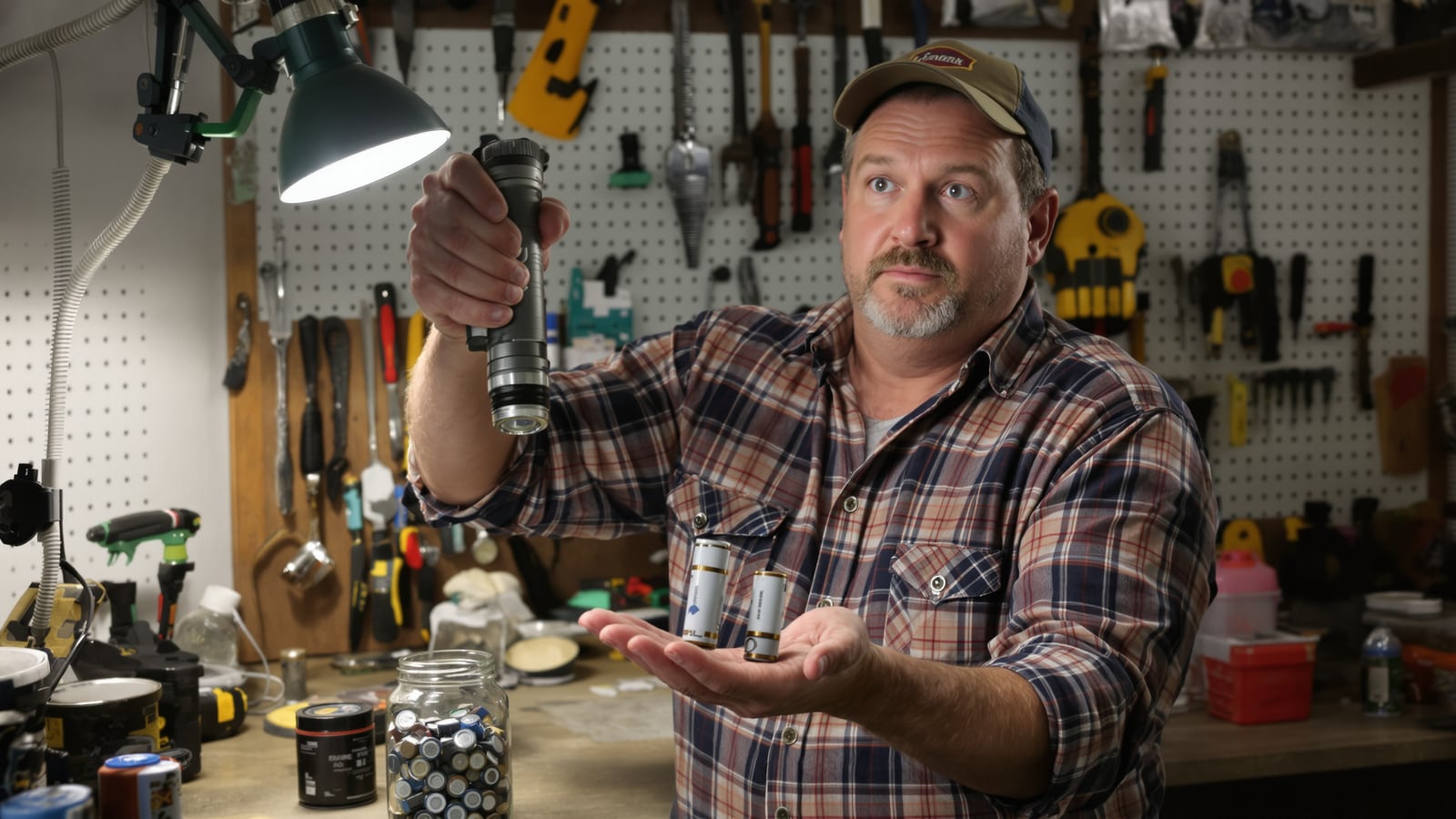
Quick answer: A battery doesn't store electrons. It stores chemicals arranged so they want to react. When it is "dead," that reaction has mostly finished, and there's nothing left to push current through your device. Nothing was used up like gas in a tank. It just rolled downhill.
A pump, not a bucket
Most people picture a battery as a little jug of electricity that drains out. Throw that picture away.
The electrons that power your flashlight are already sitting in the copper wire and the bulb. They don't come from the battery. The battery supplies the push. One end holds a material that's eager to give electrons away. The other end holds a material that's eager to take them. Inside the cell, a barrier keeps the two apart, so the electrons can only make the trip by going around, through your device. They do work on the way. That's the whole trick.
Meanwhile, charged particles called ions drift through the liquid or paste inside the cell to keep the books balanced. Electrons outside, ions inside. Both have to keep moving or the whole thing stalls.
Inside a lithium-ion cell
Your phone, laptop and most electric vehicles run on some version of the same design. There's a graphite electrode (the anode), a metal-oxide electrode (the cathode), a liquid electrolyte between them, and a sheet of porous plastic keeping them from touching.
Fully charged, the lithium ions are packed into the graphite like books pressed onto a shelf. Pull power from the cell and they start slipping out. They cross the electrolyte, pass through the plastic sheet, and tuck themselves into the cathode. Every ion that moves sends an electron around the outside circuit, and that electron is your power.
When the phone says zero, most of the lithium has made the move. Nothing was destroyed. It relocated. Plug in the charger and it forces the ions back across and onto the shelf, uphill, against their preference. That's why charging takes work and why the charger gets warm.
You can watch it happen in the voltage. A typical lithium-ion cell reads about 4.2 volts full and sags toward roughly 3 volts as the ions finish relocating. Your phone's percentage number is an estimate built from that voltage and some bookkeeping, which is why it can lie to you at 30 percent. The screen and the radios running your blue dot do most of the draining.
Why "dead" isn't zero
Your phone shuts off before the cell is truly empty. A small protection circuit cuts power at a safe floor, because pushing a lithium-ion cell much lower than that can damage it permanently. Many chargers will refuse to touch a cell that's been drained too far.
The annoying part: a "dead" phone still leaks a little charge just sitting there. Leave it in a drawer for a year and it can creep below that floor on its own. So if you're storing a laptop, a drone battery or a cordless-tool pack for a long stretch, leave it about half charged, not full and not empty. Both extremes are hard on the cell.
The dead AA that still reads 1.2 volts
Alkaline batteries work differently. Inside the can there's zinc powder, manganese dioxide and a potassium hydroxide paste. The zinc gives up electrons and turns into zinc oxide. For practical purposes that's a one-way trip, which is why you don't recharge an alkaline. Some people try. Don't.
Here's something that confuses everybody the first time. Put a meter on a "dead" AA and it may read well over a volt. So why won't it run the flashlight?
Because a voltmeter barely draws current. A flashlight draws plenty. As the zinc is spent, the cell's internal resistance climbs, and the moment you ask for real current the voltage collapses. Fresh, the cell hands over amps without flinching. Nearly spent, it can show you a number but can't back it up.
That's also why the kid's toy doesn't stop suddenly. It slows, dims and gets sluggish. The voltage under load sags a little more each week.
One more thing. A fully drained alkaline can leak that potassium hydroxide, leaving crusty white residue in the battery compartment. Pull batteries out of anything you're storing. If you find the crust, wear gloves, and wipe it off with a cotton swab dipped in vinegar. Then dry it thoroughly.
The truck that won't turn over in January
The lead-acid battery under your hood is the oldest design here and the most stubborn. It has lead plates and lead dioxide plates sitting in diluted sulfuric acid.
Discharging, both kinds of plate slowly turn into lead sulfate. The acid gets consumed in the process, so the liquid grows weaker and more like plain water. A weak electrolyte freezes at a higher temperature than a strong one, which is why a dead battery can crack its case in a hard freeze while a charged one in the same truck is fine.
Cold also slows every chemical reaction, so even a healthy battery delivers less on a 5-degree morning than on a 75-degree one. A battery that's marginal in October is the one that strands you in January.
Lead-acid has one nasty habit. Leave it discharged for a long time and the lead sulfate hardens into crystals that won't convert back. That's sulfation, and it's the most common way these batteries die. If you own something that sits for months, such as a boat, a mower or a second truck, put it on a battery maintainer. It costs little compared to a new battery.
If you ever jump a neighbor's dead truck, tell him to drive it a good while afterward, not to the end of the street and back. The alternator needs real time to put the charge back. And if you borrowed the cables, return them coiled, with a thank-you.
What to do with all this
- Store lithium-ion packs around half charged, in a cool spot, not in a hot car.
- Don't try to recharge alkalines. Buy rechargeable AAs and a charger for anything you use constantly.
- Don't mix old and new cells in the same device. The weak ones drag the strong ones down.
- Take batteries out of anything that's going on a shelf for the season.
- Put a maintainer on anything with a lead-acid battery that sits more than a few weeks.
Nothing in a dead battery has vanished. The energy that was there ran downhill, and everything you powered on the way down was the work it did.
Dean Shaw
Gear & Garage
Reads the warranty, the parts list and the long-term owner reviews before anything else. Trucks, tools, watches, and the cheap version that costs more.

Watch
Worth an hour of your evening
More from Science & Space.
From channels we rate. Plays on YouTube.
Read next