Steel wants to turn back into rock, and every fix is a delay
Rust isn't a defect in steel. It's steel going home. Here's the chemistry, and why zinc, chromium and a rag with oil each buy you time.
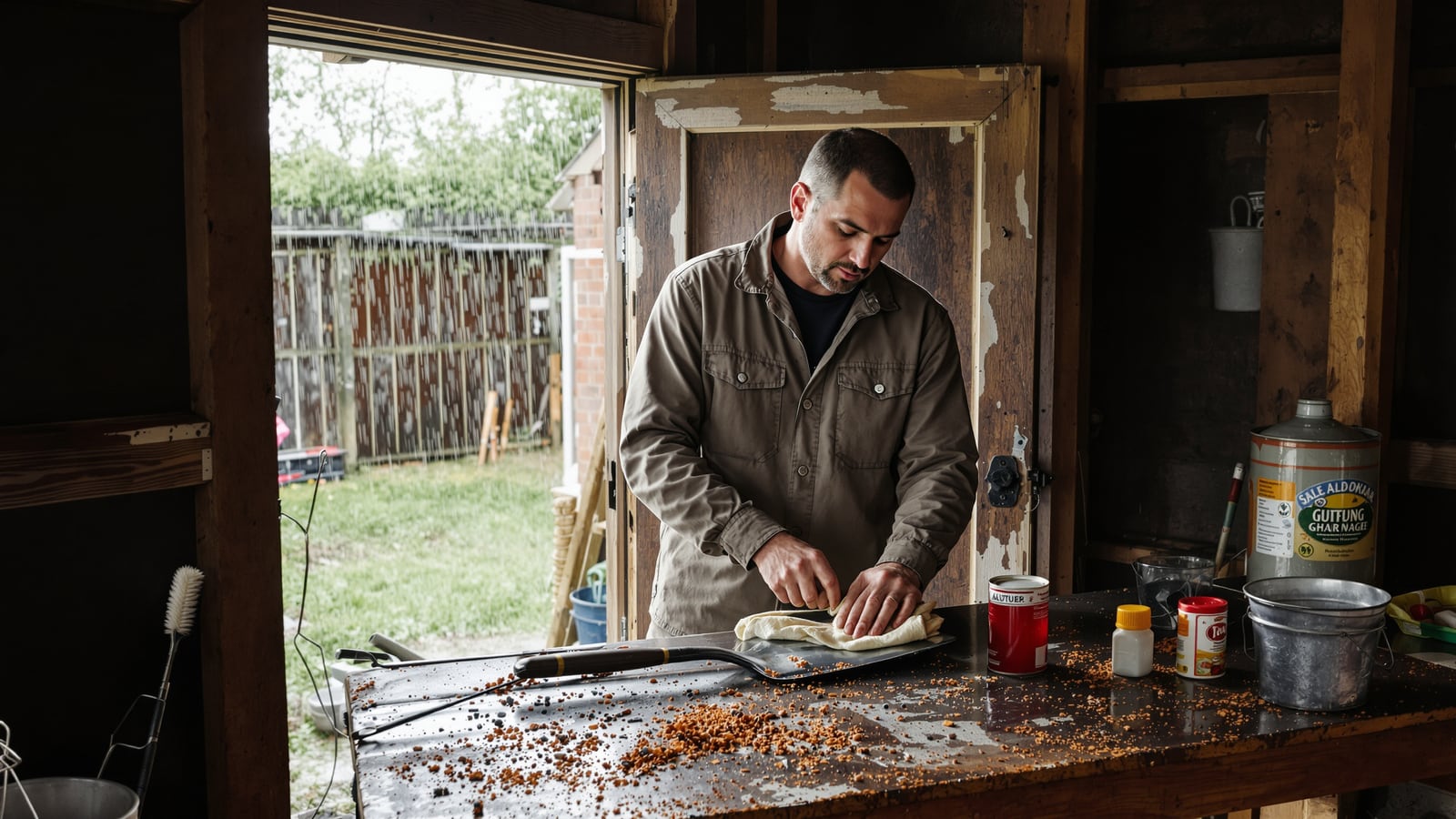
Quick answer: Rust needs iron, oxygen and water, and salt makes it run faster. Nothing stops it for good. Paint, zinc, chromium and oil work by blocking the reaction or by giving it something else to eat first.
Leave a bare steel shovel out in the yard through one rainy night. By morning it has an orange haze. Hours, not weeks.
That haze isn't damage in the way a dent is damage. It's the metal returning to its natural state. Steel is mostly iron, and in the ground iron lives as ore, bonded to oxygen. A mill spends enormous heat to tear that oxygen off. Rust is the iron taking it back.
A tiny battery on every wet surface
Put a droplet of water on bare steel and you've built a small battery.
At the center of the drop, where the water is deep and oxygen is scarce, iron atoms give up electrons and dissolve into the water as ions. The electrons travel through the steel to the edge of the drop, where oxygen from the air is plentiful. There, oxygen grabs them. The iron ions drift, meet that oxygen-rich water, and settle out as rust, a hydrated iron oxide.
So the metal is eaten in one spot and the orange shows up in another. That's why a pitted pan or truck frame can look worse underneath than the rust on top suggests.
Salt matters because the circuit only works if charge can move through the water. Pure water is a lazy conductor. Salty water is a good one. It's why trucks in the snow belt and boats in the ocean lose the fight faster than a tractor in a dry barn. The same basic idea, electrons moving between two points through a conducting liquid, is what's going on inside your phone battery. In a battery we want it. On a bridge we don't.
Why rust is worse than most corrosion
Plenty of metals corrode. Aluminum does it within moments of being cut. But aluminum oxide forms a thin, tight skin that seals the metal underneath, and the reaction stops.
Iron rust does the opposite. It's bulky and flaky, and it takes up several times the volume of the iron it came from. It cracks and falls away, exposing fresh metal. And what stays behind is porous, so it holds moisture against the steel like a sponge.
That swelling is also why rust can split concrete. When water reaches the steel bars buried inside, the rust pushes outward with real force. It's one of the quiet ways a bridge eventually fails.
Four ways to stall it
1. Block it. Paint, powder coat, oil, wax and the black finish on a gun barrel all work as barriers between steel and the water and oxygen. They're cheap and they work well, until they're scratched. Then moisture gets to bare metal, and rust creeps sideways under the coating. That bubbling you see around a chip in a truck fender is exactly that.
2. Give it a victim. Galvanizing coats steel in zinc. Zinc gives up its electrons more readily than iron does, so it corrodes first and the steel is left alone. This is the clever part: scratch a galvanized bolt down to bare steel and the zinc nearby still protects it. A painted bolt can't do that.
The same trick shows up in a water heater. There's a rod of magnesium or aluminum inside, called an anode rod. It's the sacrificial part, and it's meant to be eaten. When it's gone, the tank is next. A plumber can check yours in a few minutes.
3. Build a skin that heals. Stainless steel is steel with at least 10.5 percent chromium. The chromium reacts with oxygen and forms a film only a few billionths of a meter thick. It's invisible and tight, and if you scratch it, it re-forms as long as oxygen can reach the spot.
It isn't magic. Chlorides, from salt, pool chemicals and bleach, can break the film down. Tight crevices starve it of oxygen so it can't heal. That's why a stainless grill grate or a strainer left in a salty sink can still pit. For coastal and marine use, look for type 316, which adds molybdenum for better chloride resistance. Type 304 is fine for most kitchens.
4. Let it rust once, on purpose. Weathering steel, the Cor-Ten family used on sculptures and some bridges, contains small amounts of copper, chromium and other elements. It rusts, but into a dense, tightly bonded layer that slows further attack. It wants cycles of wet and dry, though. Keep it soaked, or bury it in road salt, and it behaves like ordinary steel.
What to do in your own garage
The science boils down to a short routine.
- Dry it before you store it. Wipe tools down after a wet job. Water trapped in a toolbox or a plastic bag does more harm than open air.
- Oil the bare steel. A light coat on hand tools, saw blades and pliers is enough. On a cast iron table saw top, use paste wax.
- Treat sweat as salt water, because it is. Wipe down firearms, knives and multitools after a humid day, a carry day or a range day. Holsters and sheaths hold moisture against the metal. A light film of oil afterward does the rest.
- Fix chips fast. Sand to bright metal, then prime and paint. A dime-sized chip left alone through a winter becomes a hand-sized bubble.
- Put a desiccant pack in the toolbox. Silica gel is cheap, and it keeps humidity down in a closed space.
- Know what seasoning is. A cast iron pan's black coating is baked-on oil that's turned into a hard film. It's a barrier. Soak the pan for an hour and you're asking it to fail.
If something has already rusted, soak it in white vinegar for several hours or use a commercial rust remover. Scrub, rinse and dry it completely, then oil it right away. Clean bare steel can flash-rust within hours, sometimes before you've put the brush away.
One more habit worth keeping. When you borrow a tool, return it wiped down and with a drop of oil on it, even if it came to you dry and dull. A neighbor who gets his wrench back better than he lent it will lend you the next one.
Steel is borrowed time. The cheapest way to extend the loan is a rag and a few drops of oil.
Dean Shaw
Gear & Garage
Reads the warranty, the parts list and the long-term owner reviews before anything else. Trucks, tools, watches, and the cheap version that costs more.

Watch
Worth an hour of your evening
More from Science & Space.
From channels we rate. Plays on YouTube.
Read next