

Why Wood Spares Your Knife and Glass Wrecks It
Glass isn't even harder than your steel. So why does it ruin an edge so fast while a maple board barely touches it?
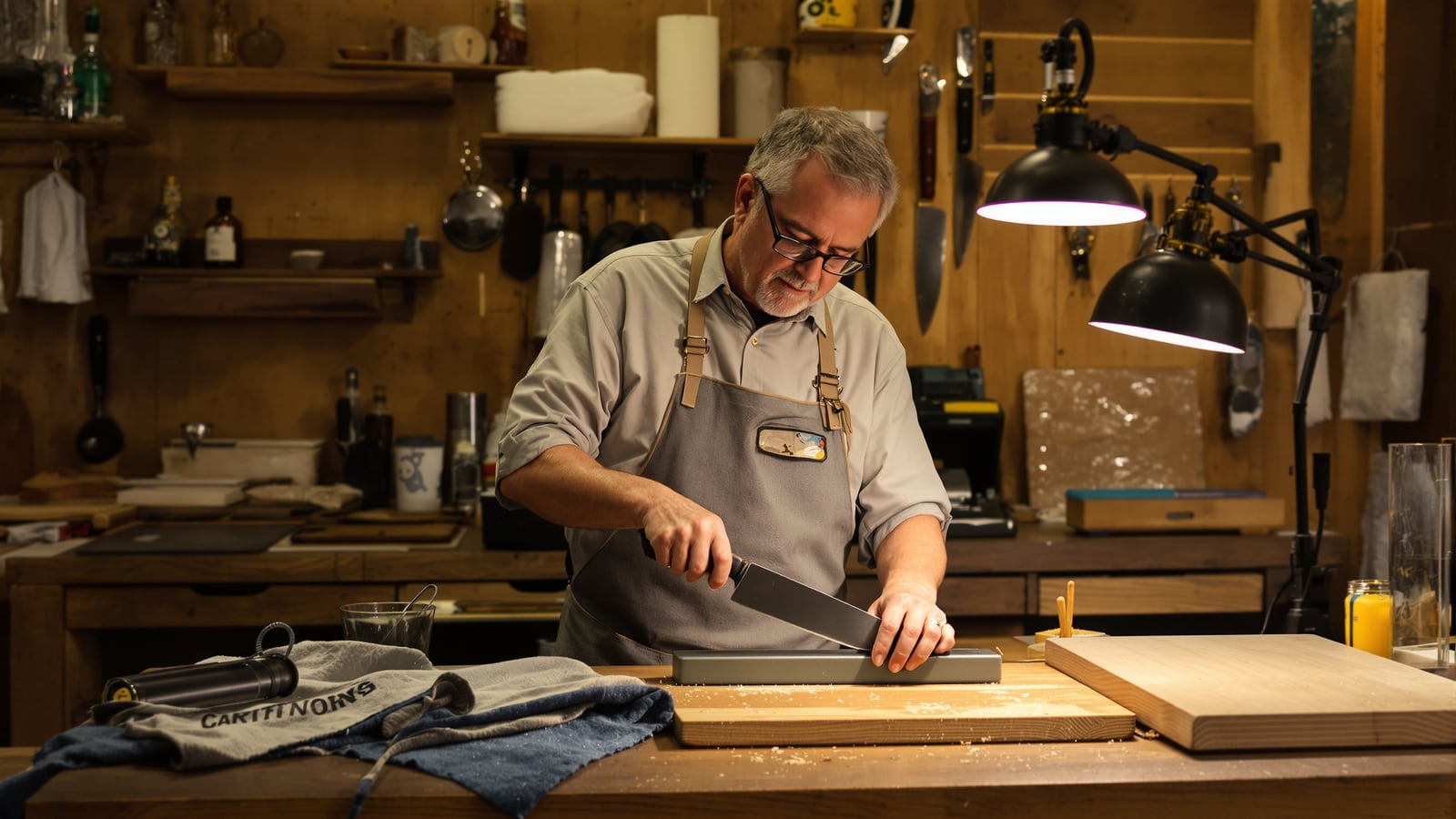
Quick answer: Glass and ceramic don't give. Your knife's edge is microscopically thin, and when it lands on something that won't yield, it bends over or chips. Wood gives a little, and its fibers let the edge sink in and spread the load.
A good kitchen knife is hardened to roughly 58 to 62 on the Rockwell C scale. Ordinary window glass sits around 5.5 on the Mohs scale. Hardened steel is the tougher material, so on paper the knife should win.
It doesn't. A glass board will take the keen edge off a knife faster than almost anything in your kitchen. The reason has less to do with which material is harder and more to do with what the edge is actually asking of the surface underneath it.
The edge is thinner than you think
A human hair is on the order of a tenth of a millimeter across. The very tip of a sharp knife, the apex where the two faces meet, is a small fraction of that. All the force from your hand, your wrist and the weight of the blade funnels into that sliver.
Steel that thin is strong in the direction it's pushed, straight down. Sideways, it's fragile. Any hard, flat, unforgiving surface will find that weakness.
When the apex slams into glass, the glass doesn't move. Nothing absorbs the shock. The edge has two options. It can fold sideways, which knife people call rolling. Or a tiny piece of steel can snap off, which is a microchip. Both leave you with an edge that's no longer a clean line, and you feel it as the knife slipping on a tomato skin instead of biting.
Knife people argue about how much of the damage is rolling and how much is chipping. Both happen, and which wins depends on the steel and the angle.
What wood does differently
Wood is a bundle of cellulose fibers, mostly running in one direction. When the edge comes down, the fibers compress and part around it. The apex sinks in a fraction of a millimeter instead of stopping dead. The force spreads across a bit of fiber instead of concentrating on a hair-thin line.
Then the fibers spring back. That's why a well-used maple board shows knife marks but doesn't turn into a gouged mess, and why oiling an old board makes many of the marks fade.
End-grain boards, where the fibers stand up like a bundle of straws and the blade slides between them, are the gentlest of all. They're also the priciest, and they need more oil. Edge-grain boards are the sensible middle for most kitchens.
None of this means wood is free. Food dulls a knife. So does the board, slowly. The difference is between wearing an edge down over months and wrecking it in a few sessions.
Ceramic is a different problem
Ceramic has the same no-give issue as glass, plus a second one. Fired clay and stone contain mineral grains, and quartz, the main mineral in sand, is harder than the steel in most kitchen knives. Cutting on a plate, a stone slab or a tile isn't just hitting a wall. It's dragging your edge across something that can cut back.
The worst offender in most homes isn't a board at all. It's the dinner plate. Run a steak knife across stoneware and you'll hear it, a faint scrape that sounds like a pencil on slate. Listen for it. That sound is your edge being ground down.
The same goes for granite and quartz countertops. Cut on the counter once and you'll forgive yourself. Cut on it daily and you'll be sharpening monthly.
The honest exceptions
Not every wood is a good board.
- Teak. It contains silica, a mineral that dulls cutting tools, which is why woodworkers complain about it. Pretty, but skip it for the kitchen.
- Bamboo. It's a grass, it also contains silica, and boards are usually made from hard strips glued together. Many cooks find it tougher on an edge than maple. Much better than glass, not as kind as hardwood.
- Plastic. A polyethylene board is soft, so it's easy on edges. It scars with use, though, and deep scars are hard to clean. It's a fair choice for raw meat if you can toss it when it's chewed up.
Hard maple, walnut and cherry are the classic choices for a reason. They're dense enough to last and soft enough at the fiber level to be kind to steel.
What to do with the glass board
If you got one as a wedding gift, you've got three options. Use it as a trivet. Use it to serve cheese, where nobody's cutting on it. Or put it away and buy a real board.
If you're cooking in someone else's kitchen and the only board is glass, go gentle, slice with a light touch instead of chopping, and leave their knife as sharp as you found it. Better, bring your own board when you visit. That's the old rule: leave a place better than you found it.
Keeping a wood board in good shape
A board that's looked after lasts decades. One that isn't cracks within a year.
- Wash by hand. Warm water, a little dish soap, a quick scrub, then wipe it dry.
- Never soak it. And never run it through the dishwasher. Wood swells unevenly in water and heat, and that's how boards warp and split.
- Stand it on its edge to dry. A board left flat on the counter dries on one side first and curls.
- Oil it when it looks pale and dry. Food-grade mineral oil is the standard. Rub it in, let it sit a few hours, wipe off the extra.
- Keep raw meat separate if you can. A second board, or a plastic one for chicken, keeps things simple. If you use one board for everything, scrub it hard with hot soapy water after raw meat and let it dry fully.
One more thing for your knives
Even with a good board, an edge will roll a little with use. A honing rod doesn't sharpen. It pushes a bent edge back into line, and a few light passes before you cook can bring back a surprising amount of bite. Real sharpening, on a stone or with a service, is for when honing no longer works.
Steel meeting something that gives a little is the same principle behind a wing that flexes in rough air (why airplanes fly and turbulence won't break one) and a bridge deck built to move instead of resist (what holds a bridge up). Engineers have known for a long time that the thing that never bends is usually the thing that breaks first.
Your knife just needs a board that knows that too.
Dean Shaw
Gear & Garage
Reads the warranty, the parts list and the long-term owner reviews before anything else. Trucks, tools, watches, and the cheap version that costs more.

Watch
Worth an hour of your evening
More from Science & Space.
From channels we rate. Plays on YouTube.
Read next