Start With Door Lettering, Not Full Vehicle Wraps
Full wraps look like easy money until you've ruined your third roll of vinyl. Lettering and decals are where a side hustle can actually pay.
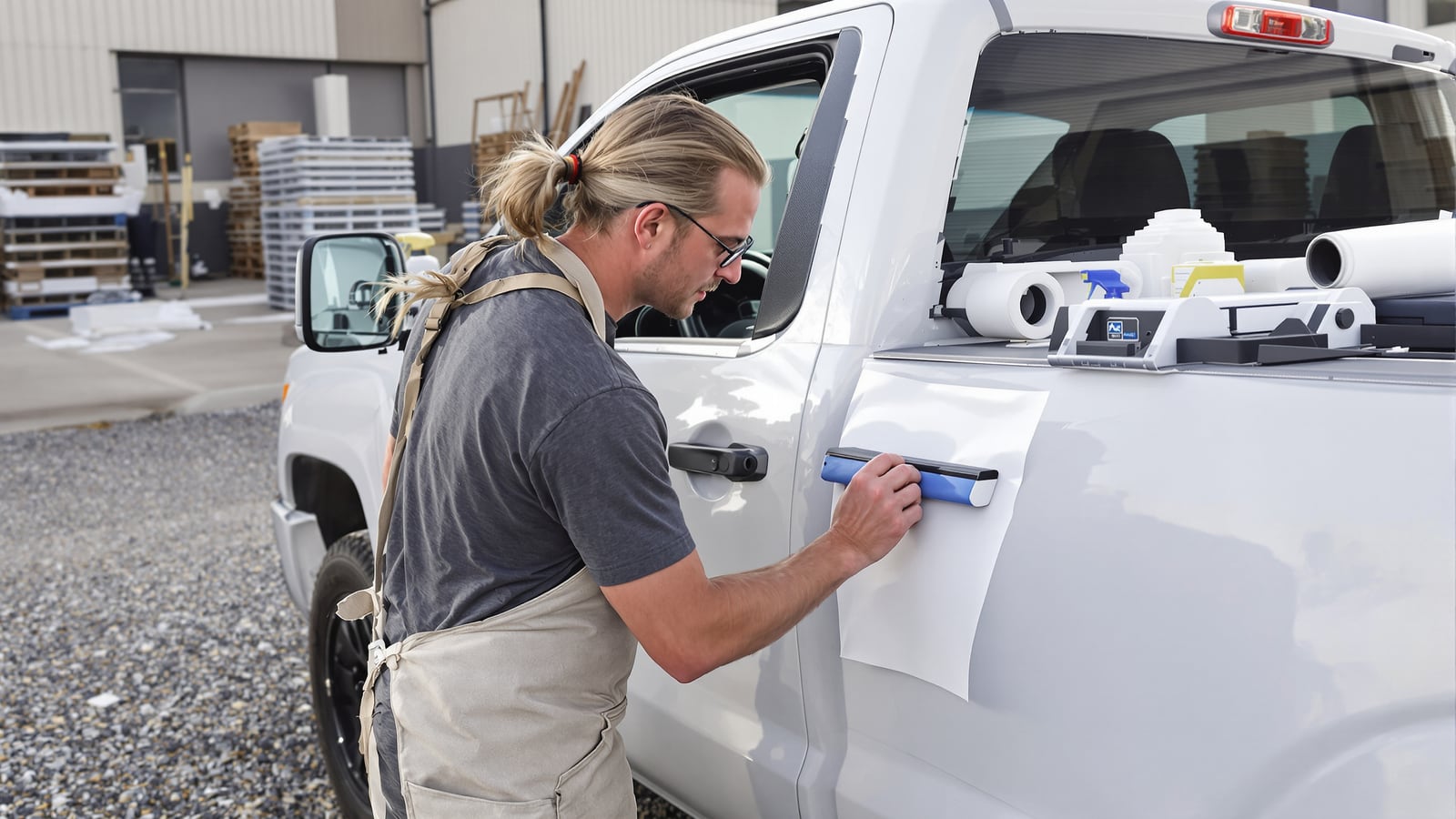
Quick answer: Skip full wraps at first. Sell door lettering, tailgate decals and small partial wraps to local tradesmen, and take a deposit before you order anything. The numbers below are example math with assumed prices, so plug in your own supplier quotes before you spend a dime.
Why not start with full wraps
A full wrap is the picture everybody has in their head. A work van, wrapped end to end, turning heads on the interstate. It's also the hardest job in the trade. You're stretching a big sheet of film over curves, around door handles and into recesses, and it has to look flat when you're done.
Beginners ruin material. That's normal. On a full wrap, ruined material is expensive, and so is the redo when a corner lifts three weeks later and the customer calls.
Door lettering works differently. A plumber, a landscaper or a roofer wants a name, a phone number and a license number on both doors of the truck. The surface is mostly flat and the vinyl is cut, so there's no giant printed sheet. A mistake costs you a few dollars, not a few hundred.
The customer is also easier to find. Every small contractor in your town drives a truck with nothing on it, or with a magnet sign that's been sliding around since 2019.
What it costs to start
Two routes, and they're very different.
Install-only. You don't buy a cutter. A local sign shop or online supplier cuts or prints the graphics, and you install them. You need squeegees, a heat gun, knifeless tape, a measuring tape, masking tape for positioning, cleaning supplies and a few hours of practice on scrap. As a ballpark, that's a few hundred dollars. The catch is that the shop keeps the margin on the graphics.
Cut it yourself. A 24-inch cutting plotter, design software, a decent laptop and a stock of vinyl rolls will run you well into four figures. Ballpark, $1,500 to $3,500 depending on what you already own. Call a couple of suppliers and get real quotes before you trust that number.
My advice is to start install-only, learn on real jobs, and buy the plotter after you've sold enough lettering to know it'll pay for itself.
Buy film from the established makers. 3M and Avery Dennison are the two names you'll hear most. Cheap, mystery-brand vinyl is where the lifting, fading and cracking complaints come from.
The honest math
Assume you charge $300 to letter a truck: two doors, name, phone, license number. Assume $70 in material, or the shop's cut if you're outsourcing the cutting. Assume five hours all in, counting the quote, the design proof, the drive and about three hours of actual install.
That's $230 left per job before software, supplies, insurance and taxes. Roughly $46 an hour.
Now do six jobs a month. That's $1,800 in revenue and about $1,380 left, for around 30 hours of work. Not a living. A solid second paycheck that costs you a couple of Saturdays.
That math hides a few things. The first few jobs will take twice as long as you planned. Winter is slow in a lot of places. And getting six jobs a month means you're spending time finding customers, not just installing.
Taxes come out of that $1,380. Self-employment tax is real, and so is income tax. Read what to set aside for taxes on side income from dollar one before your first invoice goes out. Sales tax rules on this kind of work vary by state, so ask your state revenue department or a CPA.
Design that gets read
A truck is a moving billboard that people see for about three seconds. Design for that.
- The business name and the phone number should be the biggest things on the door.
- Say what they do in a few words: "Lawn Care," "Roofing & Gutters."
- Put the license number on if your state requires it.
- High contrast. Dark on light, or light on dark. No thin script fonts.
- One website, and only if it's short. A QR code on a moving truck is a waste of vinyl.
Then check the phone number three times. Have the customer sign off on the proof in writing, a text with "approved" works. Picture a wrong digit printed on both doors of a work truck. Nobody enjoys that call, and the person who approved the proof is the person who pays for the redo.
Installation without the heartbreak
Clean the surface twice, once with soap and water and once with the prep solvent your vinyl maker recommends. Any wax or road film will fight you.
Mount the graphic with tape first. Step back and look at it from ten feet. Measure from a body line, not your eye.
Work from the center out with firm, overlapping strokes. Use heat sparingly on curves. And don't install in wind, dust, direct sun or cold. Doing it in your own garage, or the customer's shop with the door shut, beats a parking lot every time.
Inspect the paint before you touch it. Repainted panels, peeling clear coat and rust can pull off with the vinyl when it's removed, or fail right after install. If the paint is bad, tell the customer in writing and say no to that panel. Holding that line saves you a warranty fight.
Hand the truck back cleaner than you got it. Wipe the glass, clean up your trimmings, vacuum a floor mat if you set foot inside. Customers remember it, and it costs you ten minutes.
Payment terms that protect you
You're buying material for a job that only works for one customer. Once it's cut, it's theirs or it's scrap.
- Deposit: 50 percent before you order or cut. No exceptions for friends of friends.
- Balance: due when the work is done, before the truck leaves. Net 30 terms are how side hustlers end up chasing money. Offer them only to someone you've worked with several times, if ever.
- Written scope: what's being installed, where, what it looks like, the price, and what happens if they change their mind after approving the proof.
- Removal: charge for removing old decals. It's slow, sticky work.
- Workmanship warranty: pick a period you can live with, put it in writing, and say what it doesn't cover, like paint failure or damage from a car wash with a pressure wand held too close.
A deposit isn't distrust. It's how two people agree on a deal and keep it friendly.
Insurance and the line you shouldn't cross
When a customer hands you their keys or leaves their truck in your garage, you're responsible for it. Your personal auto and homeowners policies often exclude business activity. Call an independent insurance agent, describe the work, and ask about general liability and coverage for customer vehicles in your care. I can't tell you what you need. That's a conversation with a licensed agent.
Check your city and county on licensing too. Some places want a business license even for a home-based side job. If you're getting serious, read when a side hustle should become a business and when it shouldn't.
When it's not worth it
Don't do this if you don't have a clean, enclosed space to work in. Don't do it if you hate detail work, or if you can't stand redoing something that's 95 percent right. Don't do it if your plan is to sell wraps to strangers on social media with no local contractor network.
It works best for someone who already knows tradesmen and small business owners, can finish a careful job and likes a trade where the customer drives away proud of the truck. If you already clean cars on the side, the driveway detailing business is a natural way to meet the owners of the trucks you'll want to letter.
Start with one truck, do it right, and let it ride around town with your phone number on the quote you leave in the glovebox.
General education, not financial, tax or legal advice. Talk to a CPA and an insurance agent about your own situation.
Ray Okonkwo
Money & Business
Former commercial banker turned small-business owner. Covers salary, credit, margins and the arithmetic nobody does before signing.

Watch
Watch how it's done
Picked for this article.
From channels we rate. Plays on YouTube.
MHC Sign & Design
Truck Door Vinyl Installation - Step by Step - Side 1
Slicks Graphics Inc
How To Install Truck Lettering - Slicks Graphics
Read next