Apprentice to Master Electrician and What Each Step Pays
Four to five years of paid work, 8,000 hours on the books, and a code exam that eats people who wing it. The real path, the money, the trade-offs.
You get paid from the first Monday. That's the part nobody tells eighteen-year-olds while they're signing a promissory note for a communications degree. An electrical apprentice starts on a jobsite at roughly 40 to 50 percent of journeyman scale in his area, gets a raise every six months or thousand hours, and walks out the far end with a license, a tool bag, and zero tuition debt. The Bureau of Labor Statistics puts the median electrician wage a shade over $61,000 a year. Median. Half the trade makes more, and the half making more includes every service guy with a van, every industrial hand on shutdown work, and every master who put his own name on a contractor's license.
That's the pitch. Now the actual mechanics, because the mechanics are where people wash out.
The hours are the whole game
Almost every state runs on the same math: about 8,000 hours of supervised on-the-job work plus roughly 576 to 900 hours of classroom instruction before you can sit for the journeyman exam. Eight thousand hours is four years of full-time work. If the weather's bad or the company runs dry on work, it's five.
Those hours have to be documented. This is the single most common self-inflicted wound in the trade. Guys work for a small outfit for two years, the owner retires or the company folds, and nobody kept a signed log of hours by category. The state board doesn't care how hard you worked. It cares what's on the affidavit.
Keep your own record. Date, job, hours, who supervised you, what kind of work it was (residential, commercial, industrial). A composition notebook is fine. Get the master or the contractor to sign off quarterly, not at the end of four years when you can't find him.
Two doors in: union or merit shop
The union route is the IBEW local's Joint Apprenticeship and Training Committee. You apply, take an aptitude test that's heavy on algebra and reading comprehension, sit for an interview, and get ranked. Popular locals have waiting lists. The trade-off: structured raises, health and pension from early on, classroom instruction that's already vetted by the state, and dispatch to jobs you didn't have to find.
The non-union side runs through merit-shop associations like ABC and IEC, or straight through a contractor who registers you as an apprentice with the state and sends you to night school. Faster to get in. More variable in quality. You might end up on excellent commercial work or you might spend three years pulling romex in tract houses and learn one-tenth of the trade.
Ask one question before you sign anywhere: what kind of work does this shop actually do? An apprentice who only ever sees single-family residential will struggle badly on a journeyman exam full of conduit fill, motor calculations, and three-phase service sizing.
The classroom isn't optional and the code changes
Most programs run two nights a week, three hours a night, September through May. You'll do Ohm's law, conduit bending, blueprint reading, motor controls, and a lot of National Electrical Code.
The NEC gets revised every three years. 2020, 2023, 2026. States adopt on their own schedule, and some adopt with amendments, which means the code your state enforces might be a cycle behind the book on the shelf at the supply house. Before any exam, confirm which edition the test is written to. People have failed by studying the wrong year.
Learn to use the codebook rather than memorize it. Nearly every journeyman exam is open-book and timed, and it's designed so that a man who knows where Article 310 lives finishes and a man who reads the index finishes half.
Journeyman, master, contractor. Three different things.
A journeyman license means you can do the work without someone standing over you. In most states that's the 8,000-hour, pass-the-exam milestone.
A master license means you can pull permits, design systems, and supervise others. Texas, for example, requires you to have held a journeyman license for at least two years and logged 12,000 hours before you can test for master. Other states set it at four years as a journeyman. The exam is longer, harder, and leans on load calculations and code interpretation rather than field procedure.
A contractor license is a business license. It usually requires a master on staff (sometimes that's you), plus liability insurance, a surety bond, and a workers' comp policy. Having a master ticket doesn't automatically let you sell jobs to the public.
Now the caveat this entire article rests on: it varies by state, and sometimes it varies by city inside a state. California certifies general electricians at the state level through the Department of Industrial Relations but doesn't issue a "master electrician" license at all. Contractors go through the CSLB for a C-10. Illinois has no statewide electrician license, so Chicago, Springfield and the suburbs each run their own. New York licenses through municipalities too. Reciprocity between states exists but it's patchy, and it usually only covers journeyman, not master.
Before you plan a single thing, pull up your state's electrical board website and read the actual requirements. Then call them. They answer the phone, and they'd rather explain it once than reject your application twice.
The money, honestly
First-period apprentice in a mid-cost metro is often in the high teens to low twenties an hour. By your final period you're in the thirties. Journeyman scale swings hard by region: a licensed journeyman in rural Alabama and one in Seattle aren't in the same conversation, and neither are their rent checks.
Where the pay actually jumps:
- Industrial and plant work. Refineries, data centers, water treatment. Shutdowns pay overtime in slabs.
- Service and troubleshooting. The guy who can find the fault is worth three guys who can pull wire.
- Low-voltage and controls. Building automation, fire alarm, PLC work. Fewer people are good at it.
- Owning the truck. A one-man service outfit with a master license and a decent reputation in a growing suburb does very well. It also means you're now a business owner, which is a different job with different headaches.
Travel work pays a premium with per diem. It's real money and it's hard on a marriage. Decide that one with your wife, not with a recruiter.
The part that can kill you
Electrocution is one of OSHA's Fatal Four in construction, alongside falls, struck-by, and caught-in. You will meet men in this trade who have arc flash scars and men who tell you a story about a guy who didn't come home.
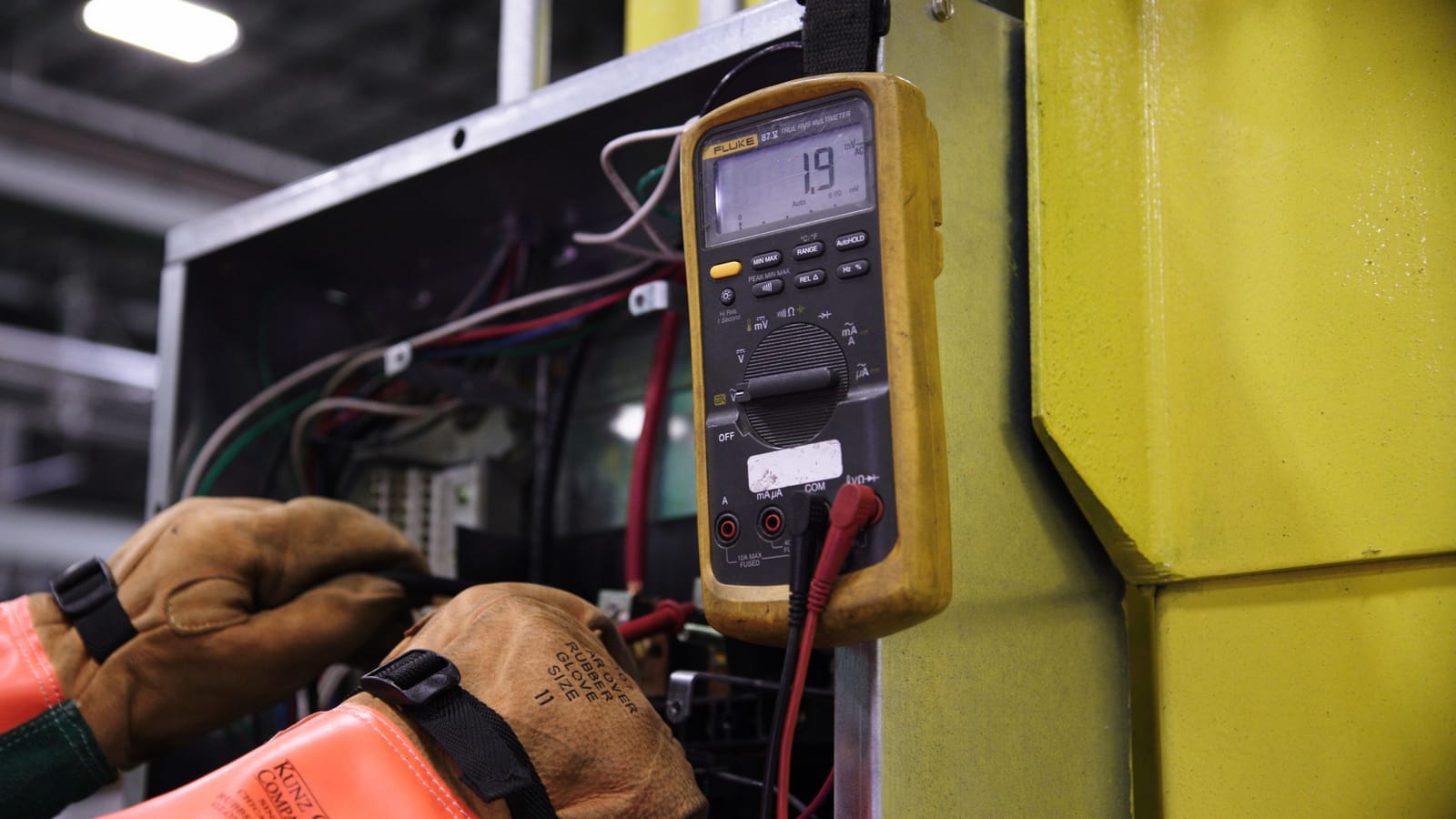
Three habits, drilled until they're reflex. Test your meter on a known live source before and after you test the circuit, every single time, because a dead meter reads exactly like a dead conductor. Lock out and tag out with your own lock, and never trust a breaker somebody else turned off. Wear the arc-rated gear for the task, and treat NFPA 70E boundaries as law rather than suggestion.
Add the boring ones. Ladders kill more electricians than panels do. So do knees and shoulders at 55 if you spent twenty years lifting wrong.
Who shouldn't do this
If you can't do fractions and basic algebra in your head, fix that before you apply, because the aptitude test will find you. If you need a climate-controlled room, note that you'll spend Julys in unconditioned attics and Januaries in open steel. If you can't take correction in front of other men, the first year will be miserable, because getting corrected loudly is how the trade transmits knowledge.
And if you want to be told what to do for forty years, this is the wrong trade. The good ones are the guys who look at a print, spot the problem the engineer missed, and say something before the concrete gets poured.
Five years from now you'll either have a license and a truck, or you'll have five more years. Same clock either way.
Ade Fisher
Young Men
Teaches the trades intake at a community college. Writes the manual he wishes his students arrived with.

Watch
Watch how it's done
Picked for this article.
From channels we rate. Plays on YouTube.
Zach of All Trades
How to Become an Electrician | Step-By-Step Guide
American Electrician
The Truth About The Electrical Apprenticeship
Read next