
Quick answer: Saddle making, blacksmithing and custom knife making aren't licensed trades with a union hall and a pay scale. They're one-man businesses. The people who make it almost always learn the craft on nights and weekends while a related job pays the mortgage, then cross over once the waiting list is real.
A decent 2x72 belt grinder is where most knife makers start, and a good one costs more than a lot of people's first car payment for a year. An old anvil in usable shape often trades for a few dollars a pound. A saddle tree comes from a separate craftsman before you've cut a single piece of leather. None of that is the hard part.
The hard part is that you're not joining a trade. You're starting a company with one employee, no customers and a skill you don't have yet. Every romantic video about these crafts skips that sentence. It's also why the smartest way in is through a paying cousin: an adjacent trade that teaches half the skills and covers the bills while you learn the rest.
Custom knife maker
The paying cousin: machinist, welder or fabrication shop hand.
Start with stock removal, not forging. You buy a bar of known steel, profile it, grind the bevels, send it out for heat treatment or do it yourself in a controlled oven, then fit the handle. Forging is wonderful, and you'll get there. But stock removal teaches you geometry and finish, and those are the two things customers actually judge. Plenty of respected makers never forge at all.
The credential that means something is the American Bladesmith Society. It runs three ranks for forged blades: Apprentice Smith, Journeyman Smith and Master Smith. The journeyman performance test is famously physical. Your blade has to cut free-hanging rope, chop through a two-by-four, still shave hair afterward, then bend ninety degrees without breaking. Master Smith adds a pattern-welded (damascus) test on top. It's a years-long path, and it's the fastest way to stop guessing whether your work is any good.
The mistakes are predictable:
- Buying pre-made damascus and calling it your work. Customers and other makers can tell.
- Pricing by what feels polite. Your first dozen knives should go to friends at material cost. Your next dozen should be priced for your time.
- Ignoring the law. Knife laws vary by state, and automatic knives run into federal rules the moment they cross state lines. Know what you can legally make, sell and ship before you list anything.
If you're coming from a fab shop, you already know how to run a grinder without losing a fingertip. Welding pays well if you chase the right certifications, and it's the most natural day job in this whole list.
Blacksmith
The paying cousin: farrier or welder.
Find your local blacksmith guild first. Most regions have one affiliated with ABANA, the Artist-Blacksmith's Association of North America. Guild members hold open forge days, lend tools and know who's selling an anvil. Formal classes run at places like the John C. Campbell Folk School in Brasstown, North Carolina, where a week at the forge teaches you more than a year of watching.
Know where the money actually is. Decorative hooks and bottle openers at the craft fair won't pay a mortgage. Architectural ironwork will: railings, gates, hardware for restoration projects, custom fireplace tools for people building expensive houses. That's commission work with real ticket sizes, and it rewards a smith who can also weld, measure a staircase and show up when he said he would.
Farriery is the working blacksmith's closest living relative, and it's a genuine full-time career. Most states don't license it. The standard mark of competence is certification through the American Farrier's Association, starting at Certified Farrier and climbing to Certified Journeyman Farrier. Farrier schools run from a few weeks to several months, and the best path after school is riding along with an established farrier.
The price is your back. You'll spend your day bent under a thousand-pound animal that didn't ask to be there. Read work forty years in the trades without wrecking your body before you sign up, not after.
Saddle maker
The paying cousin: saddle and tack repair.
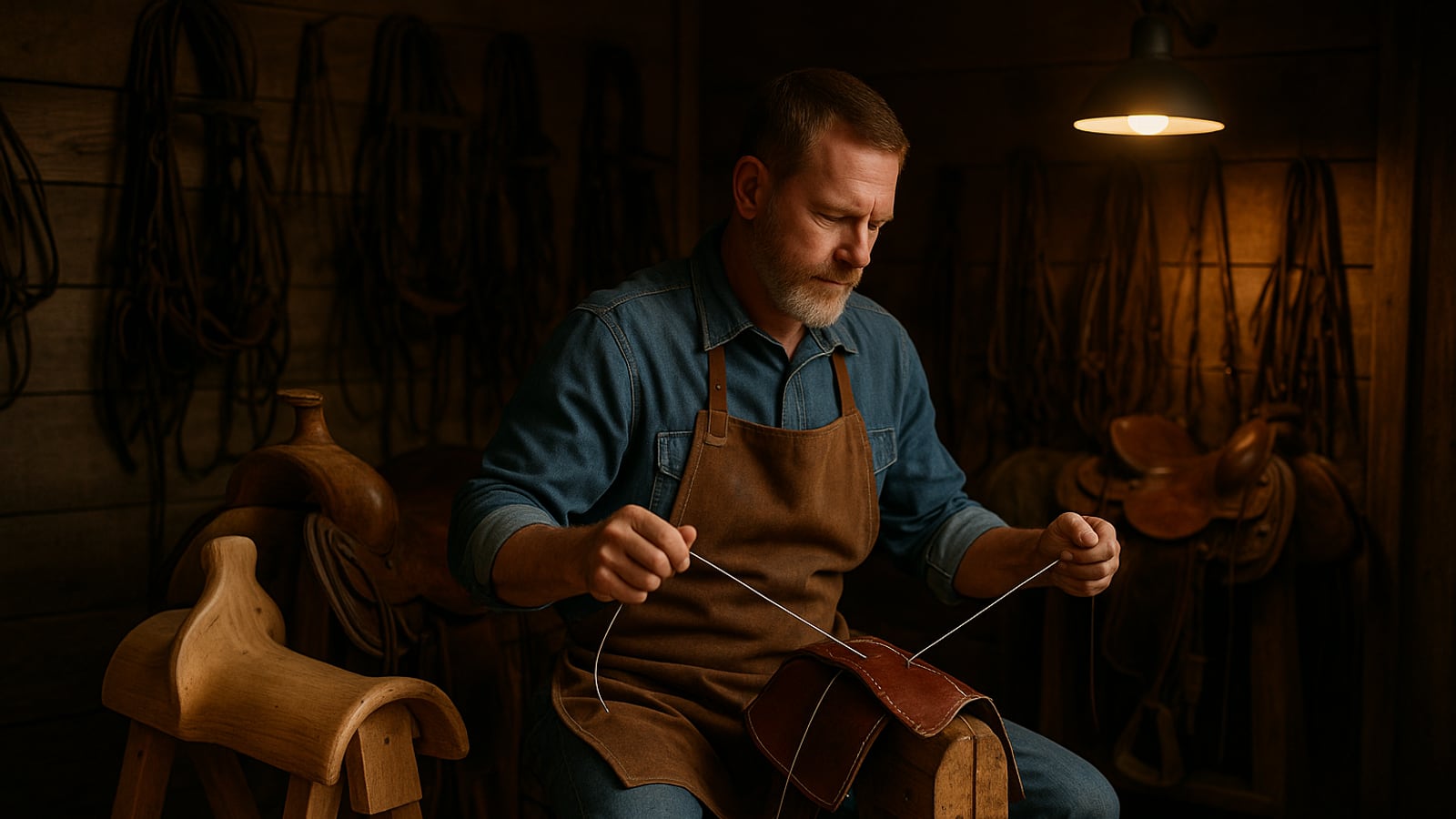
This is the slowest of the three, and the one where apprenticeship still matters most. A good custom saddle has to fit a particular horse and a particular rider, and that's knowledge you mostly get by standing next to someone who's done it for thirty years.
So start with repair. Every ranch, riding stable and rodeo family has a pile of broken tack: torn billets, worn-out latigos, a stirrup leather that gave up. Repair teaches you how saddles fail, which is the best education in how to build one that won't. It also puts you in front of the exact customers who'll eventually order from you.
Location decides a lot. A saddle shop does well where there are horses and people who ride them for a living. Leather and supplies are easy to order from suppliers like Weaver Leather Supply or Tandy Leather. Customers aren't.
The ceiling is high. The Traditional Cowboy Arts Association represents the top of the craft in saddles, bits, spurs, silver and rawhide, and custom saddles from established makers commonly run well into four figures with waits measured in months or years. That's the destination. Plan on a decade to get there.
The honest money
Nobody publishes reliable pay numbers for these crafts, and anyone quoting you an average is guessing. Your income is simple math: sale price, minus materials, minus shop costs, divided by hours.
Run it on a hypothetical. Say you sell a hunting knife for $300. Steel, handle material, pins and a sheath eat a good chunk of that. Belts, propane and electricity eat more. If the knife took you twelve hours, you just worked for less than you'd make sweeping a fab shop. That's normal in year two. The only fix is getting faster and getting a name that lets you charge more, and both take years.
So keep the day job until three things are true: you've got orders booked months out, you've raised your prices at least twice and people still pay them, and you've got six months of expenses saved.
Licensing, taxes and paperwork
The crafts themselves are rarely licensed. The business is. Depending on your state and county, you'll likely need a business license, a sales tax permit and possibly a home-business or zoning permit if a forge is going in your garage. Product liability insurance is worth pricing the day you sell your first knife. This all varies by state, so talk to a local accountant and your county office before you open.
Safety that the videos skip
- Forges produce carbon monoxide. Propane or coal, run it with serious ventilation and a CO detector.
- Grinding makes dust you shouldn't breathe. Steel dust and some exotic handle woods are genuinely nasty. Wear a real respirator, not a paper mask.
- Belt grinders grab. A blade caught by the belt becomes a projectile. Keep your hands behind the edge and never wear gloves near a moving belt.
- Quench oil can flash. Keep a metal lid next to the tank.
- Leather work uses solvents and dyes. Ventilate, and respect your head knife. It's sharper than anything in the kitchen.
- Eyes and ears, every time. Hammer on an anvil for an hour without plugs and you'll hear it for a week.
How to earn a spot in someone's shop
The old makers still take apprentices, but they don't take tourists. Show up early. Sweep before you're asked. Return every borrowed tool cleaner and sharper than you got it, and buy the next box of belts without being told.
But have a spine about it. Agree up front what you'll learn and by when. Sweeping for six months is paying your dues. Sweeping for three years while the old man's customers never see your name is free labor, and you're allowed to thank him and go.
The guy with the waiting list at the knife show didn't get there by being talented. He got there by making his five-hundredth knife while you were still watching videos about your first.
Dean Shaw
Gear & Garage
Reads the warranty, the parts list and the long-term owner reviews before anything else. Trucks, tools, watches, and the cheap version that costs more.

Watch
Worth an hour of your evening
More from Trades.
From channels we rate. Plays on YouTube.
Read next