
Check your truck's payload before you fall for a camper
A truck camper gets you where trailers can't. First you need one number from the sticker on your door, and most buyers learn it too late.
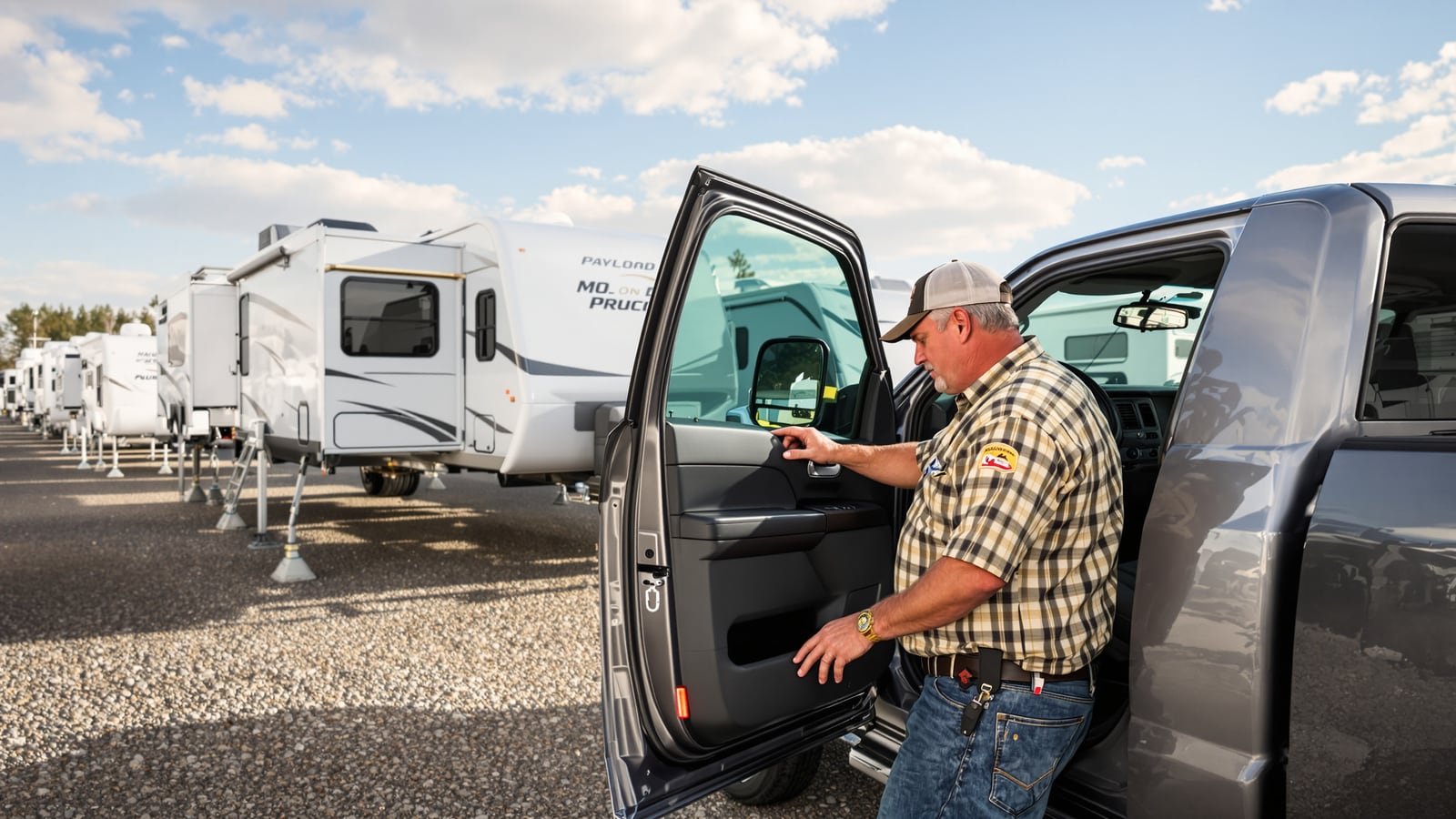
Quick answer: A truck camper rides in your pickup bed, so your truck's payload decides what you can buy. Find the sticker on the driver's door jamb, subtract everything you'll load, and shop only for campers that fit under what's left.
The sticker comes first
Walk onto a camper lot before you've read that sticker and you'll fall in love with the wrong camper. It happens every season. A man sees a hard-side with a real bed, a dinette and a heater, signs the paper, and then finds out his half-ton squats like a tired mule.
Open the driver's door. Look for the yellow and white placard that says "The combined weight of occupants and cargo should never exceed..." followed by a number. That's your payload. On many half-ton pickups it lands somewhere between 1,500 and 2,000 pounds. Some are lower, especially trucks loaded with options. A truck with a leather interior and a big engine can carry less than a plain work truck, because the extras use up some of its capacity.
Everything you put in or on the truck comes out of that number. You, your wife, the kids, the dog, the cooler, the tools in the toolbox, and the camper.
The brochure weight is a lie, politely told
Camper makers list a dry weight. That's the camper empty. No water, no propane, no battery, no gear.
Now fill it:
- Fresh water weighs about 8.3 pounds a gallon. Twenty gallons is roughly 166 pounds.
- Propane runs around 4.2 pounds a gallon, plus the weight of the tank itself.
- Add the battery, bedding, a stove, pots, chairs, food and firewood.
A camper listed at 2,200 pounds dry can easily ride at 2,800 loaded. If your payload is 1,800 pounds, the math ended before the trip started.
So work it backward. Take your payload. Subtract passengers and the gear you'll carry in the cab. Subtract a few hundred pounds for the camper's loaded extras. What remains is the dry weight you can afford. Write that number on a card and keep it in your wallet when you go shopping.
And be honest about the margin. You want to be under the limit, not at it.
What the truck needs besides capacity
Payload is the biggest question, but it isn't the only one.
Tires. Check the load rating on the sidewall. Many owners move up to a stiffer load range before they haul a camper. A tire shop can tell you what your truck's wheels will take.
Suspension. A camper sits high and mostly behind the rear axle. Helper springs or airbags can level the truck and cut sway. They don't raise your legal or rated limit. They only make the ride better.
Wheelbase and bed length. A short bed under a camper built for a long bed pushes weight far behind the axle, and the truck gets light and floaty in front. Match the camper to your bed length. The manufacturer's spec sheet says which beds it fits.
Size of the truck. Bigger hard-side campers generally belong on three-quarter-ton or one-ton trucks, and the biggest on dual rear wheels. If you own a half-ton, shop in the lightweight class: pop-tops and smaller hard-sides.
Insurance. Call your agent before you buy. Ask how the camper is covered and what happens if it's loaded on the truck or sitting on its jacks. This is a question for a professional, not a forum.
Why bother, then?
Because a truck camper goes where a trailer can't.
You're not towing anything. You back up like you always do. You can take the narrow forest road, park at the trailhead, squeeze into the small campground that turns away fifth-wheels, and drive through a town without a hundred-foot turning plan. Wind pushes you around less than it pushes a tall trailer. Weather that would make an RV owner stay put is just weather.
It's also the cheapest way to turn a weekend into a trip without hunting for a motel at 9 p.m. with two tired kids. Pull in, level up, make supper.
If you're planning a longer run, the same rules from planning a road trip that's still fun on day four apply, with one addition. Your truck is now your house, so stop for fuel before the light turns on.
What goes wrong
Nobody puts this in the brochure.
It's tight. A small camper sleeps two adults well. Two adults and two kids can work, but only if the kids are young and the trip is short. Four people and a dog in a 90-square-foot box makes an old family saying come true: you'll find out who you married. If you're taking the kids, read three hundred miles a day, and other rules for driving with kids first and plan shorter days than you think.
The bathroom is small or missing. Many smaller campers have a wet bath, a cassette toilet or nothing at all. If your wife is going, settle this before the purchase, not after. How to plan a trip your wife actually wants to be on covers the right order of questions. A camper she likes will get used for twenty years. One she tolerates gets sold.
Your truck is stuck with it. A slide-in camper can come off, but loading and unloading takes time and level ground. Plan on a full, slightly sweaty hour the first time, longer with a helper who doesn't know the jacks. If you want to set up a base camp and drive to town, you either unload the camper or you drive the whole rig to the grocery store.
Tie-downs matter. Use the manufacturer's tie-downs, hooked to the truck's frame or designated anchor points, and re-tighten them after the first few miles. A camper that shifts in a hard stop is a danger to everybody around you.
It costs real money. Buy a new camper and you may spend as much as you would on a modest travel trailer. If you also need a bigger truck to carry it, the total can pass what you'd pay for a small motorhome. Price the entire setup before you decide the camper is the cheap option.
Before you buy
- Read the payload sticker and write the number down.
- Subtract people, cargo, and a loaded-weight allowance for the camper.
- Find campers whose dry weight fits under what's left.
- Check bed length, tire load rating and suspension.
- Call your insurance agent.
- Rent a camper for a weekend before you commit.
That last step saves more marriages and bank accounts than the rest combined. Two nights in a real camper will tell you whether you want a dinette or a bigger bed, whether you can stand the cassette toilet, and whether loading it up is a chore you'll put up with. Plenty of rental outfits will set you up with a truck camper and show you how to run the jacks.
When you do, return it the way you'd want to get it. Full tank. Holding tanks emptied. Floor swept, counters wiped, and the cooler rinsed out. The owner will remember you.
Dean Shaw
Gear & Garage
Reads the warranty, the parts list and the long-term owner reviews before anything else. Trucks, tools, watches, and the cheap version that costs more.

Watch
Worth an hour of your evening
More from Travel.
From channels we rate. Plays on YouTube.
Read next