

In the Southwest in July, the clock matters more than the car
Your air conditioning isn't the plan. A schedule built around the sun, a water rule, and a few cheap checks are what get you home.
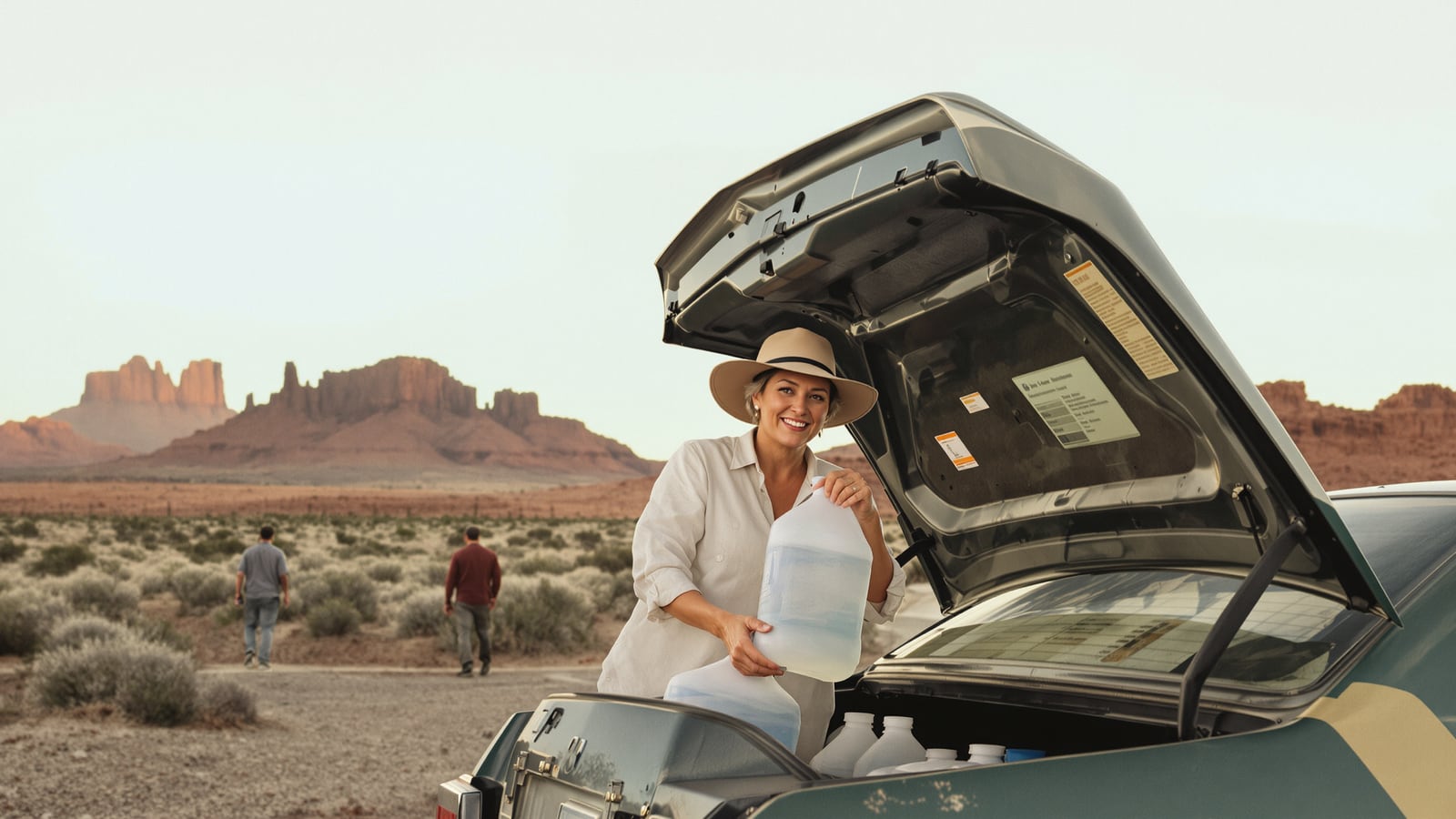
Quick answer: Do your driving before 10 a.m. and after 5 p.m. Spend the middle of the day indoors. Carry a gallon of water per person per day as a floor, plus extra in the trunk. Fill the tank at half, not at empty.
Phoenix in July regularly clears 110°F. Death Valley holds the official world record of 134°F, set in 1913. You won't hit that on I-40, but you don't need to. Ordinary Southwest summer heat is plenty to kill a tire, cook a phone, or put a man in the shade with a headache and a bad attitude.
Most people treat this as a car problem. Buy a sunshade, crank the AC, keep going. That's backwards. The car is the tool. The clock is the plan.
Build the day around the sun
Think of it as a shift schedule. The hours between roughly 11 a.m. and 5 p.m. are the dead zone. Nothing hard happens in it.
- Wheels rolling by 6 a.m. Seven is fine. Eight is where the trouble starts.
- Hard stuff before 10. Long drives, hikes, anything outdoors with a trailhead.
- 11 to 5: inside. A museum, a diner with a long lunch, a motel pool, a nap. Pick a town for it in advance so you aren't driving around at 2 p.m. looking for somewhere with AC.
- Back on the road around 5. The light is better anyway, and the rock turns colors you'll want to stop for.
The surprising part is how much you'll enjoy the dead zone. A two-hour lunch in Winslow or Truth or Consequences isn't lost time. It's the part of the trip nobody remembers being miserable.
Use elevation as a tool. Flagstaff sits around 7,000 feet and runs noticeably cooler than Phoenix, which is a couple of hours south. Santa Fe and Prescott do the same job. Put your long midday stop at altitude and your hot-country driving at dawn. If your route lets you sleep high and cross low, take it.
Planning the trip as a whole? Our piece on planning a road trip that's still fun on day four covers pacing the days so the early starts don't wear everybody out by Thursday.
The water rule, and why it needs a backup
The Park Service's rule of thumb for desert hiking is a gallon per person per day. Use that as your floor for the car too, then add more. You're not carrying it for the drive. You're carrying it for the day the drive stops.
Here's how that works in practice:
- Buy it by the gallon jug, not in thin bottles that split in a hot trunk.
- Keep one jug in the cabin and the rest low in the trunk, out of direct sun.
- Freeze two or three jugs the night before. They'll act as ice in the cooler and drinking water by afternoon.
- Carry one extra gallon beyond what your family needs. If you pass someone broken down on a long empty road, you'll be glad you did. Stopping for them is the old code, and it costs you a few minutes and a jug.
Drink before you're thirsty, and keep drinking. If you're sipping all day, you won't have to think about it. Salty snacks help. Pretzels and jerky are better road food in August than candy bars, which melt anyway.
What to check on the car before you leave
Do this at home, not at a gas station in Kingman.
- Tire pressure, cold, in the morning. Use the number on the sticker inside the driver's door, not the number on the tire sidewall. Hot pavement raises pressure fast. Starting right matters.
- Tire age. Look for the four-digit date code on the sidewall. If the tires are old and cracked, let a tire shop tell you whether they should make a 2,000-mile trip.
- Coolant level and battery. Heat is hard on both. A parts store will usually test a battery for free.
- A gallon of coolant or water in the trunk, and a rag for the cap.
If the temperature gauge starts climbing, pull off where it's safe. On the way there, turn the AC off, the heater on, and the fan up. It's miserable, and it pulls heat away from the engine. Don't open a hot radiator cap. Let it cool first.
For more on keeping a car full of people happy over distance, see how four friends share a car for a week without falling out.
Gas, signal, and the long empty stretches
Out here, a gas station that looks close on the map may be closed or out of fuel. On any route with long gaps, fill up at half a tank. That's a simple rule with no downside.
Download offline maps before you leave town. Cell coverage drops out in whole counties, and a blue dot on a blank screen won't tell you where the next gas pump is. Tell somebody your route and when you expect to check in. Keep a paper map in the glovebox. It never overheats.
Sun, monsoon, and the parked car
Your left arm. It gets hours of sun through the window. Wear a broad-spectrum SPF 30 or higher every day. Any of them beats skipping it, and sun damage is a proven cause of skin cancer. If you're choosing, go mineral, meaning zinc oxide or titanium dioxide. Those are the only two filters the FDA proposed as generally recognized as safe and effective in 2019, and mineral is easier on sensitive skin. The trade-off is a white cast on some formulas, and tinted ones fix that. EltaMD UV Physical SPF 41 (tinted), Blue Lizard Sensitive Mineral SPF 30, and Badger Clear Zinc SPF 30 are worth a look. Reapply every two hours, and wear a hat.
Monsoon season. July through September brings afternoon storms and flash floods. Never drive into a flooded wash, even one that looks shallow. Water moves faster than it looks, and it can move a truck. If the road is covered, turn around and wait. Another reason the afternoon belongs indoors.
The parked car. A closed car in this sun gets far hotter inside than the air outside. Never leave a child or a pet in one, not for a minute, not with the windows cracked. Take every kid out every time. Put your phone or a shoe in the back seat as a reminder if you're tired. Also don't leave electronics, aerosol cans, lighters, or medications in there.
If someone is in trouble. Heat illness shows up as heavy sweating, dizziness, headache, and nausea. Get them out of the sun, into AC or shade, loosen clothing, cool them with wet cloths, and have them sip water. If they're confused, stop sweating, faint, or keep vomiting, that's an emergency. Get medical help right away. Don't wait to see if it passes.
The version of this trip that works
You leave before sunrise with a cooler of frozen jugs and a full tank. You're at the trailhead while the rock is still cool. By noon you're eating a long lunch somewhere with a fan and a pie case. At five you're back on the highway, the windows throwing gold light across the dash, and nobody in the car has a headache.
The desert isn't hostile to people who respect it. It just doesn't care how tough you think you are.
Dean Shaw
Gear & Garage
Reads the warranty, the parts list and the long-term owner reviews before anything else. Trucks, tools, watches, and the cheap version that costs more.

Watch
Worth an hour of your evening
More from Travel.
From channels we rate. Plays on YouTube.