Six snug clamps beat one cranked down hard
Clamps don't squeeze a joint together. They hold it still while the glue sets, and that job takes more clamps, not more muscle.
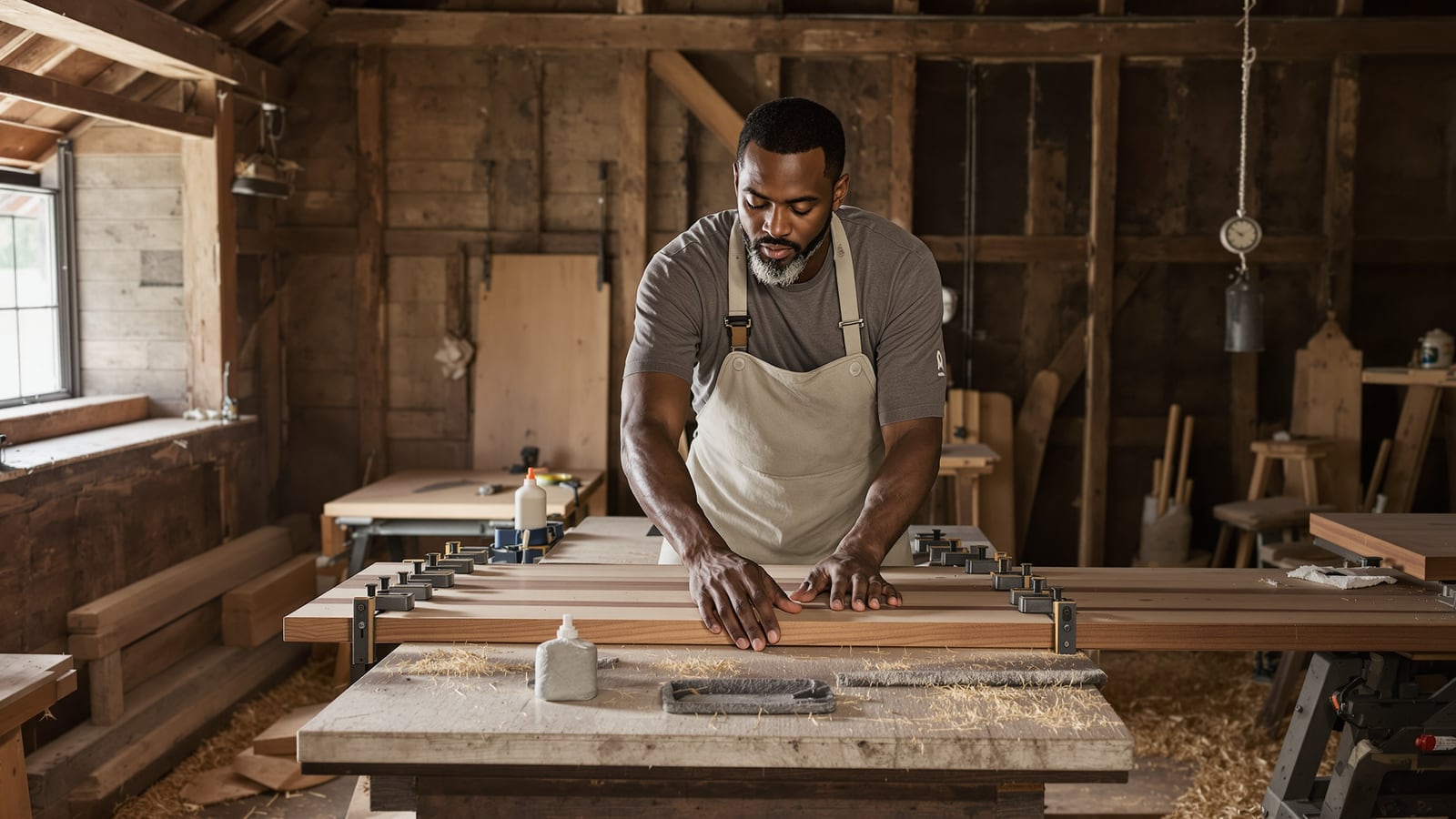
Quick answer: Snug is enough. Space clamps every 6 to 10 inches along a glue line, alternate them above and below the panel, and if a joint needs a hard crank to close, fix the joint before you reach for a stronger clamp.
The clamp isn't the glue
Most guys learn this the same way. You're gluing up a tabletop, five boards, 36 inches long. You've got two clamps. So you put one at each end and wind them until the handles won't move and the glue runs down the edges like a leaky faucet.
You feel good about that. You shouldn't.
Two clamps at the ends put all their force at the ends. The boards bow slightly away from each other in the middle. The glue line closes at the ends and stays hairline-open in the center, where nobody's looking until the panel is sanded flat and a thin dark seam shows up in the middle of the table.
Clamping pressure has one job. It brings two clean, flat surfaces into full contact and keeps them there while the glue cures. That's all. A joint that's flat and fits well needs very little force to close. A joint that doesn't fit well can't be rescued by force. It just gets stressed, and the stress shows up later as a crack or a seam.
What too much pressure actually does
Crank a clamp as hard as you can and three things go wrong.
You starve the joint. Squeeze-out is normal. A fine bead along the seam tells you there's enough glue. But wind a clamp down on a thin glue line and you can push nearly all of it out, leaving the surfaces with too little to bond. The joint looks tight and holds worse.
You bow the work. A bar clamp is a lever, and the force sits on one side of the board's thickness. Put every clamp on the same face and the panel cups toward it. Once the glue sets, that cup is permanent.
You slide things. Tighten hard on a cabinet face frame or a mitered box and the joints creep out of alignment. You'll see it a minute later, when it's already too late to fix without a mallet and some bad language you shouldn't use.
Why more clamps wins
A clamp doesn't spread pressure evenly. It creates a cone of pressure running out from the jaws, strongest right at the pad and fading as it moves away. Put clamps eight inches apart, with light pressure each, and those cones overlap and cover the whole seam. Put them two feet apart with heavy pressure each, and you've got tight spots with weak zones between.
So the rule of thumb in my shop is simple. Space clamps every 6 to 10 inches along the glue line. Closer for thin or springy stock. A little wider for heavy, flat lumber. That's a habit, not a lab number, and you'll adjust it by feel.
Then alternate. On a panel, put one clamp across the top, the next across the bottom, the next on top again. The force balances through the thickness and the panel stays flat. Add a couple of straight scrap cauls across the top and bottom faces, clamped at the ends, and you've got insurance against cupping that costs you a few pieces of scrap and two minutes.
The stack of clamps looks like overkill the first time you do it. Then you pull the panel out of the clamps the next morning and the seams disappear.
The five-minute dry run
This is where most glue-ups are won or lost, and it happens before the glue comes out.
- Clamp it up dry. No glue. Tighten snugly and look at the seams. If you see gaps, no amount of pressure will close them cleanly. Go back to the jointer or the hand plane and fix the edges.
- Count your clamps. If the dry run takes eleven and you own eight, stop. Borrow three, or glue up in two stages.
- Set out everything you'll need. Glue, a brush or roller, a damp rag, cauls, a mallet, and some wax paper or painter's tape where glue could bond to your bench.
- Check your open time. Standard yellow wood glue gives you a few minutes before it starts to skin. That's less than you think when you're fumbling with the ninth clamp. Read the label on your bottle.
Everything on that list is faster to do cold than hot. The panic of a glue-up in progress is where the cranked clamp comes from. A man in a hurry with glue drying turns the handle another half-turn because it feels like doing something.
Skip the half-turn.
Where strong clamps earn their keep
I'll concede the other side, because it's real. Some jobs need force.
Veneer work and bent laminations need heavy, even pressure over a wide area, usually from a press or a vacuum bag, not a few bar clamps. Very dense hardwoods and thick stock want firmer pressure than a pine shelf does. And a bowed board sometimes has to be pulled into line, which takes a stout clamp and a bit of patience.
That's a short list. For the ordinary stuff, panels, boxes, face frames, drawers, a heavy-duty clamp mostly buys you a heavier clamp. You'd be better off with a few extra cheap ones in the rack. Parallel-jaw clamps are lovely, and they keep their faces square to the work, but a row of pipe clamps and a handful of F-style clamps in the right places will glue up a tabletop just as well.
If you're sorting out which ones to buy first, a solid workbench setup gives you somewhere to lay out a glue-up without playing Tetris on the floor. And a sturdy sawbench works as a handy extra support when a long panel needs holding level.
Clean up like somebody's watching
Wipe squeeze-out while it's wet, or let it set to a rubbery stage and scrape it off with a chisel. Don't let it harden and sand it later. Dried glue seals the grain, and stain won't take where it's been, which is a big reason most bad finishes are really sanding problems in disguise.
And if you borrowed the clamps, return them with the bars wiped, the glue chipped off the jaws, and the threads clean. Bring them back before they're asked for. A man who returns his neighbor's clamps better than they came out of the garage gets them offered again.
The takeaway
Next time you reach for a clamp and your hand wants to give it another turn, stop. Go and get another clamp instead.
Wes Dunbar
Country & Skills
Grew up on an acreage and never quite left. Covers trucks, trades, land, and how to do the thing yourself.

Watch
Worth an hour of your evening
More from Woodworking.
From channels we rate. Plays on YouTube.
Read next