

The lump in your neck that won't leave, and when to push
Most swollen lymph nodes are just your body winning a fight. Here's how to tell patience from a problem, and what an ultrasound does and doesn't settle.
Quick answer: A node that's soft, a little tender and shrinking over two to four weeks is usually just doing its job. One that's hard, growing, stuck in place, or still there after about a month needs a doctor's hands on it, and often an ultrasound.
This is general education, not medical advice. Your doctor makes the call on your body.
The lump that outlasts the cold
You find it in the shower. A bump under the jaw, about the size of a pea. You think of the week your youngest brought home a cough, and you figure it'll pass.
Then it's three weeks later and it's still there.
That's the most common version of this story, and most of the time the ending is boring. Lymph nodes are filters packed with immune cells. When something sets off an alarm nearby, like a cold, a sore throat, a dental problem or a scratch that got irritated, the nearest nodes swell while they work. If you've got kids in school or daycare, your immune system is in a near-permanent skirmish. Nodes in your neck and under your jaw get a workout.
Reactive nodes can also take their time going down. They often shrink slower than the sickness that caused them. A node that lingers for a couple of weeks after you feel fine isn't unusual.
Measure it, then leave it alone
Stop poking it. Pressing on a node every morning keeps it irritated and keeps you anxious. Use that energy for a better method.
Compare it to a coin. A dime is about 0.7 inches across. A quarter is just under an inch. Check it once, write down the date and the coin it's closest to, then check again in a week. Same finger, same spot, same time of day. Your phone's notes app works fine.
You're looking for direction. Smaller or stable is reassuring. Bigger is information your doctor wants.
Note these while you're at it:
- Texture. Soft and rubbery, or hard like a pebble?
- Movement. Does it roll a little under the skin, or feel anchored?
- Tenderness. Sore nodes are more often reactive. That's a tendency, not a rule.
- Location. Neck, armpit, above the collarbone.
What "wait and see" actually means
When a doctor says to watch it for a few weeks, that isn't a brush-off. For a small, soft node with an obvious recent illness, watching is a standard and reasonable plan. Imaging a node that's already shrinking mostly buys you a bill and a worry.
The mistake is watching with no end date. Open-ended waiting turns into six months of wondering. Ask for the plan out loud: "If it's still here in four weeks, what do we do?" Put that date on the calendar before you leave the office.
A common rule of thumb is that a node still enlarged after roughly four weeks deserves a proper look. Treat it as a prompt to call, not as a verdict.
What moves you off the couch sooner
Some things shouldn't wait out the month. Get it examined promptly if you notice any of these:
- A node that's hard, fixed in place, or growing week over week
- A lump above the collarbone
- Swollen nodes in more than one area with no obvious cause
- Drenching night sweats, fevers that keep returning, or weight loss you didn't plan
- Fatigue that's heavier than "I have three kids and a job"
- A node that's large, roughly an inch or more
Most people with a lump won't land on that list. But if you do, don't wait to see if it gets better. Call and say the specific words: "I have a lump that's been there X weeks and it's hard," or "it's getting bigger." Specifics get you scheduled faster than "I'm a little worried."
If you also have a toothache, a sore throat that won't quit, or a skin infection near the node, mention that. A dentist visit sometimes solves a neck node that three weeks of waiting didn't.
What imaging is, and what it isn't
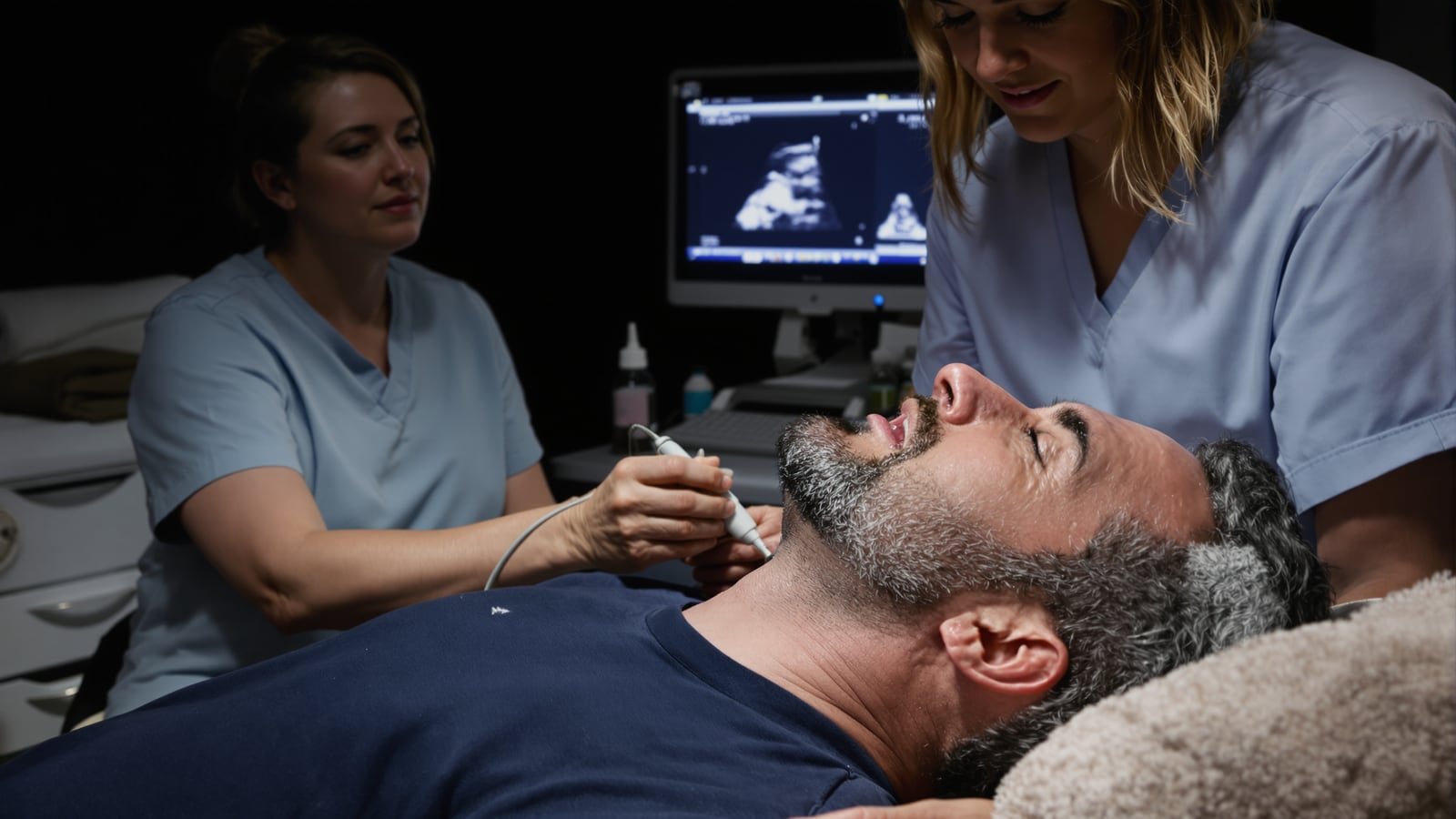
For a node in the neck, a doctor often starts with an ultrasound. It uses sound waves, no radiation, takes under half an hour and doesn't hurt. It shows the node's size and shape and whether the inside looks like a normal, reactive node or something that needs a closer look.
Ultrasound is a sorting tool. A reassuring result can end the worry. A result that's unclear, or a node with concerning features, usually leads to the next step, which might be a CT scan, bloodwork, or a small needle sample from the node. Your doctor decides which, based on you.
Two things to understand before you go in:
- A scan that says "reactive" is good news, not a dodge. Don't ask for a second scan just because you didn't feel dramatic relief.
- A scan isn't a substitute for the exam. A doctor who can feel the node, and who knows your history, reads the picture better than the picture reads itself.
If you're in a high-deductible plan, ask the office what an ultrasound typically costs before you book it. It's a normal question, and it doesn't make you difficult.
Training around it
If the node came with a fever or you're clearly sick, rest. That's the whole program. A week of lifting you skip is nothing compared with dragging an illness out for a month.
If you feel fine and your doctor hasn't told you otherwise, normal training is generally fine. Walk, lift, carry the kids. A swollen node doesn't mean you have to stop living. Just don't press on it, and don't grind through a workout when you're coming down with something. A loose rule many people use is that symptoms only above the neck, like a runny nose, can allow easy movement, while anything below the neck or with a fever means you sit it out.
Sleep matters here more than any supplement. If you're running on short nights, your immune system runs on short nights too. Why eight hours in bed doesn't feel like eight hours of sleep covers the usual leaks.
One more thing. Neck tension from a desk or a screen can feel like a lump when the real culprit is a knotted muscle, and sometimes the two get confused. If your neck has been tight for months, what eight hours at a screen does to your neck, eyes and sleep is worth a look. Still, don't diagnose yourself. Let the doctor sort out which one you've got.
What to bring to the appointment
Walk in with a short list. Doctors work fast, and you'll forget half of it.
- The date you first noticed it, and the coin you've been using
- Whether it's grown, shrunk or stayed the same
- Any recent illness in you or the kids, dental work, or skin injuries
- Fevers, sweats, weight changes, or unusual fatigue, with rough dates
- Medications and supplements you take
Then ask two questions: what do you think is most likely, and what would change your mind?
A lump you're watching with a plan is a lump you can stop thinking about. Pick the date, put it on the calendar, and go pick up the kids.
Cal Brennan
Fitness
Strength coach. Trains fathers, tradesmen and desk workers, which means programs that survive a bad week.

Watch
Worth an hour of your evening
More from Fitness.
From channels we rate. Plays on YouTube.
Read next