

Why your belly grows when your weight doesn't
You weigh what you weighed at thirty, but your pants disagree. The scale isn't lying, it's just leaving out the part that matters.
Quick answer: After forty, you tend to lose muscle and gain fat around the middle without the scale moving. Track your waist instead of your weight, lift twice a week, eat protein early, and sleep. Crunches won't touch it. Not medical advice.
Say you weigh 185. You weighed 185 at twenty-eight, too. Same number, different guy. The belt is on a new notch and your shirts fit like they shrank in the wash.
Nothing shrank in the wash.
The scale weighs you, it doesn't audit you
A pound of muscle and a pound of fat weigh the same. They don't look the same, and they don't act the same. From your thirties on, if you aren't training, you lose muscle slowly. Not dramatically, not in a way you'd notice in a month. In a decade, plenty.
Meanwhile the fat you gain doesn't spread out politely. It heads for the middle. Part of it sits just under the skin, the part you can pinch. Part sits deeper, around the organs. That deeper fat, called visceral fat, is the kind doctors care about, because it's linked to heart disease and type 2 diabetes. It's also the kind you can't see in a mirror.
So you can lose five pounds of muscle, gain five pounds of fat, and the scale smiles at you. The scale is a bad witness. It saw the whole thing and reported nothing.
For women, there's another piece. The hormone shift around menopause moves where the body stores fat, and it moves toward the midsection. A woman who has eaten the same way for twenty years can watch her shape change anyway. That isn't a character flaw. It's biology, and it still responds to the same tools.
Why you, specifically, and why now
Your body didn't turn on you. Your life changed around it.
You sit more. The commute is longer, or the job is a screen, or both. The workouts that used to happen by default, pickup games or a physical job or just being twenty-five, quietly disappeared when the kids arrived. Sleep got chopped. Late nights and early mornings pile up, and short sleep pushes hunger the wrong way and makes you crave the worst food in the house. I wrote more on that in why eight hours in bed doesn't feel like eight hours of sleep.
Then there's the food you don't count. The crusts off the sandwich. Half a quesadilla. The last of the mac and cheese, because throwing it out feels like a sin and you're standing right there. Two hundred extra calories a day doesn't feel like anything. Over a year, it's a spare tire.
None of this needs a villain. It needs a plan that fits a house with a calendar on the fridge.
Measure the waist, not the weight
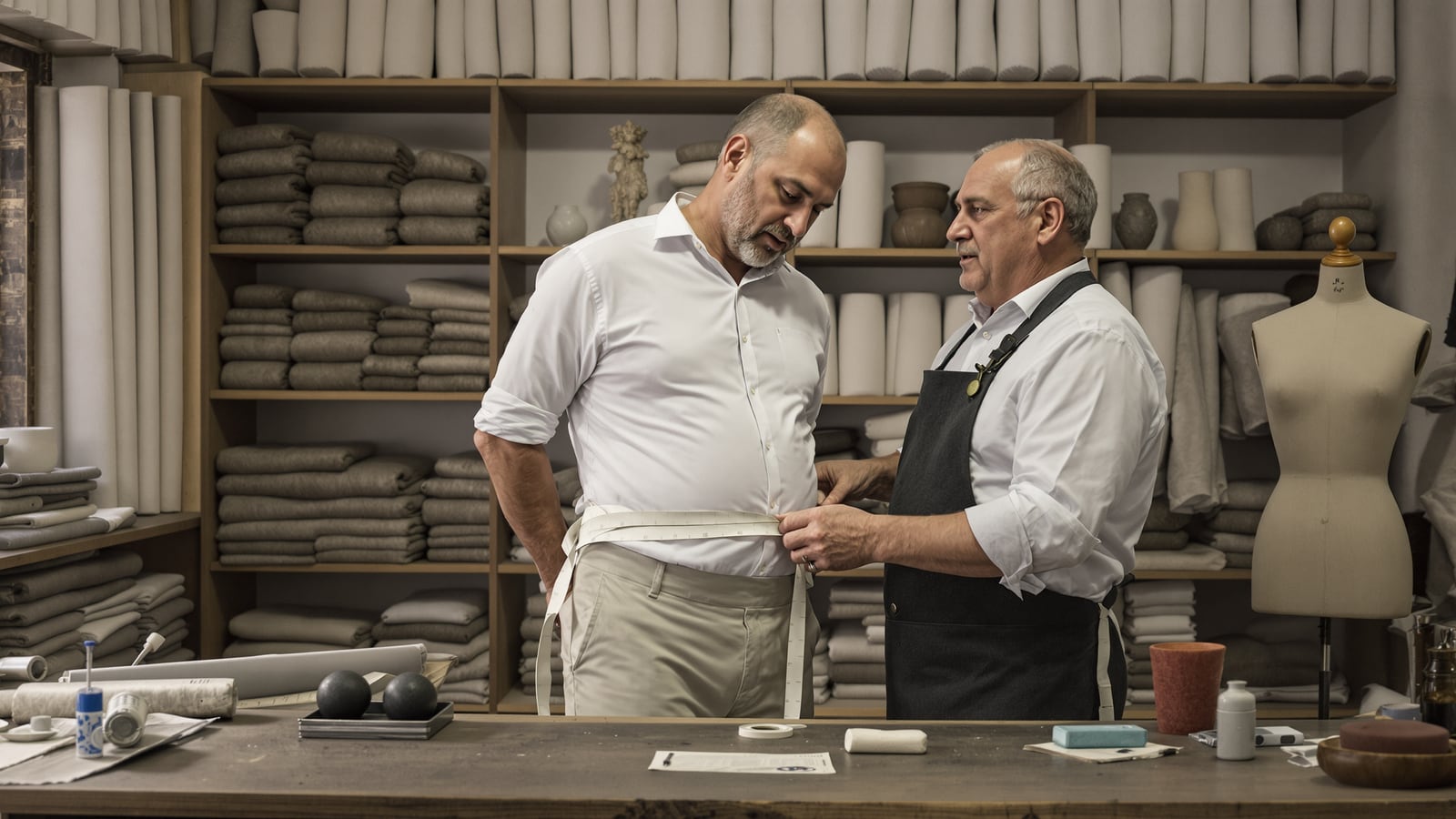
Get a soft tape measure. Wrap it around your middle at the level of your navel, relaxed, not sucking in. Write the number down.
A common rule of thumb says to keep your waist under half your height. If you're six feet, that's 72 inches of height, so a waist of 36 or less. Five foot four is 64 inches, so 32. It's a rough screen, not a diagnosis, but it tracks the thing that matters better than the scale does. If you're well over, mention it to your doctor at your next checkup.
Measure once every two weeks, same time of day, same spot. Daily is pointless. Your waist swings by an inch depending on what you ate and when.
A waist that's dropping while your weight stays flat is the best news you can get. It means you're trading fat for muscle, which is exactly the trade you want.
What actually moves it
Lift something heavy, twice a week. This is the big one. Muscle is what you're losing, so muscle is what you rebuild. Squats or leg presses, a push, a pull, something that makes you carry weight. Thirty to forty minutes, twice a week, is enough to start. It doesn't have to be pretty. It has to be heavy enough that the last couple of reps are a fight.
Get protein early. Most guys and most moms eat three bites of protein at dinner and call it done. Spread it out, and put real protein at breakfast. It keeps you fuller and gives your muscles something to work with. Full details in the protein problem is breakfast, not dinner. If you can't hit your number from food, protein powder has a real job to do, and what it isn't.
Walk. Boring, free, and it works. A brisk walk after dinner with the kids, the dog, or your wife burns a little, calms your appetite, and gets the family out of the house. Aim for most days. A walk you actually take beats a run you plan.
Trim the liquid and the leftovers. Alcohol is calories with no fullness attached, and it wrecks sleep even when it feels like it helps. Cut it to a couple of nights a week and watch the tape. Then stop being the family garbage disposal. Pack the rest of the kid's dinner for tomorrow's lunch. Your waistline isn't a landfill.
Protect your sleep like it's your paycheck. Seven hours as a floor. If you can only fix one thing about your evenings, make it the hour you go to bed.
What won't work
Crunches. You can't choose where fat comes off. Ten thousand sit-ups will build abs you still can't see, and the fat on top of them will stay right where it is. Core work is fine for strength and posture. It isn't a belly-fat plan.
A crash diet. Eat too little and you lose muscle along with fat, which leaves you softer and slower than before and sets up the rebound. Aim for a modest cut, a pound or less a week at most, with protein high and the lifting steady. Slow is the whole point.
Anything sold as a belly-fat burner. If the label hides its doses behind a "proprietary blend," that's a red flag by itself, and I explain why in what a proprietary blend on the label is actually hiding. Spend that money on groceries.
When to call the doctor
If your waist is growing fast with no change in how you live, if you're unusually tired, thirsty, or short of breath, or if you've had a long stretch of poor sleep and low energy, get checked. Thyroid problems, blood sugar, hormones, and medications can all play a part, and a blood test settles in a morning what guessing can't. A good doctor is cheaper than a year of the wrong plan.
The long game
You won't fix this in thirty days, and anyone promising you will is selling something. You fix it the way you built it: a little at a time, for years.
Two lifting sessions. A walk after dinner. Eggs instead of nothing. The tape measure on the first and fifteenth of the month. It's not glamorous. It's just the plan that's still running in five years, which makes it the best one.
Cal Brennan
Fitness
Strength coach. Trains fathers, tradesmen and desk workers, which means programs that survive a bad week.

Watch
Worth an hour of your evening
More from Fitness.
From channels we rate. Plays on YouTube.
Read next