Check the free stuff first when your car pulls to one side
Most steering pulls come from a tire, not a failing part. Work down the list from free to expensive and you'll often stop early.
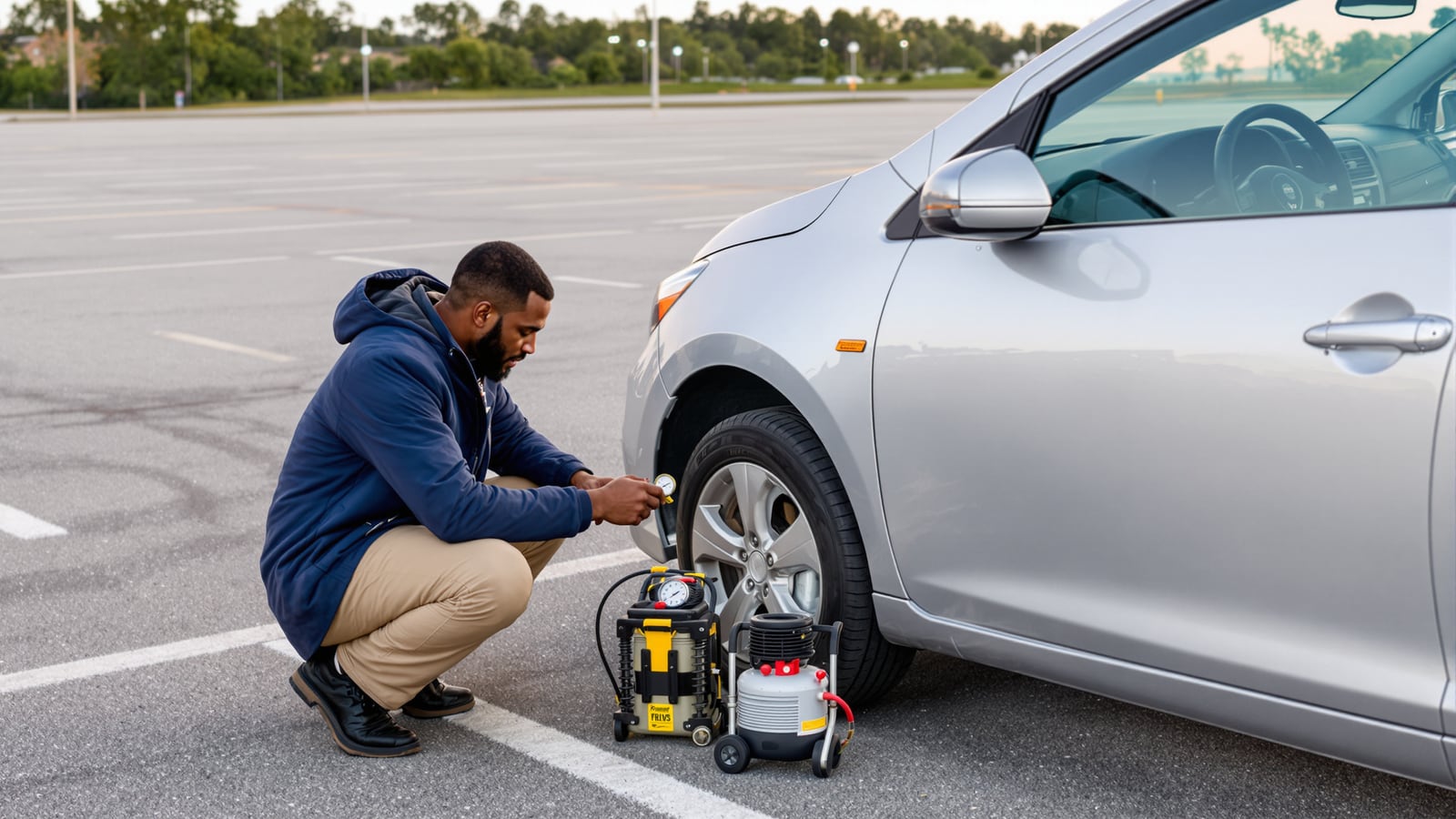
Quick answer: Check tire pressure on all four tires, then swap the front tires side to side. Those two steps cost nothing and fix or identify the problem more often than anything a shop will sell you first. If the pull only shows up when you brake, skip ahead to the brake section.
Start with the road, not the car
Roads aren't flat. They're built higher in the middle so rain runs off, and that slope nudges any car toward the shoulder. In the U.S. that means a gentle drift to the right is normal.
So find an empty, level parking lot and drive straight at about 10 mph with a light grip. Then try a different road. A car that drifts the same way everywhere has a problem. A car that drifts only on one stretch of two-lane has a road.
Also pay attention to when it happens. A pull that appears only when you accelerate is a different animal from one that appears only when you brake. Write that down. It'll save you money later.
Free: air pressure, all four tires
A tire a few pounds low drags more on its side, and the car leans toward the soft one. Two tires on the same axle that differ by 4 or 5 psi can produce a pull you'll feel at once.
The correct number isn't on the tire sidewall. That's the maximum. Open the driver's door and read the sticker on the jamb. Most passenger cars call for somewhere in the low-to-mid 30s, but read yours.
Check them cold, before you've driven a mile. A gauge costs a few dollars. If a buddy lends you his, hand it back wiped down and with a fresh battery if it needs one.
Fill them to spec, drive the same stretch, and see what changed. Plenty of people stop right here.
Free: the swap test
If the pressures were fine, you're looking at one of two things: the tires or the alignment. This test tells you which, and it's the part most shops skip.
Tires can develop a "radial pull," usually from a belt inside the tire that has shifted. The tire itself tugs the car sideways, and no amount of alignment will correct it.
To test it, swap the two front tires side to side. Left goes to right, right goes to left.
- If the pull flips direction, the tire is the culprit.
- If the pull stays the same, the tires are innocent and you're probably looking at alignment or something mechanical.
Use a proper jack, set jack stands under the car, and never put any part of yourself under a vehicle held up by a jack alone. If you don't own the gear, a tire shop can do the swap. Some will do it free if they sold you the tires. Ask.
Check the sidewall first. Directional tires, marked with an arrow, can't be swapped across the car without remounting them.
If it was a bad tire, move it to the rear. A pull from the back tire is far milder than one from the front, and often disappears. Or replace it, particularly if the tread is nearly gone anyway.
Cheap: the alignment
Alignment means the angles your wheels sit at, and the one that matters most for pulling is toe. A shop puts the car on a rack, measures, and adjusts. It costs a lot less than a set of tires.
Signs you need one:
- The steering wheel sits crooked when you're driving straight.
- The inside or outside edge of a front tire is worn smooth while the rest of the tread looks fine.
- Run your hand across the tread. If it feels like saw teeth in one direction, that's feathering, and it points to a toe problem.
Here's the annoying part. An alignment on a car with a bad tire fixes nothing, and shops will happily sell you one anyway. That's why you swap tires first. Another annoying part: an alignment on a car with worn parts won't hold. Ask for the printout of before and after numbers. If a number is out of range and can't be adjusted, a part is bent or worn.
If it only pulls when you brake
This is a different problem, and it isn't one to put off. The usual cause is a brake caliper that's sticking. One side grabs harder, or never fully lets go.
Warning signs:
- The car yanks to one side under braking.
- A burning smell after a drive.
- One wheel is much hotter than the others. Hover your hand near it. Don't touch it.
- Fuel economy has slipped for no reason you can name.
A stuck caliper cooks a pad and warps a rotor, and a brake that drags is a brake that can fail. Fix it now. Expect to pay for a caliper and pads, and brake work is done in pairs across an axle, so the other side comes along too. It stings. It also costs far less than a rotor, a wheel bearing and a tow.
The expensive end
Sometimes it's the heavy stuff. Pull plus a clunk over bumps, loose or wandering steering, or a pull that began the day after you hit a pothole or clipped a curb all point to the suspension. A tie rod, a ball joint, a control arm bushing or a bent arm can all do it.
A bent part won't align. A worn ball joint is a safety item, because when it fails the wheel can go where it likes. Get the car on a lift and have someone show you the play in the joint with a pry bar. Don't take it on faith. Ask them to point at it.
This is also where a pull works as a clue when you're shopping. A car that pulls on the test drive may have had a hard life or a hit nobody mentioned. Our piece on what to check before you hand a stranger cash for a car covers the rest of that inspection.
How to talk to the shop
You'll walk in better than most customers. Say what you've done: tire pressures set, fronts swapped, pull stayed or flipped. Say when it pulls: steady, accelerating or braking. Then let them work.
Don't be a pushover about it. If they quote an alignment and a set of tires on the first visit, ask them to show you the wear and the numbers. A good shop will. A shop that won't isn't worth a second visit.
Steering problems tend to sit on the line between maintenance that can wait and maintenance that can't. Our guide to the car servicing that can't wait, and the kind that can draws that line, and if you want to catch problems before they announce themselves, twenty minutes with the engine off will find most of them.
A car that pulls is telling you something. Spend ten minutes and a gauge before you spend a dime.
Dean Shaw
Gear & Garage
Reads the warranty, the parts list and the long-term owner reviews before anything else. Trucks, tools, watches, and the cheap version that costs more.

Watch
Worth an hour of your evening
More from Cars.
From channels we rate. Plays on YouTube.
Read next