Do the hardest spark plug first
Most botched plug jobs go wrong on the last cylinder, when you're tired and the gap check feels optional. Flip the order.
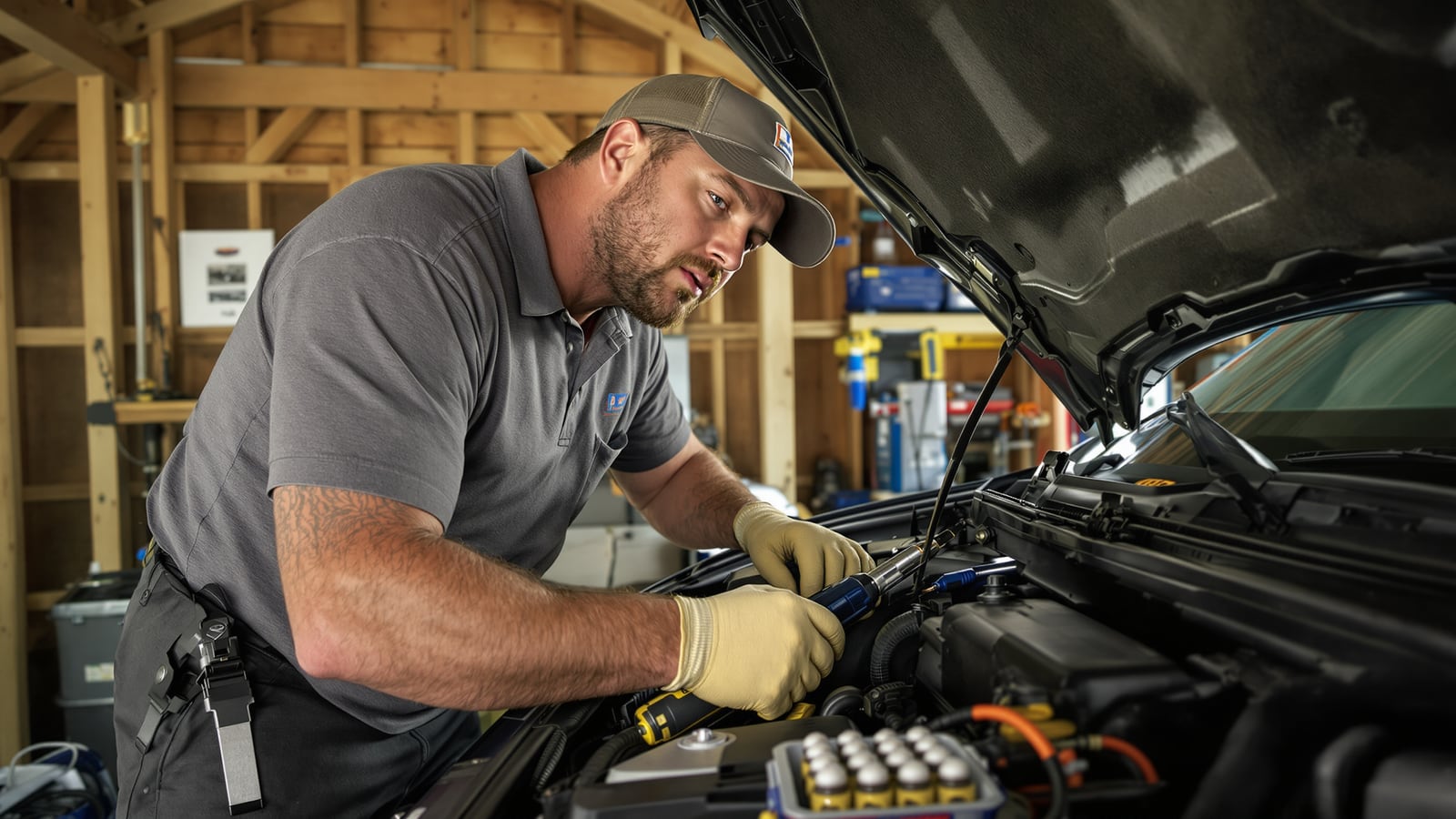
Quick answer: Check the gap on every new plug, even the "pre-gapped" ones. Measure with a wire gauge. Start with the plug that's hardest to reach, while you're fresh, and thread every plug in by hand.
On a transverse V6, the rear bank sits tight against the firewall. The plug on the far end needs two extensions, a swivel and a lot of patience. Everybody saves it for last. That's the mistake.
By the sixth plug your knuckles are raw, the shop light is in your eyes, and you've been bent over a fender for an hour. This is when people skip the gap check "because the other five were fine." It's also when they force a plug that isn't going in straight, in an aluminum head, where a cross-threaded hole turns a forty-dollar job into a four-figure one.
Do the worst one first. Your patience is at its peak, and the easy ones will forgive a tired mind.
What the gap actually is
The gap is the space between the center electrode and the bent ground electrode. The spark jumps it. Too tight, and the spark is weak and can fail to light the mixture cleanly. Too wide, and the coil has to work harder to push a spark across, which can show up as a misfire under load.
The right number depends on the engine. Many modern engines fall somewhere between 0.028 and 0.060 inch, and turbocharged engines often want a tighter gap than naturally aspirated ones. Don't guess and don't trust the box on the shelf. Your owner's manual or the emissions sticker under the hood has the spec.
"Pre-gapped" isn't a promise
Plugs come set from the factory. Then they ride in a box, get dropped on a counter, get tossed in a bag. A plug can arrive off by a few thousandths, and a few thousandths matter.
Check every one. It takes ten seconds a plug.
Use a wire gauge, not a flat blade
A flat feeler gauge is the wrong tool here, which surprises a lot of people. The ground electrode on a plug is curved, so a flat blade rests on the high points and gives you a bad reading. A round wire gauge slides between the two electrodes and measures the real gap. A coin-style or ramp gauge with wires runs about the price of a sandwich.
The motion is simple. Slide the wire for your spec between the electrodes. You want a slight drag, like a pencil going into a snug sleeve. If it falls through, the gap is too wide. If it won't go, too tight.
Adjust the ground electrode only
Never push or pry on the center electrode. Fine-wire platinum and iridium tips are tiny and brittle, and one slip can crack the insulator or damage the tip. Some plug makers say not to adjust certain iridium plugs at all, so read the instructions in the box.
If the gap needs a change, bend only the ground electrode. Use the gapping tool's notch or the edge of the gauge, and move it a hair at a time. Tapping the plug's side on a bench is a good way to ruin it, so don't. Re-measure after every nudge. If you bend it back and forth a few times, buy a new plug.
Getting to the one you can't reach
This is what separates a good afternoon from a bad one.
- A deep spark plug socket with a rubber or magnetic insert. It holds the plug so you can drop it into a well you can't see.
- Extensions in a few lengths, plus a short wobble extension. Wobble-style ones work better than a standard swivel in tight spots.
- A small flashlight or a headlamp. You need both hands.
- A short length of rubber hose that fits snugly over the plug's top terminal. This is the old mechanic's trick for starting a plug by hand when you can't see what you're doing. The hose gives you the feel of the threads and slips before it forces them.
If the plug on that last cylinder sits under the intake manifold, stop and look up the procedure for your engine. Some require pulling the manifold, which is a different job than a tune-up, and not one to improvise. Sometimes the honest call is to take it to a shop. There's no shame in it. The point is a running engine.
Thread it by hand. Every time.
This is the rule that matters most. Lower the plug in and turn it by hand, using your fingers or the hose, until it stops. It should spin freely for several turns. If it doesn't, back out and start over. A plug that resists early is cross-threaded, and finishing it with a ratchet only makes the damage permanent.
Then snug it with the socket. Use a torque wrench if you can, and set it to the number in your manual. If you're working at an angle through a swivel, remember that a joint can throw off what the wrench reads. Keep the bend as small as you can, and err toward a hair under rather than over. Overtightening a plug in an aluminum head is how threads get stripped.
Two small points. Clean the area around each plug before you pull it. A quick blast of compressed air, or a vacuum, stops grit from falling into the cylinder. And work one cylinder at a time, so the coils and wires always go back where they came from.
A few other things worth knowing
Most new plugs have a plated shell that doesn't need anti-seize, and some makers tell you flat out to skip it. Read the box. A dab of dielectric grease inside the boot helps it slide on and seal out moisture.
If a plug you pull is oily, sooty or has a melted look, don't toss it in the trash and move on. That's a message about what's happening inside. Keep it, and ask a mechanic what it means. A single odd plug in a set is worth a closer look.
If you borrow a socket set from a neighbor for this, bring it back clean, wiped down, with the extensions in their slots. Bring a six-pack of something cold, too. And wipe the fender when you're done, because the last guy who worked on this engine probably didn't.
For the bigger picture on what keeps an engine alive, read what it really takes to get a car past 250,000 miles and the car servicing that can't wait, and the kind that can. If this is your first wrench job, start with a car like the ones in your first project car should be boring, cheap and popular.
The easy plugs will still be easy when you get to them. Go get the hard one now.
Dean Shaw
Gear & Garage
Reads the warranty, the parts list and the long-term owner reviews before anything else. Trucks, tools, watches, and the cheap version that costs more.

Watch
Watch how it's done
Picked for this article.
From channels we rate. Plays on YouTube.
Royalty Auto Service
How To Replace Spark Plugs Like A Professional
ChrisFix
How to Gap a Spark Plug
Read next