

Walk in with a headcount, not a cut
The best free advice in an expensive city is behind a meat counter, and most people waste it by asking for the wrong thing.
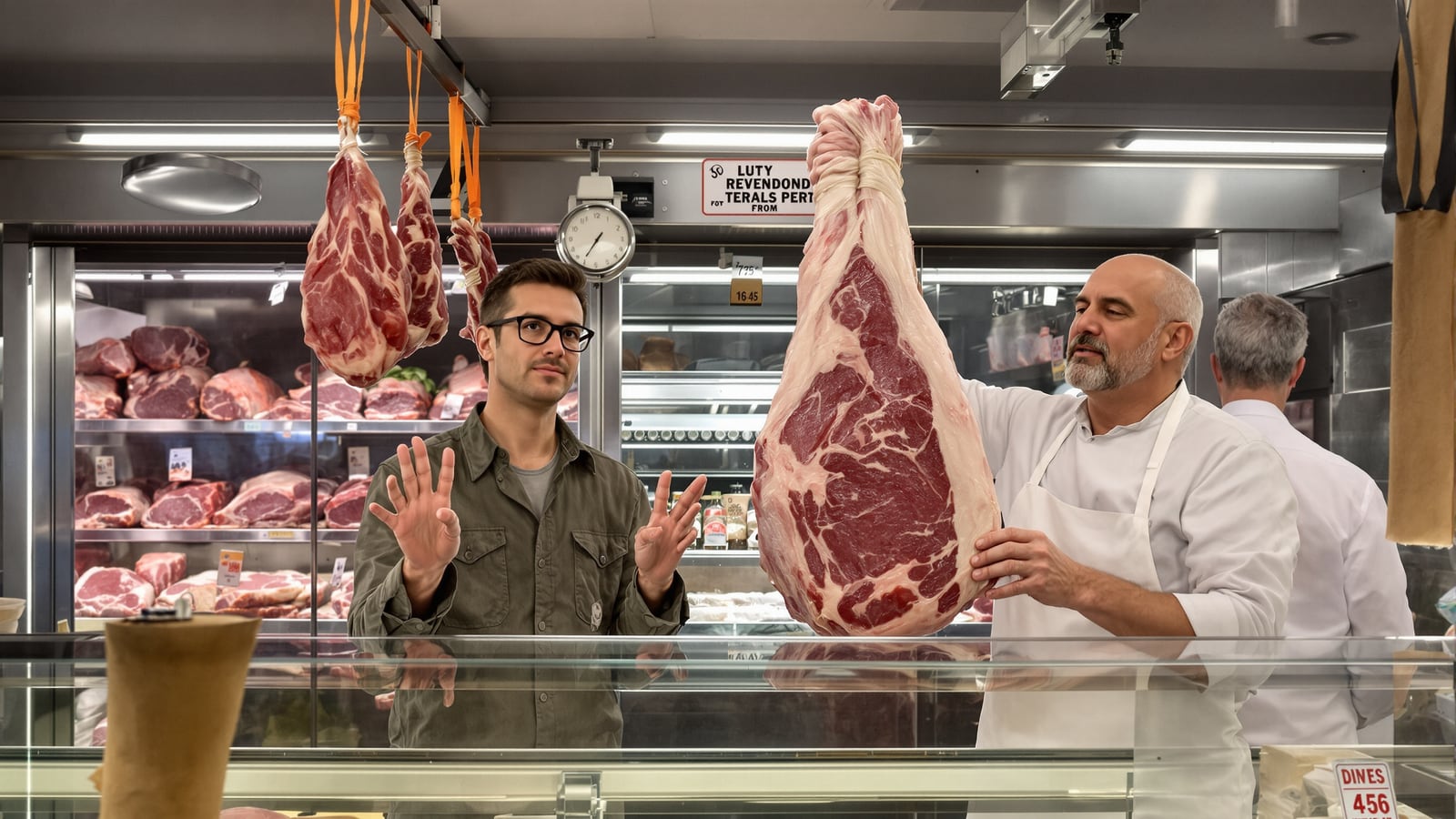
Quick answer: Tell the butcher how many you're feeding, what pan and oven you own, and when you want to eat. Let him pick the cut. Order Thursday for Sunday, and be a regular.
The guy who asked for "a good steak"
Saturday, 11:15 a.m. The line at a neighborhood counter runs to the door. A man in a quarter-zip reaches the front and says he needs steaks for six. The butcher asks what else is on the table, how everybody likes theirs, and whether there's a grill or just a skillet.
The man doesn't know. He saw a ribeye on a video. Six ribeyes, in a city where a ribeye isn't cheap, cooked in a pan that fits two at a time. You can see the evening before it happens: four steaks resting while two cook, everyone eating in shifts.
The butcher saw it too. He steered him to a roast, one big piece, in the oven while the man did something else. The guy walked out with less stress and a cheaper dinner.
That's the whole job. A good butcher is a consultant who works for the price of the meat.
Lead with the situation
Most people walk in and name a cut. Name the situation instead.
- Headcount. Plan about a half pound per person for boneless, closer to a pound for bone-in. He'll adjust for appetites and sides.
- Equipment. One oven, a Dutch oven, a grill on a balcony, a skillet that fits two. Say what you've got.
- Clock. Do you have forty minutes or an entire Sunday afternoon? The answer decides between a flank steak and a chuck roast.
- Budget. Say a number out loud. He won't be offended. He'd rather know.
Then stop talking and listen. He might send you to something you'd never have asked for: short ribs, a tri-tip, a pork shoulder, a bone-in leg of something. Ask him how to cook it and ask for the temperature, not just the time.
Cheaper cuts are where he earns his keep
The expensive center-cut piece is easy to cook and easy to sell. The cuts that take patience cost less per pound and taste like Sunday.
A chuck roast braised at a low oven for a few hours turns tender enough to pull with a fork. A pork shoulder wants to reach roughly 195 to 205 degrees inside before it shreds. Pull a beef roast for medium-rare closer to 130 to 135 degrees and let it rest fifteen to twenty minutes, because it keeps climbing on the counter. An instant-read thermometer is the one gadget this approach asks you to own.
Ask him for the small favors, too. Have him tie the roast so it cooks evenly. Have him trim the silverskin, split a whole chicken down the back so it cooks flat, or cut a big shoulder in half so you can freeze one piece. He'll do it in ninety seconds and it saves you twenty minutes and a bad knife moment.
And ask for bones. Most counters have them and will hand them over for little or nothing. A pot of stock on a Monday night is a soup you didn't pay for.
Where it doesn't pay
Be honest about the trade-off. A neighborhood butcher is often not the cheapest per pound. A warehouse club will beat him on a bulk pack of ground beef. If you're buying forty dollars of anything for the freezer, shop where it's cheap.
What you're paying him for is the right cut for tonight, trimmed properly, with instructions that work. One ruined roast costs more than the premium you'd have paid. And you get a guy who'll tell you the pork looks better than the beef this week, which no refrigerated case will ever say.
Be the customer he remembers
The good cuts don't go to the loudest customer. They go to the regular.
- Order ahead. Call Thursday for a Sunday roast. By Saturday midmorning the counter's been picked over and he's slammed. Tuesday through Thursday mornings are when he has time to talk.
- Don't haggle. Ask what's good value this week instead. He'll show you.
- Be on time when you say you'll pick up. His planning runs on small numbers.
- Report back. Next visit, tell him how it went. The roast was perfect or it was a little dry. Either answer teaches him how you cook, and he'll tune what he sells you. Almost nobody does this, which is why it works.
It's the same principle behind stopping the room-working and being useful. Show up the same time, treat him like a professional, and in a few months he's saving you the end cut of the brisket before you ask.
Finding the right counter
You're looking for a case with a person behind it, not a wall of sealed trays. Walk in and ask a real question, like what he'd cook this weekend. A good butcher answers and then asks you one back. If he just points at the packages, keep walking.
Look for whole pieces being broken down in the back, a short list of what's fresh today, and a line of regulars who get greeted by name. A small business built on knowing its customers is the kind a neighborhood needs more of, and the kind a man ought to support when he can.
If you're still working out what to cook the other nights, the city kitchen that beats delivery pairs well with one decent butcher. So does living in your city like it's home, not a long business trip.
The point of Sunday
An expensive postcode charges you for everything. Most of what it sells is noise. A butcher who knows your name and your oven is one of the few things in it that gets better the longer you're there.
Set the table, carve it at the head, and tell the kids where the roast came from. Then, Monday, put the bones on to simmer.
Marcus Vale
Editor-in-Chief
Twenty years in magazines, most of it deciding what to cut. Writes about work, discipline and the decisions that compound.

Watch
Worth an hour of your evening
More from City Bro.
From channels we rate. Plays on YouTube.
Read next