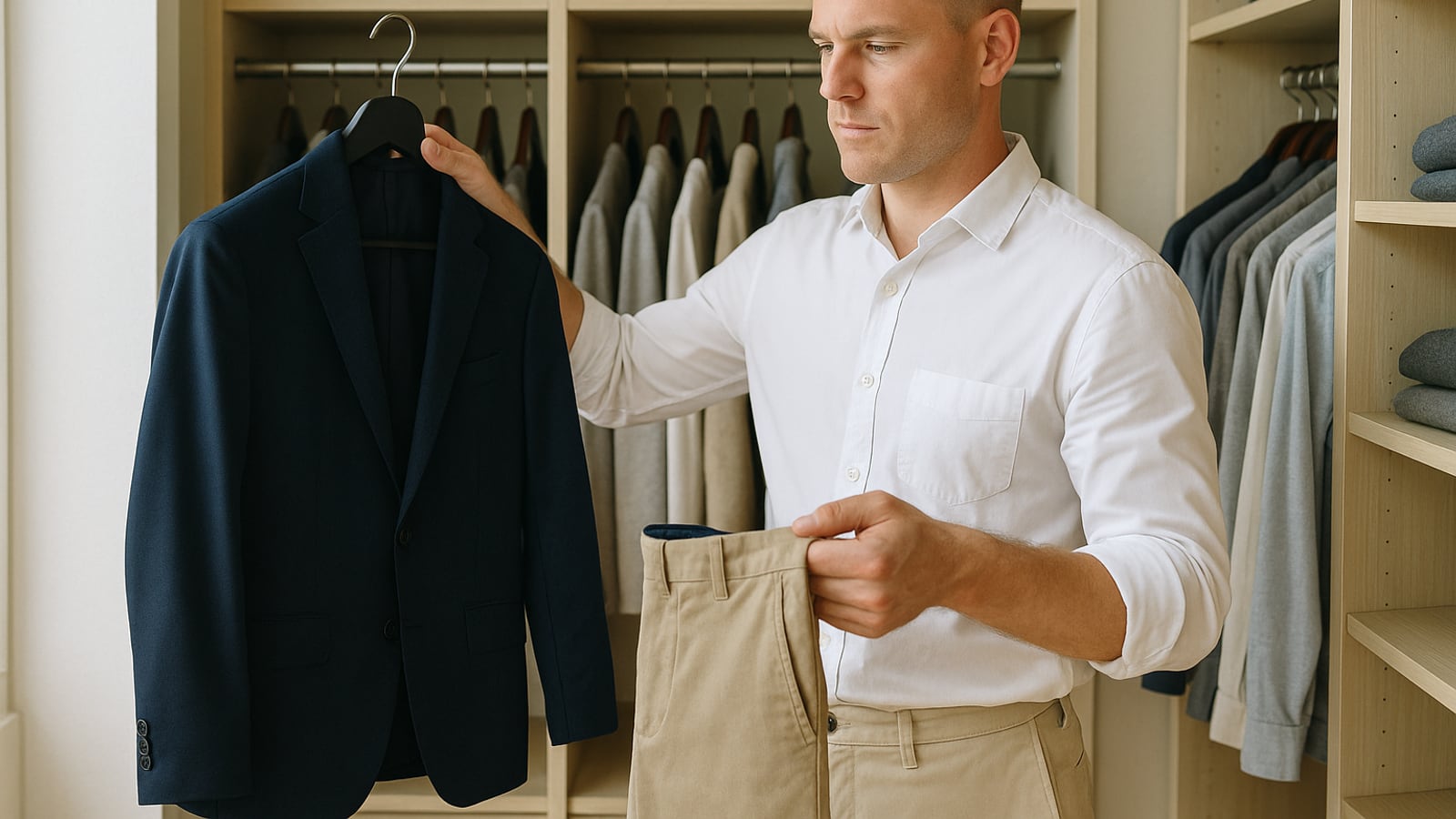
Stop buying clothes in two categories.
That's the whole problem, and it's the reason your closet is full and you've still got nothing to wear. You've got office clothes that feel like a costume on Saturday, and weekend clothes you'd be embarrassed to wear into a meeting. Two collections, each one half-used, each one costing money.
The fix is to buy for the middle. Pieces that are a touch relaxed for the office and a touch sharp for Saturday. That narrow band covers about eighty percent of your week, and once you're living in it, getting dressed takes ninety seconds.
Pick four colors and stay there
Everything in the working part of your closet should go with everything else. That's not a style rule, it's an arithmetic one. Ten pieces that all combine give you far more outfits than twenty that don't.
Navy, gray, olive, and tan will carry almost any man. Add white and a mid-blue for shirts. Black if you like it, but black trousers are harder to wear in daylight than people expect, and black shoes push you formal fast.
The test is simple. Take any top and any bottom out of the closet at random. If the pair looks deliberate, your palette is working. If you find combinations that clash, one of those pieces is a stray. Wear it, enjoy it, but don't count it as part of the system.
Patterns are where this breaks. A loud check shirt or a distinctive jacket gets noticed, which means it gets noticed the second and third time too. Solids and subtle textures do the quiet work. Save the memorable piece for when you want to be memorable.
Trousers carry more weight than you think
Everyone shops for jackets and shirts. Trousers are what actually decides whether an outfit reads as work or weekend, and most men own the wrong ones.
The single most useful pair you can own is a flat-front wool trouser that didn't come with a suit. Mid-gray, no shine, no stretch panel in the waistband. It wears with a sweater and boots on a Wednesday, and with a blazer and a collared shirt on a Sunday. It's the piece that makes the rest of your closet more flexible.
Next, a five-pocket in something with structure. Dark denim with no fading, no distressing, no contrast stitching. Or a cotton twill in olive or tan. The word to look for is stiff. Soft, stretchy, light-wash jeans slide toward lounging. Rigid dark denim holds a line and can go almost anywhere a chino can.
Then a chino in tan or olive to round it out. Three pairs, in rotation, will handle nearly everything.
What kills a trouser's range: sheen, technical fabric, elastic cuffs, and anything with a logo on the back pocket. Those all signal one context and one only.
Shirts and knits in the crossover zone
An oxford cloth button-down is the most flexible shirt made. Untucked with jeans it's Saturday. Tucked with wool trousers it's Tuesday. Same shirt.
The thing that decides whether it can do both is hem length. If it covers half your backside it's a tucking shirt, permanently. You want a hem that hits somewhere around mid-fly at the front. Try it both ways in the store before you buy.
Add a chambray shirt for the same reason, and a couple of fine-gauge knit polos for summer. Skip the heavy pique polo with the big chest logo. It reads golf course, and only golf course.
Knitwear is the crossover engine. A merino crewneck in navy or charcoal over a collared shirt does most of what a blazer does with none of the formality. A half-zip or a shawl-collar cardigan works the same way. Wear one over a button-down with the collar out and you look considered without looking dressed up.
Skip the hoodie in this part of the closet. It has a place, and that place is the gym and the couch, not the middle band.
Three jackets, maximum
One layering jacket that reads both ways. A chore coat in a dark solid, a harrington, or a waxed cotton field jacket. Any of the three goes over a sweater on Saturday and over a shirt on a casual Thursday.
One navy blazer, unstructured, in a fabric with some texture to it. Hopsack, a soft flannel, cotton in the summer. The soft shoulder is what keeps it from looking like the top half of a suit you've lost. Wear it with gray trousers, wear it with dark denim, wear it to church.
One real coat for your climate, and it should be dark, plain, and long enough to cover the blazer.
That's it. The fourth jacket is almost always the one that sits unworn.
Shoes are where two-wardrobe thinking shows
You can dress entirely in the middle band and then undo it with footwear. White running shoes with wool trousers, or dress shoes with jeans, and the whole thing falls apart.
Three pairs cover it.
- A leather boot. Brown, plain toe or cap toe, on a leather or rubber sole. Goes with denim, chinos, and gray wool without complaint.
- A clean leather sneaker. Minimal, low-profile, white or off-white, no visible tech. Not a running shoe.
- A loafer or a derby. Brown again. This is the pair that handles the slightly dressed-up evening.
Keep the athletic shoes for athletics. Nothing drags an outfit toward the couch faster.
Buy it slowly, on failure
Don't tear the closet apart this weekend. You'll spend a lot and get it half right.
Replace on failure instead. When something wears out or you finally admit you don't wear it, replace it with the middle-band version. Start with trousers, because they change the most. Then shoes. Shirts and knits last longer and can wait.
Two rules when you're in the store. Buy it only if you can name three things in your closet it goes with. And buy it only if you can picture wearing it on a Wednesday afternoon and a Saturday morning both.
If you can't answer either question, put it back. The piece you're unsure about in the store is the piece you don't wear at home.
The Sunday step-up
One step above the middle band, ready to go without thinking: navy blazer, white or light blue shirt, gray trousers, brown leather shoes, a belt that matches the shoes.
That's church, a funeral, a dinner where you want to show respect, meeting her parents. You already own every piece of it because each one earns its keep the rest of the week too. Keep the shirt pressed and hanging. Keep the shoes polished. Don't discover a scuffed heel twenty minutes before you leave.
Where this ends up is less about clothes than about mornings. A closet built this way takes one decision off your plate at an hour when you don't have decisions to spare, and gives it back to the people who need you awake and paying attention. That's worth more than any particular jacket.
Tobias Reed
Style & Grooming
Spent a decade in menswear retail watching men buy the wrong size. Believes fit is ninety per cent of it and says so weekly.

Watch
Worth an hour of your evening
More from City Style.
From channels we rate. Plays on YouTube.
Read next