Dress for the vent over your desk, not the weather outside
Your office is three climates in one building. Here's how to dress for all of them without looking like you packed for a hike.
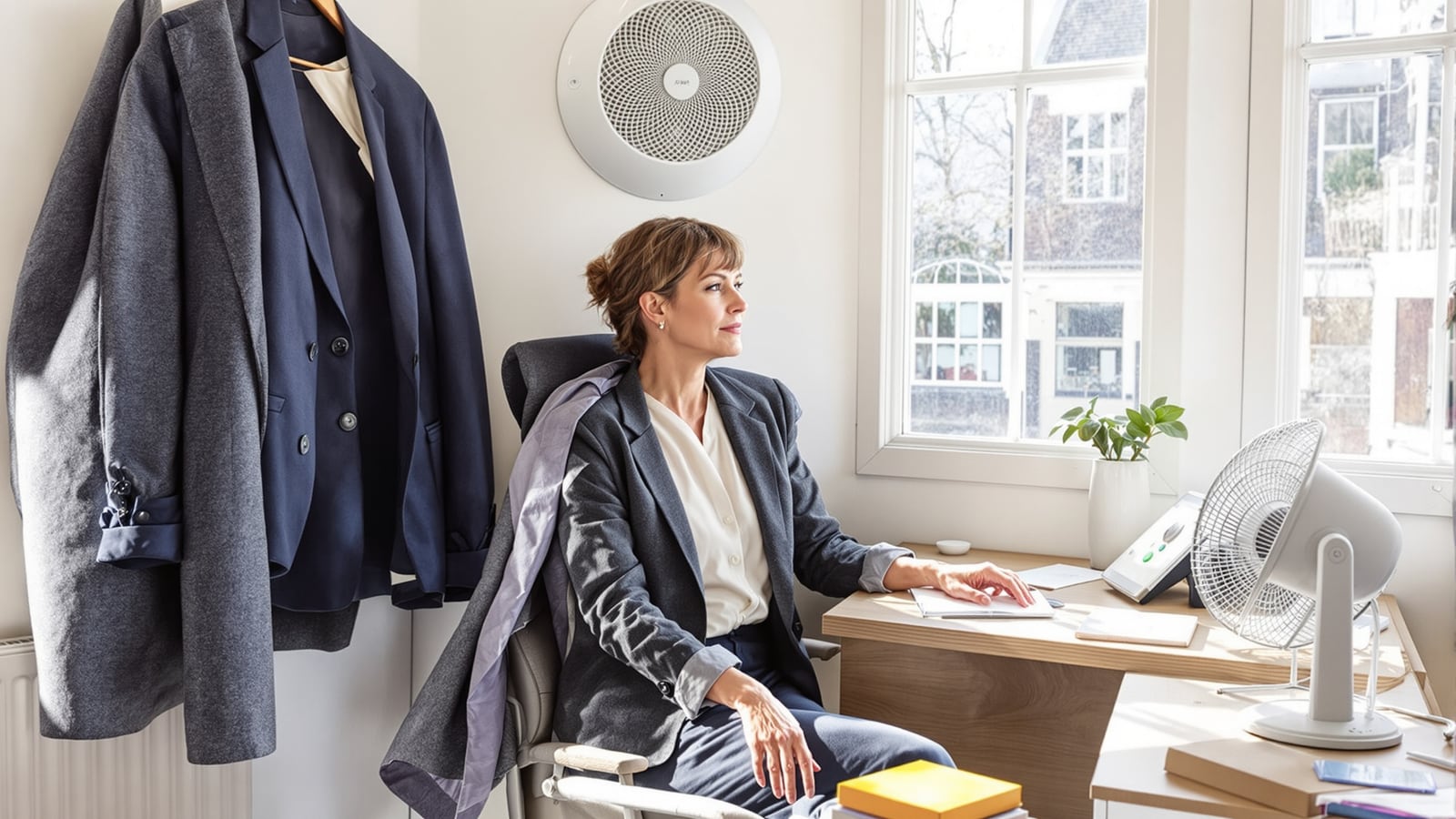
Quick answer: Build every outfit around a shirt that looks finished by itself. Add one thin knit and one easy outer layer that lives on your chair. Wear your coat for the commute only. If you can strip to the shirt at 3 p.m. and still look dressed for work, you've got it right.
Start with the desk, not the forecast
Say it's 31 degrees at 7:30 a.m. The conference room runs cold at ten. By three, the sun hits the window and your corner is 76. The guy two rows over keeps a fan going. Somebody else keeps a blanket.
Nobody's winning that argument, and you don't need to. What you need is clothing that adjusts in five seconds without a production.
Most people dress for the walk in. They wear a heavy sweater because it's freezing outside, then bake at their desk by midmorning. Or they dress light for the afternoon heat and shiver through the first meeting. Both are the same mistake. You're dressing for the weather, and you'll spend eight hours indoors.
The three layers
The shirt is the foundation. Pick something that breathes: an Oxford cloth button-down, a poplin, a fine cotton knit polo. For women, a plain cotton or silk-blend blouse works the same way. Cotton is fine here because it's the layer closest to the air and you can't see it under anything else. It just has to look right on its own, with the sleeves down or rolled twice at the forearm.
A plain crew-neck undershirt under a dress shirt buys you a little buffer in both directions. It's also cheap insurance if you tend to run warm.
The middle layer is one thin knit. A fine-gauge merino crewneck or quarter-zip is the workhorse. Merino handles moisture better than cotton and doesn't turn clammy when you warm up, which is why it works indoors where temperatures keep drifting. Cotton holds sweat and feels cold once you cool off. Fine gauge matters. A chunky sweater won't slide under a blazer, and it'll make you sweat the moment the heat kicks on.
Quarter-zip versus cardigan is a real choice. The zip lets you vent your neck without taking anything off. The cardigan comes off in two seconds and hangs on a chair. Pick whichever you'll actually adjust. A layer that's a hassle to remove stays on all day, which defeats the point.
The outer layer lives at the office. A blazer or cardigan hanging on the back of your chair, or in your bottom drawer, is the layer that handles the surprise. It isn't your overcoat. You wear the overcoat in and hang it up. The chair layer is what you add when the vent over your desk decides to go arctic at 2 p.m.
If you're short on closet space, one unstructured blazer in a mid-gray or navy does the job. It reads as work in a meeting, and it comes off without ruining the look.
The test that settles it
Stand in front of a mirror in just the shirt. Roll the sleeves. Tuck it properly. If you'd be comfortable walking to a coworker's desk like that, the foundation is sound.
Then add the knit. Does it look intentional with the collar showing? Then add the outer layer. Does each step look like an outfit rather than a pile?
If any layer only works when the others are on, it's carrying too much weight. A shirt that needs a sweater to hide a wrinkled collar will betray you the first warm afternoon.
Fit, because layers stack
Each layer needs to be slightly trimmer than the one over it. A baggy shirt bunches under a sweater. A bulky sweater binds the shoulders of a blazer and makes the whole thing look borrowed.
You don't need a tailor for this, but a good one earns the money when sleeves are the problem. If a shirt cuff pokes out too far or too little under a jacket, it's fixable. What tailoring actually costs and what's worth paying for covers which alterations are worth it and which are a waste.
Feet and hands get cold first
Everybody forgets this. Your core can be perfect while your feet are ice. A pair of thin wool dress socks does more than a second sweater. Keep a spare pair in the drawer.
If your hands go cold at the keyboard, fingerless gloves look silly in a meeting and fine at a desk, but a warm mug does the job with zero explanation. A small thing, but it lets you leave the thermostat alone.
Leave the commute at the door
Wear your coat and scarf on the way in, then hang them up. Don't wear the sweater you'll need at 2 p.m. on a hot train at 8 a.m. and arrive damp. Put it in your bag, or wear it only once you're indoors.
If the weather's the actual problem, getting to work dry when the weather turns handles the wet-coat, wet-shoe side of it.
When the dress code gives you nothing
Some offices tell you nothing. No policy, no example, just a room of people dressed differently. The layering system works there precisely because it flexes. Dress to the more formal end in the morning, and let the layers come off as the day loosens up. It's easier to dress down at noon than to apologize for a hoodie at a client meeting. If you need more help reading that kind of room, dressing for an office that never tells you what to wear is the place to start.
The thermostat is a shared thing
Don't wage a war over it. One polite note to facilities or the office manager is fair when a room is truly off. After that, dress for it. The person who keeps nudging the dial every hour makes enemies fast.
If you bring a space heater, check the office rules first, and don't point it at a neighbor. If a coworker lends you a sweater or blanket, wash it and hand it back folded. Leave a shared space a little better than you found it. The same goes for a shared conference room: if you opened the window, close it.
And speak up once if the cold is genuinely affecting the whole team. Being agreeable doesn't mean freezing in silence for someone else's comfort.
What to keep in the drawer
- A fine-gauge merino or cotton-wool cardigan
- A spare pair of wool socks
- A comb or small brush, because static from sweaters is real
- A spare undershirt
That's it. A drawer full of gear starts to look like moving in.
By 9:15 you should have stopped thinking about the temperature. If you're still tugging at your collar or hugging your arms at 10, something in the system is off. Fix the layer, not the thermostat.
Tobias Reed
Style & Grooming
Spent a decade in menswear retail watching men buy the wrong size. Believes fit is ninety per cent of it and says so weekly.

Watch
Worth an hour of your evening
More from City Style.
From channels we rate. Plays on YouTube.
Read next