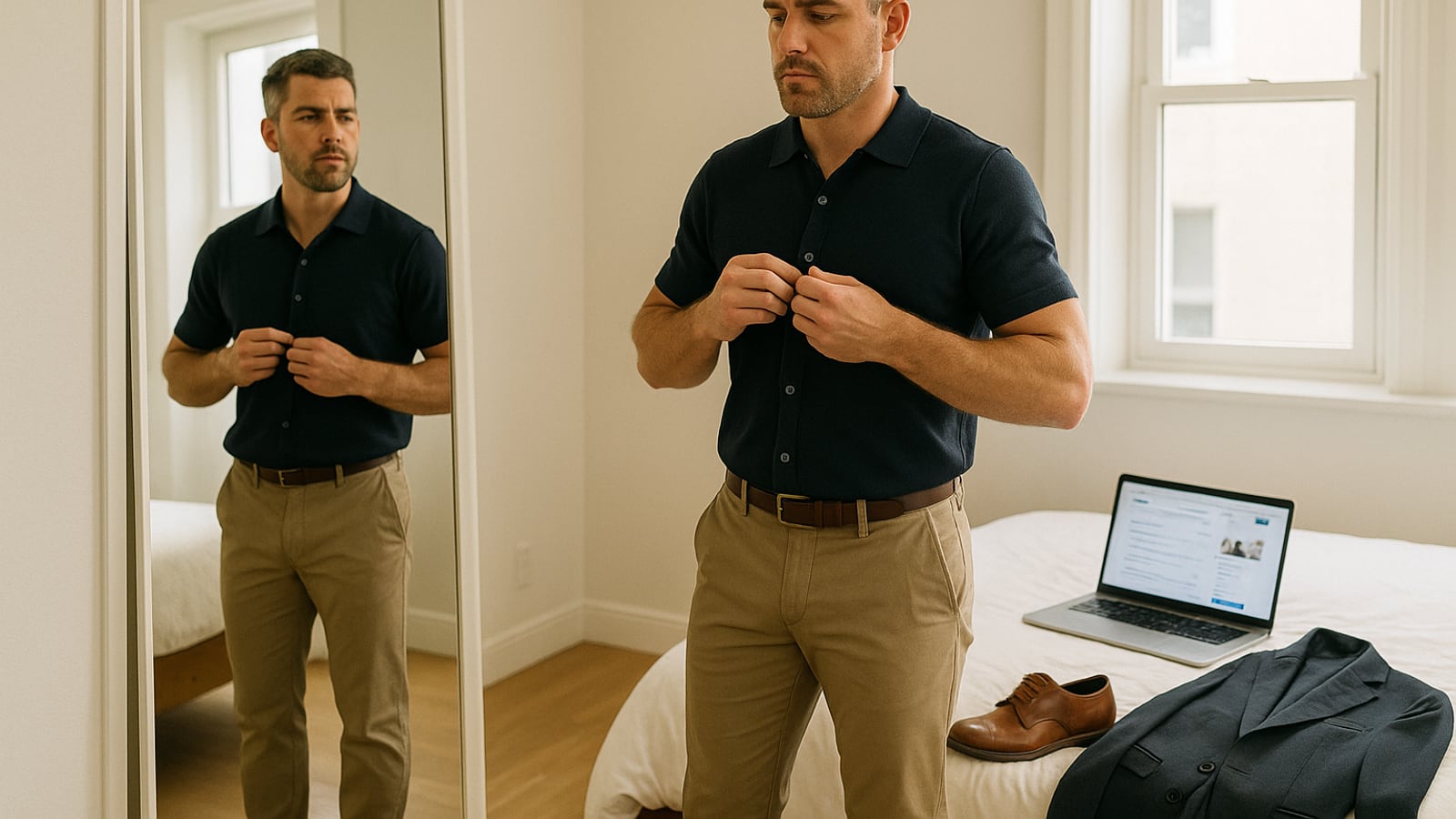
Dress one notch above the room. One. Not three.
If the team wears T-shirts and sneakers, you wear dark chinos or clean dark denim, a collared shirt or a fine-gauge knit, and leather shoes that have seen polish this month. If the team wears button-downs and chinos, add an unstructured jacket. If nobody in that building has owned a tie since 2015, you don't own one either on that particular Tuesday.
That's the whole answer. The rest is figuring out what the room actually wears, which takes about ten minutes and almost nobody does.
Read the room before you're in it
Open the careers page and look at the photos. Ignore the hero shot, which is staged. Look at the candid ones in the background, the ones where somebody's at a desk. Then pull up eight or ten people from the team you'd be joining on LinkedIn and look at their profile pictures. Not the executives. The people at your level and one above.
Then ask. Recruiters get this question constantly and they answer it honestly, because a candidate who shows up wrong is a waste of their afternoon too. Phrase it so they can't give you a useless answer. "Come as you are" is useless. "What does the hiring manager typically wear on a normal Tuesday?" gets you something you can work with.
If it's an office you can walk past, walk past it at 8:45 in the morning.
The default that survives almost anywhere
There's a combination that reads as respectful at a design studio and reads as relaxed at a bank, and it's the safest thing you can put on when the signals are mixed.
- Tailored trousers or a straight skirt in navy, charcoal, or a mid-gray. Wool or a wool blend if you can, so it holds a line after two hours in a chair.
- A shirt with a collar, or a fine-gauge merino crewneck. Solid color. No logo, no novelty button, no contrast collar.
- Leather shoes. Derbies, loafers, a plain low block heel, a clean leather sneaker if the company is genuinely a sneaker company. Polished. Heels not worn to the nail.
- One layer you can remove. An unstructured blazer, a cardigan in a real fiber. This is the dial. Wear it in, take it off if you've overshot, and now you're dressed correctly either way.
That last point is the trick. You can't add a jacket you left at home, but you can always take one off in the lobby after you've seen what the receptionist is wearing. I've done it. It costs nothing and it buys you the entire range.
Leave the tie unless the industry demands it. In a company with no dress code, a tie is a flag that says you didn't check.
Where the default breaks
It breaks in both directions, and you should know which risk you're taking.
At a startup with a fourteen-person engineering team, a full suit is a handicap. Not a mild one. The hiring manager in a band shirt will spend the first five minutes wondering whether you understood the job, and you'll spend them trying to seem relaxed while wearing the most formal garment in the building. Nobody recovers well from that.
Going the other way, if there's any chance you'll be in front of clients, investors, or a board, dress for those people and not for your future colleagues. A "no dress code" law firm still puts you in a room with a general counsel who owns forty suits. Agencies are the same. The internal culture is one thing; who you'd be sitting across from is another, and the second one wins.
And if you genuinely can't tell, overshoot slightly. Being the best-dressed person in a casual room is a small, survivable awkwardness. Being the worst-dressed person in a formal one is the thing people mention afterward.
The details that get noticed without being noticed
Sleeve length matters more in an interview than anywhere else, because you spend the hour reaching across a table and gesturing. If your jacket sleeve rides halfway up your forearm when you point at something on a screen, that's what the room sees.
Sit down in the trousers before you commit. Sit the way you actually sit, with an ankle crossed if that's your habit. If the fabric pulls across the thigh or the hem rides up over the sock, it'll do that for ninety minutes in a glass-walled room.
Socks that reach the calf. Nobody has ever been hired for their ankles.
Shoes get looked at when you walk down a corridor in front of somebody. Scuffed toes are forgivable; worn-through heels and trodden-down backs aren't, because they say you've been meaning to sort it out for a year. A cobbler can re-heel most leather shoes for a fraction of replacing them, and it takes a few days, so start that now rather than the night before.
Get the haircut five to seven days out. Fresh-cut hair on the morning of looks like a costume, and if the barber makes a mistake you've got time to live with it.
Video interviews change the math
Everything above the sternum does the work. Everything below it's invisible, which tempts people into wearing something that makes them sit badly. Don't. Dress the whole way, because your posture follows your clothes.
Avoid a pure white shirt on camera. Most webcams will meter for it and leave your face in shadow. Mid-tones do better: a light blue oxford, a soft gray knit, a deep green. Skip fine stripes and small checks, which shimmer on a compressed video feed and make you look like a test pattern.
Check what's behind you at the same time you check what's on you. And check it at the actual time of day the interview happens, because a window that's fine at 9 a.m. turns you into a silhouette at 4.
The night before
Lay it out. All of it, including the socks and the belt. Put the clothes on for two minutes, because that's when you discover the missing button.
Steam or press the shirt. A travel steamer takes four minutes and beats an iron on anything with a collar. Lint roll dark fabric. Cut the loose thread you've been ignoring on the jacket vent, and check the vent isn't still basted shut with a big X stitch from the shop, which happens to at least one person in every interview cycle.
Pick the bag. A slim portfolio or a structured tote reads better than a backpack in a formal setting, and the backpack strap will crease one shoulder of your jacket anyway. If you're carrying a laptop and the company is casual, a backpack is fine. Carry it on one shoulder at the door.
Don't wear anything for the first time. Not the shirt, and above all not the shoes. Blisters change how you walk, and how you walk changes how you come across when you're being led to a meeting room by somebody who's deciding about you.
Then wear the same outfit on your first day. The person who hired you should recognize the guy who walks in.
Tobias Reed
Style & Grooming
Spent a decade in menswear retail watching men buy the wrong size. Believes fit is ninety per cent of it and says so weekly.

Watch
Worth an hour of your evening
More from City Style.
From channels we rate. Plays on YouTube.
Read next