Most men need one tie knot, not five
The four-in-hand covers almost everything, the width matters more than the pattern, and there are days when the tie makes you look worse.
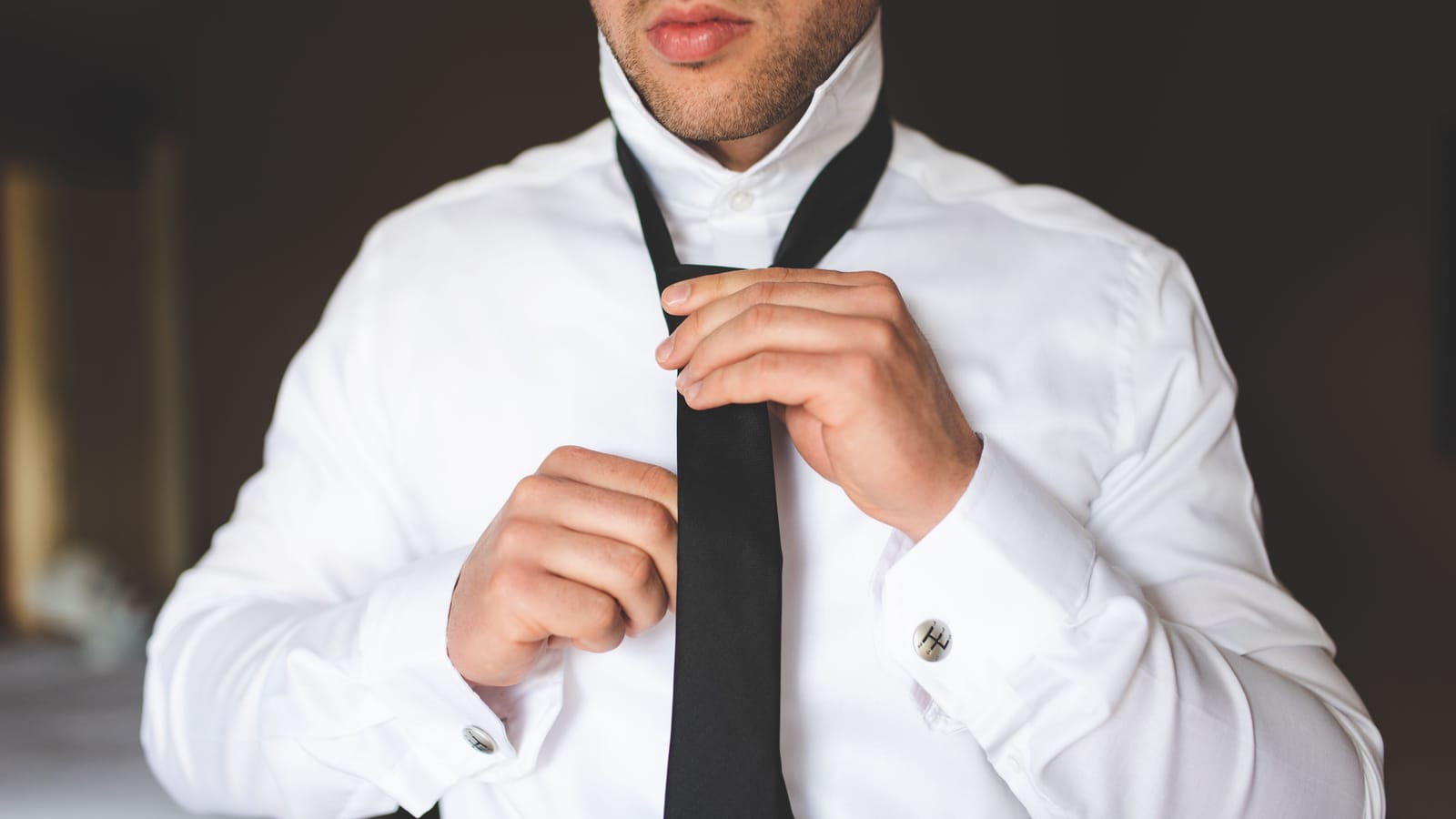
Learn the four-in-hand and you've solved roughly ninety percent of the problem. It's the slightly lopsided knot your grandfather tied, it takes about eight seconds once it's in your hands, and it sits well under nearly every collar sold in a normal shop.
Wide end on your right, hanging around 30cm lower than the narrow end. Cross the wide end over the narrow, round behind, over the front again. Up through the neck loop from underneath, then down through the front loop you've just made. Hold the narrow end and slide the knot up.
The asymmetry is the point. A four-in-hand is a little taller than it's wide and it leans very slightly to one side, which reads as a man who got dressed rather than a man who was dressed. A perfectly symmetrical knot looks like a photograph of a knot.
The dimple, and how to actually get one
Pinch the tie just below the knot with your thumb and forefinger as you draw it tight. That's it. You're creating a fold in the blade before the knot closes around it, not fixing one afterwards.
Some ties won't hold a dimple. Very thin unlined silks and most knits simply collapse flat, and no amount of fiddling changes that. Don't fight the fabric.
When the four-in-hand isn't enough
Cutaway and wide spread collars leave a gap the four-in-hand can't fill. You end up with a stripe of shirt visible either side of a small knot, and the whole thing looks undersized.
That's the one case for a half Windsor. Wide end over, round behind, up through the neck loop and down on the far side, then across the front, up through the loop again and down through the wrap. It's symmetrical, it's noticeably fatter, and it eats about 5cm more length than a four-in-hand, which matters if you're tall.
The full Windsor is mostly a trap. It's enormous, it flattens the tie against your chest, and on a standard point collar it looks like a school photograph. If you want more presence, use a thicker tie with a four-in-hand rather than a bigger knot with a thin one.
Untie every knot at the end of the day. Pulling the narrow end back through and hanging the tie up creased is how silk gets a permanent ridge across the blade.
Length, and the one measurement that counts
The tip of the tie should land in the middle of your belt buckle. Not above it. Not covering your flies.
Most ties come around 147cm long, and if you're over about 6ft 2in or you're building a half Windsor, that's not enough. Extra-long ties run to roughly 155cm or more. If your tie keeps finishing at your sternum, that's the fix, not tying a smaller knot.
Adjust by changing how far the wide end hangs below the narrow end when you start. More drop at the beginning means a longer blade at the end. Two or three attempts and your hands will learn the distance for a given tie.
The narrow end should sit behind the wide one and slip into the keeper loop on the back. If it hangs out below the blade, you started with the wrong drop. Tucking it into your shirt between the buttons is a fix, though it's a visible one.
Width
Between 7cm and 8.5cm at the widest point covers every reasonable situation. Anything under 6cm dates a photograph to a very specific window and looks mean on a broad man. Anything over 9cm belongs to a particular kind of 1970s suit.
The old guidance is to roughly match your lapel width, and it holds up. A 9cm lapel with a 6cm tie looks like a borrowed outfit. If your jacket lapels are around 8cm, an 8cm tie will look correct for the next twenty years.
Build matters too. If you're 110kg and wide through the chest, a narrow tie makes your torso look bigger. Go to 8.5cm and it balances.
Fabric is what people actually notice
Silk twill is the default, and there's nothing wrong with it. But it's the most formal, shiniest option, and it's the one that looks most out of place in an office where nobody else is wearing a tie.
Grenadine is a woven silk with an open, textured surface. It's plain from three meters away and interesting from one, and it works with everything from a navy suit to a tweed jacket. If you buy one good tie, make it a navy or dark burgundy grenadine.
Wool and cashmere are for autumn and winter with flannel, tweed and corduroy. They tie a soft, slightly untidy knot, which is exactly right with rougher cloth.
Knit ties have a flat end rather than a point. They're the most casual option that still counts as a tie, and they're the single best thing to wear with a jacket and no suit. They also stretch over time, so hang them rather than roll them.
Linen and cotton wrinkle immediately and that's fine in July.
Check for a slip stitch: a loose thread running inside the back seam with a small loop of slack at the bottom. That's what lets the tie stretch and recover instead of twisting. A tie without one will start to curl within a year.
The tie bar
Clip it through both the tie and the shirt placket, between the third and fourth buttons from the top. If it isn't holding the tie to the shirt, it's jewelry and it's doing nothing.
It should never be wider than the tie. A bar poking out either side is the most common way men get this wrong. Slide it on from the side rather than clamping down on the fabric.
When to leave it at home
Funerals and weddings, wear one. That's not a style question. Keep a plain dark tie somewhere you can find it in five minutes, because the day you need it won't be a day when you feel like shopping.
Interviews depend on the industry, and you can find out. Ask the recruiter or look at the leadership photographs on the company website. In finance, law and most of the public sector, wear one. In a software company, a tie will make you look like you didn't do your homework.
The real problem is the tie with no jacket. It's the uniform of estate agents and supply teachers, and it looks unfinished because the tie needs the jacket to frame it. If you're not wearing a jacket, don't wear a tie. Open the collar, wear a decent shirt, and be done.
A tie with a shirt that doesn't fit at the neck is worse than no tie. If you can fit more than one finger between your collar and your throat when it's buttoned, the collar gapes and the knot floats. Get the neck size right first.
Hot weather is a legitimate reason to skip it, with one condition: if the other men at the table are wearing ties, you wear one. Being the only open collar in the room reads as a decision about them, whether you meant it that way or not.
One navy grenadine, one dark knit, one wool in something quiet, and a plain black or very dark navy for funerals. That's the whole collection for most men, and it'll outlast three suits.
Tobias Reed
Style & Grooming
Spent a decade in menswear retail watching men buy the wrong size. Believes fit is ninety per cent of it and says so weekly.

Watch
Worth an hour of your evening
More from City Style.
From channels we rate. Plays on YouTube.
Read next