Dressing well out of a three-foot rail
Measure the rail, do the hanger math, and build the wardrobe around the closet you actually have instead of the one you wish you had.
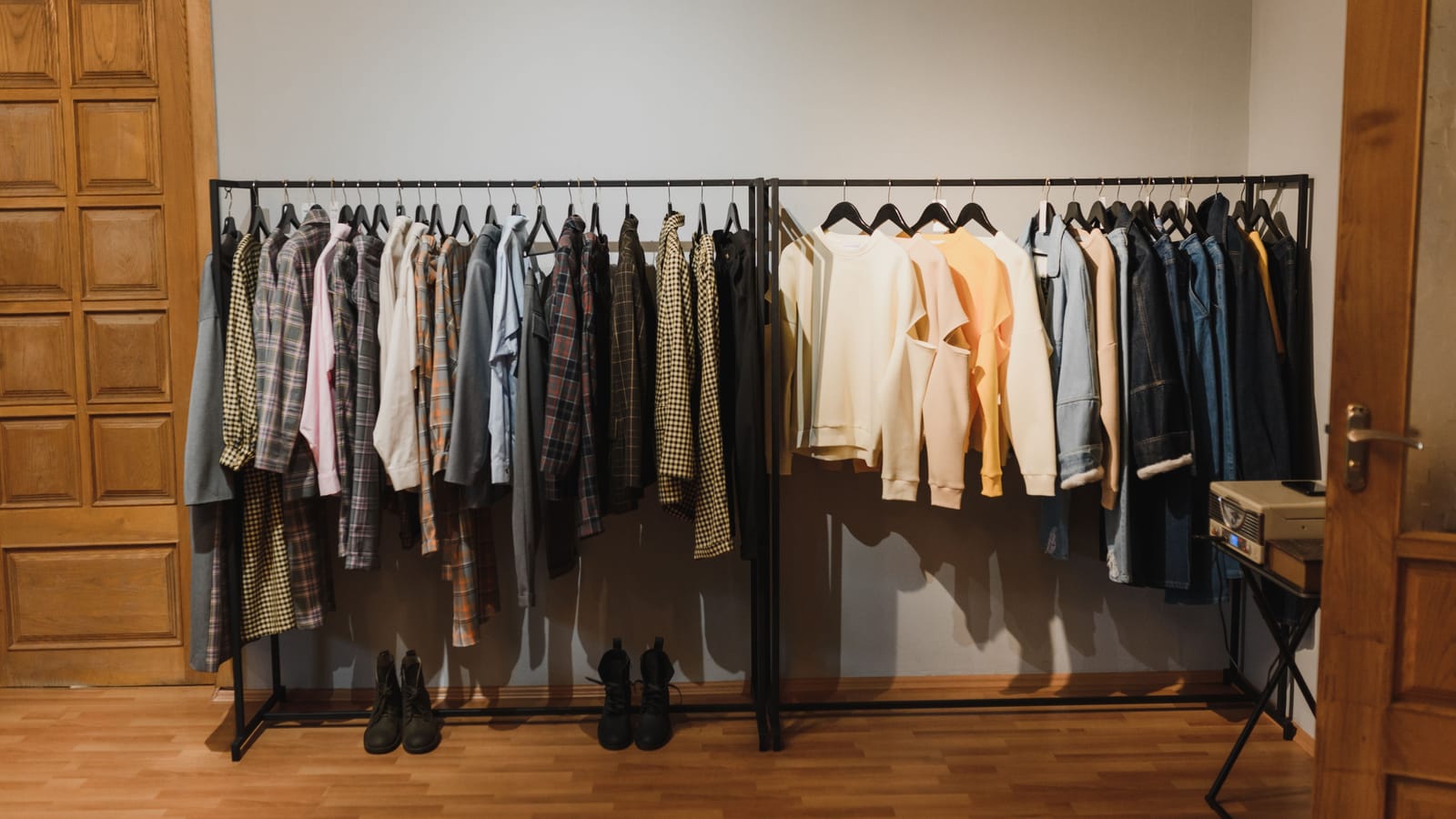
Go measure the rail. Not the closet door, not the room. The metal bar your clothes hang on, end to end, in inches.
The closet in my last apartment was 34 inches of rail, one wire shelf above it, and a sliding door that only ever gave me access to half of it at a time. That number is the whole project. Everything else — what you buy, what you keep, how often you do laundry — is downstream of it.
The hanger math nobody does
A slim velvet hanger takes about half an inch of rail. A cheap plastic one takes closer to three-quarters. A wooden suit hanger takes a full inch and a half, sometimes more with the shoulder flare.
So on 34 inches of rail, in theory, you could cram 60 velvet hangers. Don't. At that density you can't see anything, you can't pull a shirt out without dragging three others halfway off, and everything comes out creased across the chest. The usable number is roughly one garment per inch of rail if you want to actually reach in and grab something. Call it 30 to 34 hanging pieces on a three-foot rail.
That sounds brutal until you add the second rod.
Double-hang before you do anything else
Most shirts and jackets hang 38 to 42 inches from the hook to the hem. Most closet rails are set around 66 inches off the floor, which means you have well over two feet of dead air underneath your shirts doing absolutely nothing.
A hanging double-rod — the kind that clips over your existing rail and drops a second bar about 18 inches below — costs less than a decent lunch and roughly doubles your hanging capacity for short items. Trousers folded over a bar hang around 22 inches. Shirts, polos and light jackets are fine on the lower bar too if you keep the drop generous.
Run the long stuff on one side, floor to rail. Everything short goes double-stacked on the other. I did this on a Sunday morning with a screwdriver I didn't end up needing, and the closet went from 30 pieces to 52 without a single new square foot.
The trade-off is real: the lower bar is dark, and things on it get forgotten. Put the stuff you wear weekly down there, not the stuff you're sentimental about.
Fold the things that don't care
Knitwear should never hang. Gravity pulls the shoulders into little pointed horns and no amount of steaming brings them back. Same for heavy sweatshirts.
T-shirts, underwear, socks, gym gear and jeans all fold without complaint. That's an enormous amount of volume off your rail and onto a shelf, in a dresser, or into two fabric bins.
What has to hang: anything tailored, anything linen, anything you'd be embarrassed to show up in wrinkled. Dress shirts, blazers, trousers with a crease, dresses, coats.
File-fold rather than stack. Standing items on their edge in a drawer, spines up like books, means you see all twelve T-shirts instead of the top two. It takes an extra forty seconds per laundry load and it's the single change that stops you wearing the same three shirts for six months.
Laundry cadence sets the number, not the closet
This is the part the tidy-apartment content always skips.
If you have in-unit laundry and you run a load every Sunday, you need roughly nine days of clothing. Seven for the week, two for the gap while things are in the machine. If you're hauling a bag six blocks to a laundromat every other weekend, you need sixteen days of socks and underwear minimum, and you need more shirts than someone with a washer in the hall closet. That's not a wardrobe philosophy. It's arithmetic.
Work out your actual cycle first. Then build the count. A person washing weekly can genuinely live on eight shirts and three pairs of trousers. A person washing fortnightly can't, and telling them to is just telling them to smell.
The floor is for five pairs of shoes
Closet floor space in a city apartment is the most expensive real estate you own, because it's also where the vacuum goes, and the suitcase, and the box you haven't opened since you moved.
Five pairs, standing heel-to-toe in a single row, is about what a three-foot closet floor takes. Anything more needs a rack, and a rack eats the bottom of your hanging space. Anything you wear less than once a month goes in a box under the bed.
The over-door shoe organizer is tempting and it's a trap on a sliding door. It only works on a hinged door, and it rattles.
Coats don't live in the closet
A winter coat is four to six inches of rail on its own. Two of them and you've lost a fifth of your capacity to garments you wear five months of the year.
Put a hook by the door. A single sturdy one, screwed into a stud, holding the coat you're actually wearing this week. The other one goes in a garment bag under the bed from April to October.
Same for the suit, if you own one suit and wear it four times a year. Garment bag, under the bed, out when needed. It stays cleaner there than it does compressed against a rail anyway.
The rotation, and why people abandon it
Seasonal rotation works. It also fails constantly, because the swap takes ninety minutes and you always do it a month too late, shivering in a linen shirt in October.
Two things make it stick. First, pick a date rather than waiting for weather — the first weekend of April and the first weekend of October. Second, use vacuum bags, not cardboard boxes, because a compressed bag slides under a bed frame and a box doesn't, and if the storage is annoying you'll leave the summer stuff on the rail.
The honest cost of vacuum bags: everything comes out of them looking like it's been sat on by a horse. Budget an evening with a steamer, or hang things in the bathroom while you shower for two days. If that sounds like too much, rotate with garment bags instead and accept you'll store less.
Where this advice breaks
A small capsule assumes one dress code. If you work in boots and high-vis four days a week and then need to look sharp at church and at your sister's wedding, you're maintaining two wardrobes in one closet and no amount of velvet hangers fixes that. Give the work clothes their own bin, keep them physically separate, and stop trying to make the numbers match.
Same if you live somewhere with a genuine 70-degree annual swing. Two full seasons in one closet is a storage problem, not a style problem.
The cull, done in one sitting
Pull everything out. All of it, onto the bed, so you can't go to sleep until it's finished. That's the point of using the bed.
Three piles. Worn in the last twelve months. Not worn but genuinely fits and you'd wear it tomorrow. Everything else.
The third pile goes. Not to the back of the closet, not to a maybe box. Into a bag, into the trunk, dropped off Saturday. The maybe box is how the closet fills up again by March.
Then hang the first pile back, count what's left, and you'll know exactly how many gaps you have and how many inches you have to fill them with.
Buy against that number. Not against a list somebody wrote for a house with a walk-in.
Tobias Reed
Style & Grooming
Spent a decade in menswear retail watching men buy the wrong size. Believes fit is ninety per cent of it and says so weekly.

Watch
Worth an hour of your evening
More from City Style.
From channels we rate. Plays on YouTube.
Read next