

The shirt that comes out of the bag ready to wear
Skip the "wrinkle-free" label. Fabric, weave and how you pack decide whether you step off the plane looking sharp or slept in.
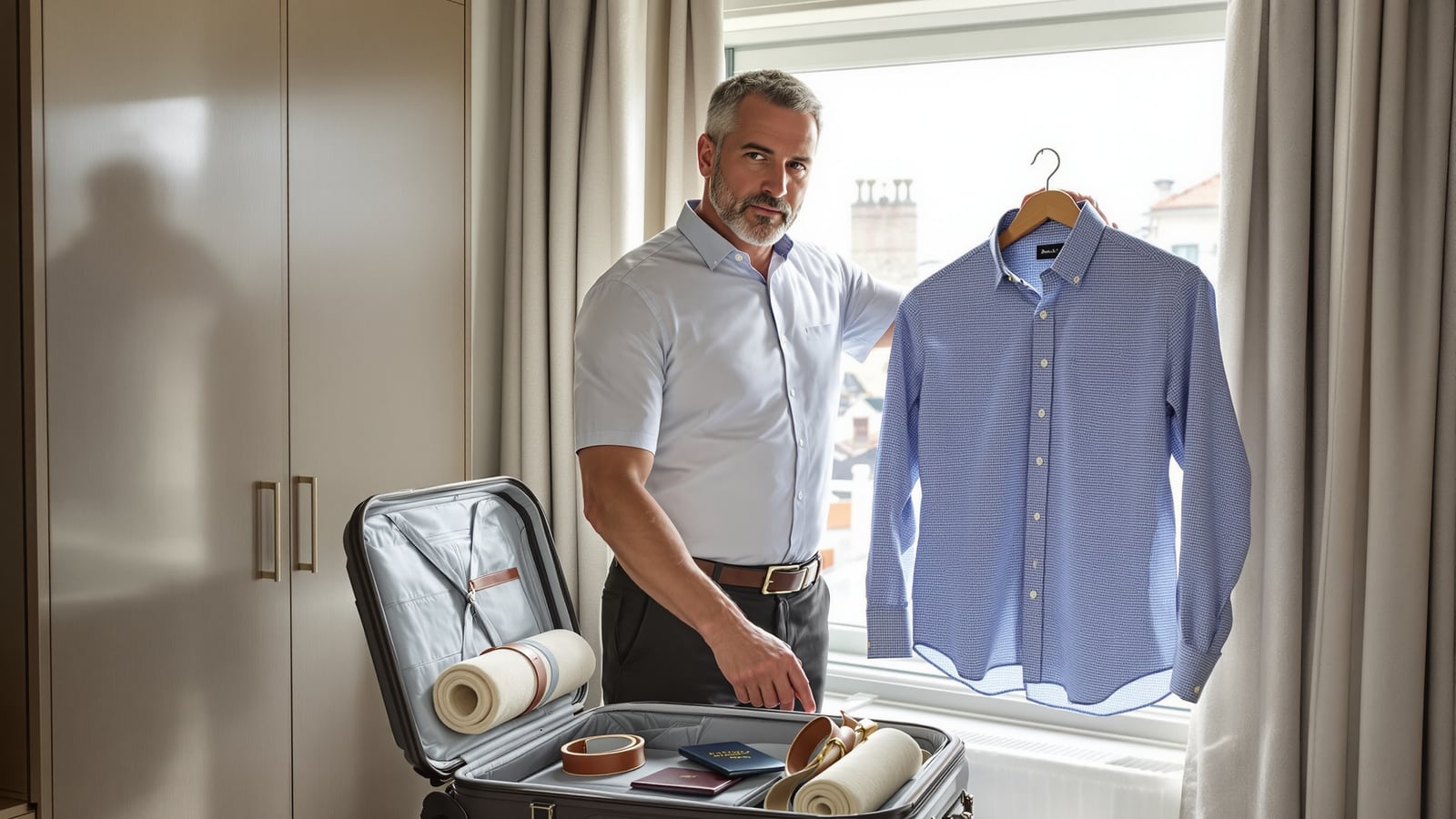
Quick answer: Buy a mid-weight shirt with some texture in the weave, in a mid-tone color, with a soft collar that stands on its own. Pack it folded on top of the bag, and hang it the minute you land.
You land at 8:40. The meeting is at 11. The hotel won't let you into the room until two, and the lobby bathroom has one mirror and a hand dryer. That's the moment a shirt either earns its place in your bag or doesn't.
Most men solve this by buying whatever says "wrinkle-free" on the tag and hoping. It sometimes works. Often it doesn't. Here's why, and what to do instead.
What the label doesn't tell you
A non-iron cotton shirt gets its smoothness from a finish applied to the fabric. It holds up well on day one. It can also feel a little stiff, a little warm, and a little plastic against the skin by hour six of a travel day. And when the finish wears down after a season of washing, the shirt starts creasing like any other.
That doesn't make non-iron cotton a bad choice. It makes it a decent one that gets oversold.
The better question isn't whether the shirt resists wrinkles. It's whether the shirt hides them, and whether it recovers from them. Those are two separate jobs, and different fabrics do them differently.
The three things that actually matter
Texture hides creases. A flat, smooth poplin shows every fold like a road map. A weave with some grain to it, like oxford cloth, a fine basketweave or a slightly slubby surface, breaks up the light so a crease reads as shadow instead of damage. This is why a good oxford button-down looks better slightly rumpled than a dress shirt does.
Weight helps. Very thin shirts crumple the way tissue paper does. Very heavy ones hold a fold like cardboard. Mid-weight is the sweet spot. It has enough body to fall straight when you hang it and enough give to relax out of a fold.
A little stretch or a little synthetic helps recovery. Cotton blended with a small amount of stretch fiber, or a performance weave made mostly of synthetic fibers, springs back faster than all-cotton. Fine merino wool does this too, and it's the best of the group at resisting odor, though it costs more and you'll want to wash it gently.
Concede the trade-offs. Synthetics can hold smells after a long day. Merino shirts run pricey and don't love a rough machine cycle. Texture-heavy oxford reads a notch more casual than a crisp dress shirt, which matters if the room expects a tie.
Color and pattern do half the work
A solid white shirt is the least forgiving thing you can pack. Every crease, every sweat line, every fold shows. Pale blue, a fine stripe or a small check hides all of it.
Mid-tones are friendly. Navy shows lint and the white lines left by folding. Light blue, soft gray and a muted check forgive almost everything. If you own one travel shirt, make it light blue with some texture and you'll rarely regret it.
The collar decides the whole look
Most men look rumpled at the neck first. A stiff collar with a tie hides a lot. Without one, it can sit crooked, so a travel shirt does better with a soft collar that holds its shape on its own, like a button-down or a collar with a bit of structure sewn in.
Open at the neck, it should lie flat against the shirt and look intentional. If it flares or curls on the hanger, it'll do the same on you. Check this in the store, not at the airport. If you're unsure how a shirt like this fits the dress code of wherever you're headed, the piece on what to wear when the invitation says smart casual sorts it out.
Fit matters more for travel than at home
A shirt cut too full bunches at the waist the second you sit down, and then it's wrinkled in a seat belt-shaped band across your middle. A shirt that fits across the shoulders and tapers cleanly through the body stays smoother because there's less loose fabric to fold.
If a favorite shirt billows at the waist, a tailor can take it in for a modest fee. What that costs, and what's worth paying for, is covered in what tailoring actually costs.
How to pack it
Even the right shirt loses if you pack it badly.
- Pack it on top. The shirt goes in last, flat, over everything else. Shoes and a dopp kit on top of a shirt is how you get a permanent crease.
- Button it up. Do the top button, the middle button and the cuffs. It keeps the shape and stops the collar from curling.
- Fold along the seams. Fold the sleeves back along the side seams, then fold the body in thirds, collar facing up. Fewer folds means fewer creases, and a fold at the seam hides better than one across the chest.
- Fill the bag. A half-empty suitcase lets everything slide and crush. A full one holds the shirt still.
- Skip the roll. Rolling suits knits and T-shirts. For a collared shirt it just makes a crease in a more creative place.
What to do when you land
Hang it first. Before you unpack, before you check email, before you do anything else. Gravity does more than most people give it credit for, and half an hour on a hanger relaxes a fresh fold.
If you've got ten minutes, run the shower as hot as it goes with the door closed and hang the shirt on the back of the door. Leave it alone while you shave. The steam loosens the fibers, and you can smooth the front panels flat with your hand and pull the hem taut as it dries.
A small handheld steamer is worth owning if you travel more than a handful of times a year. It takes up almost no space and works faster than a hotel iron, which is always either missing or sticky.
If there's no hanger and no time, wear it. Smooth the placket and the cuffs, tuck it in and put on a jacket. Nobody checks the back of your shirt under a jacket.
What we'd buy, and what we'd skip
Buy: A mid-weight oxford or similar textured weave in light blue or a fine stripe. It's cotton with a little stretch, or a good performance blend, with a soft button-down collar. Add merino if you want one shirt to handle a long trip without being washed.
Skip: Thin, smooth white poplin that has to be perfect to look right. Skip anything labeled wrinkle-free that feels slick or stiff in your hand. And skip a shirt you haven't worn for a full day first. Find out at home that the collar flares or the fabric clings, not in a conference room.
Buy it, wear it once around the house for a day, pack it twice, and you'll know whether it's the one. When it is, buy the same shirt again. A man who owns two of the right shirt packs in five minutes and never wonders what to wear.
If your job leaves you guessing what the room expects, dressing for an office that never tells you what to wear will help you pick the right shirt for it.
Land at 8:40, step into a lobby bathroom, button a shirt that has been waiting on top of the bag. Be the one at the 11 o'clock meeting who looks like he just arrived from a good night's sleep.
Tobias Reed
Style & Grooming
Spent a decade in menswear retail watching men buy the wrong size. Believes fit is ninety per cent of it and says so weekly.

Watch
Worth an hour of your evening
More from City Style.
From channels we rate. Plays on YouTube.
Read next