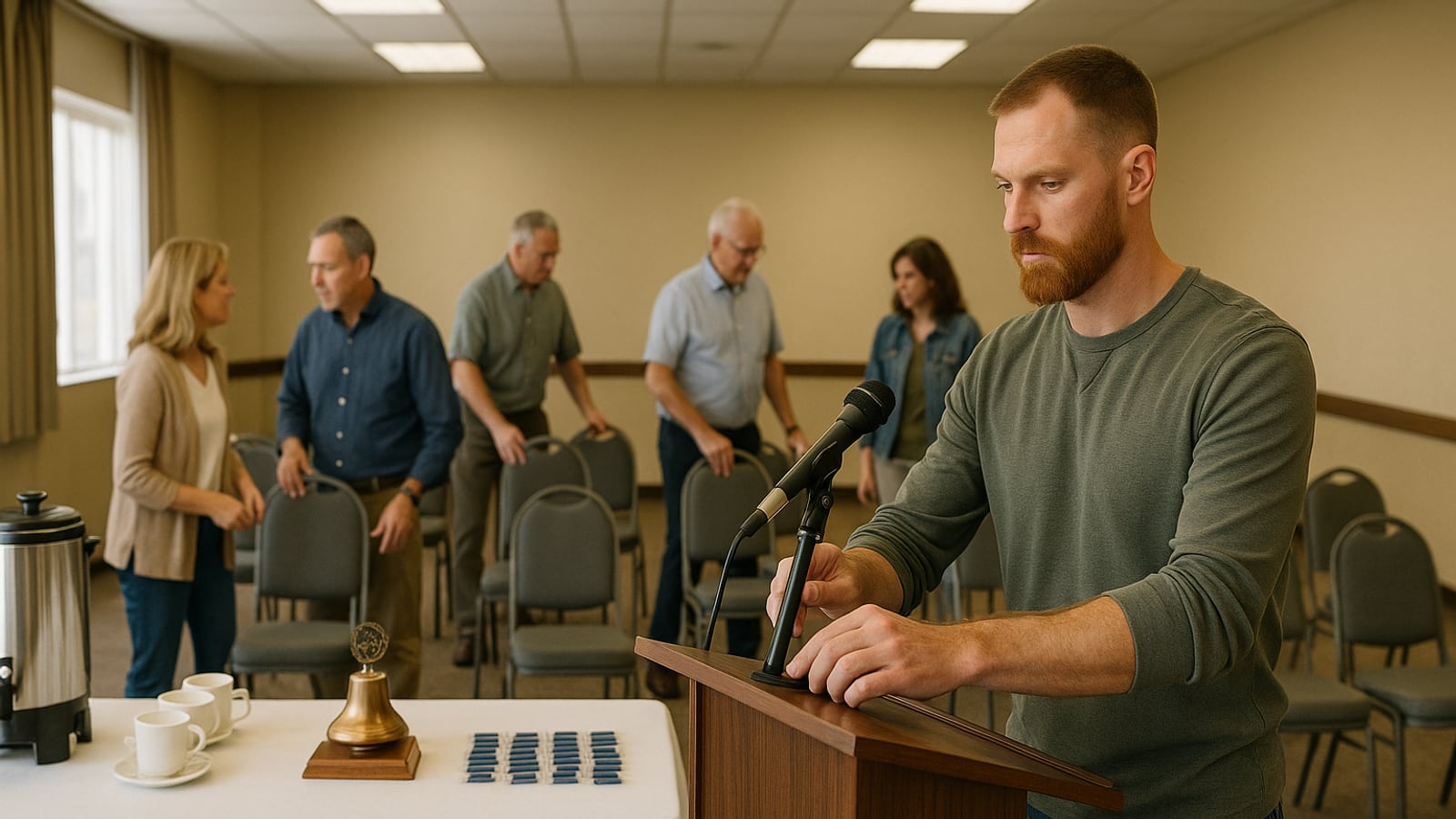
Walk into a Rotary lunch on a Tuesday and this is what you get: a room in the back of a steakhouse or a Holiday Inn, forty people, a bell on a lectern, chicken with a cream sauce nobody ordered, and a meeting that starts at noon sharp and ends at one because half the room has to be back at work. Somebody will announce a grandchild. Somebody will pass a hat for a fine because he forgot his pin. Then a guy from the county water authority will talk for eighteen minutes about aquifer levels, and you'll learn more about your town in that eighteen minutes than in two years of scrolling the local news.
That's the whole product. It looks unimpressive from outside. It's the most reliable on-ramp to civic life that exists in an American town, and it's sitting there half empty.
The three you'll actually run into
Rotary started in Chicago in 1905, founded by a lawyer named Paul Harris who was lonely in a big city and wanted the kind of friendships he'd had growing up in Vermont. The name came from rotating meetings between members' offices. It's built around occupational classifications, so a club tries to collect one banker, one dentist, one contractor, one school principal. Rotary has been a lead partner in the global fight to eradicate polio since it launched PolioPlus in 1985, which means the guy next to you eating the chicken is connected to a campaign that has pushed a disease to the edge of extinction. The Four-Way Test hangs on the wall: Is it the truth? Is it fair to all concerned? Will it build goodwill and better friendships? Will it be beneficial to all concerned? Men and women both. Rotary opened to women in 1989, Lions in 1987.
Lions Clubs, founded 1917 by a Chicago insurance man named Melvin Jones, tends to skew a little more blue-collar and a little more hands-on. The motto is two words: We Serve. In 1925 Helen Keller stood up at their convention in Cedar Point, Ohio, and asked them to become knights of the blind. They took it literally. A century later Lions are still the people collecting used eyeglasses in the bin at the library and running vision screenings at the county fair. If you'd rather cook pancakes than listen to a presentation, look at Lions first.
The Knights of Columbus is different in kind, not just in flavor. It's a Catholic fraternal order for men, founded in 1882 at St. Mary's Church in New Haven by Father Michael McGivney, a parish priest who watched working men die young and leave widows with nothing. He built an insurance society so that wouldn't happen. McGivney was beatified in 2020. The Knights still run the insurance arm, still bury their own, still put men in capes at Confirmation, and still stand outside the grocery store with Tootsie Rolls raising money for people with intellectual disabilities. If you're a Catholic man and you've been showing up to Mass and going straight to the car, this is the door.
Go three times before you decide anything
Don't join off a website. Call the club secretary, say you'd like to visit, and ask if they'll comp your lunch. They will. Go three times, because one visit tells you nothing. The first meeting you'll be introduced and clapped for and you won't remember a single name. The second one you'll notice who actually does the work. The third one you'll know whether you want to be in that room every week for the next decade.
What to look for while you're sitting there: Does anybody under fifty speak? Is there a project going on right now, this month, with a date on it? When the president asks for volunteers, do hands go up or do people look at their plates? A club with three live projects and a cranky treasurer is healthy. A club whose main activity is discussing the club isn't.
Ask the treasurer straight out what a year costs, all in. Club dues, the per-member amount that goes up to the international organization, the meal charge, the raffle, the fundraiser tickets you're expected to move. Nobody will be offended. Every member did the same math. Knights councils are generally the cheapest of the three by a wide margin; a weekly lunch club is the most expensive, because fifty-two lunches add up faster than the dues do.
The part nobody tells you
You will get put on a fundraiser. That's the deal. Some of it is genuinely great work and some of it is standing in a parking lot in October selling raffle tickets to people who are trying to get to their cars. The pancake breakfast will require you to be at the hall at 5:40 a.m. The committee meeting about the pancake breakfast will take ninety minutes and could have taken twenty. There's a man in every club who has an amendment to every motion.
And the average age is going to be higher than you'd like. That's not the club's fault and it's not a reason to walk. It's the reason to join. When a sixty-eight-year-old past president finds out you know how to run a spreadsheet or a website, you will be handed responsibility at a speed that would take fifteen years in your industry. That's the trade: you tolerate the parliamentary procedure, they hand you a town.
Take the unglamorous job first
The men who quit in year one are the ones who joined and then waited to be assigned a purpose. The ones who stay volunteer for something small and concrete within the first ninety days. Not a committee chair. A job.
Run the sign-in table. Take over the Facebook page. Be the guy who picks up the trailer. Be the guy who calls the twelve members who haven't come in a while and asks how they're doing, which sounds like nothing and is in fact the most valuable job in the club.
One job, done on time, every time. That's the entire secret. You will be trusted with a budget inside two years.
Bring your kid, too. A thirteen-year-old flipping pancakes next to three men in their seventies who are giving him a hard time about his flipping technique is getting something he can't get anywhere else, and he's watching his father serve people who can't pay him back. Boys learn service by carrying tables, not by hearing about it.
What comes back
You'll know your town. Not opinions about it, the actual mechanics: who runs the food bank, which nonprofit is well run and which one isn't, what the school board is really arguing about, who to call when a family on your street loses a house to a fire. That knowledge makes you useful in an emergency, and emergencies are the whole point of a neighbor.
You'll also get friendships with men twenty and thirty years older than you, which is the thing most men our age are starved for and can't name. Not mentors in the corporate sense. Just guys who've already buried a parent, raised the teenagers, survived the bad stretch in the marriage, and will tell you about it in a parking lot after a meeting if you ask.
The Rotary charter hasn't changed much in 120 years. The Lions still want your old glasses. The Knights still take care of the widow. None of it is new, none of it is clever, and all of it is still standing while flashier things fall over.
Find out when your local club meets. It's public, it's on a sign at the edge of town under the speed limit, and it's probably this Tuesday at noon.
Marcus Vale
Editor-in-Chief
Twenty years in magazines, most of it deciding what to cut. Writes about work, discipline and the decisions that compound.

Watch
Worth an hour of your evening
More from Community.
From channels we rate. Plays on YouTube.
Read next